
Close Menu
    Facebook X (Twitter) Instagram
    SciTechDaily
    • Biology
    • Chemistry
    • Earth
    • Health
    • Physics
    • Science
    • Space
    • Technology
    Facebook X (Twitter) Pinterest YouTube RSS
    SciTechDaily
    Home»Space»Hubble Captures Rare Celestial Phenomenon: A Herbig–Haro Object
    Space

    Hubble Captures Rare Celestial Phenomenon: A Herbig–Haro Object

    By ESA/HubbleAugust 29, 2021No Comments2 Mins Read
    Facebook Twitter Pinterest Telegram LinkedIn WhatsApp Email Reddit
    Share
    Facebook Twitter LinkedIn Pinterest Telegram Email Reddit
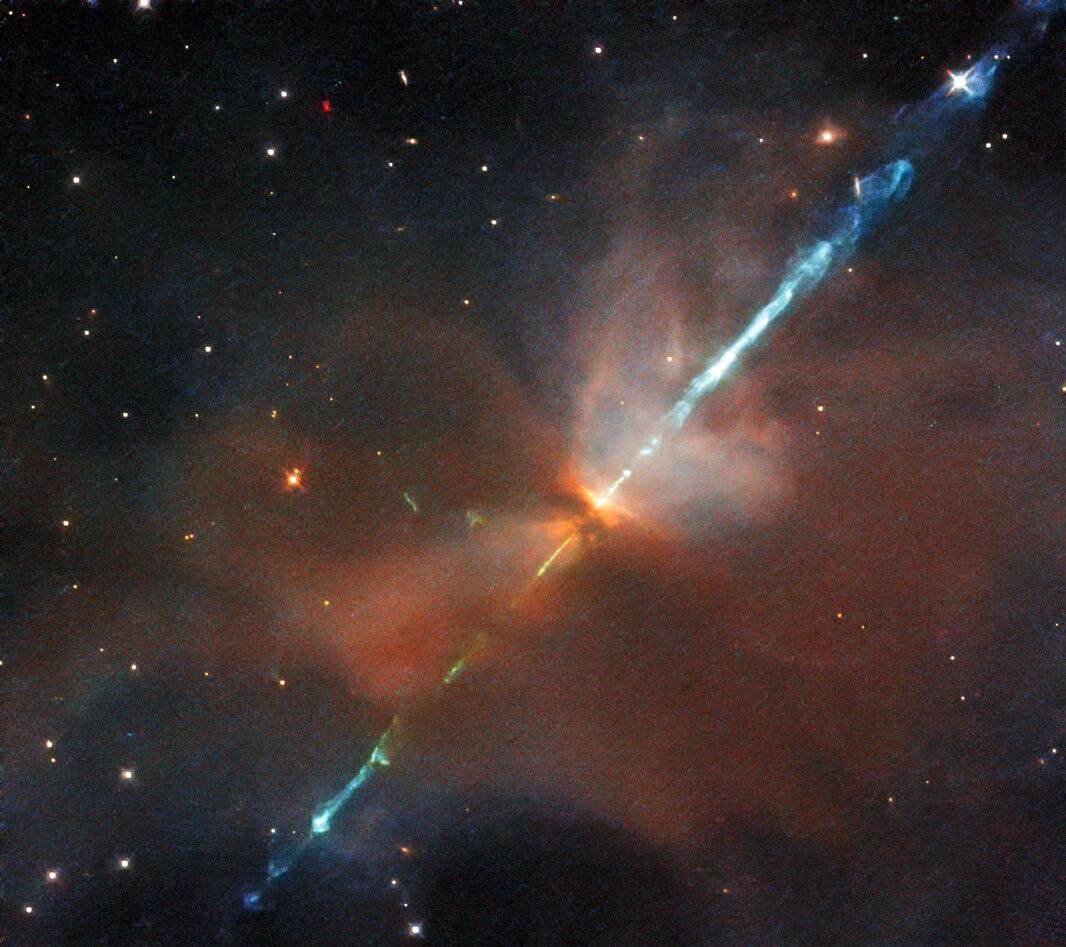
    Herbig–Haro Object HH111
    Herbig–Haro object named HH111, captured by Hubble Space Telescope’s Wide Field Camera 3. Credit: ESA/Hubble & NASA, B. Nisini

    HH111 is a Herbig–Haro object formed by high-speed jets from a newborn star crashing into surrounding clouds. Hubble’s infrared imaging reveals the hidden spectacle.

    This striking image features a relatively rare celestial phenomenon known as a Herbig–Haro object. This particular Herbig–Haro object is named HH111, and was imaged by Hubble’s Wide Field Camera 3 (WFC3). These spectacular objects are formed under very specific circumstances. Newly formed stars are often very active, and in some cases they expel very narrow jets of rapidly moving ionised gas — gas that is so hot that its molecules and atoms have lost their electrons, making the gas highly charged. The streams of ionised gas then collide with the clouds of gas and dust surrounding newly-formed stars at speeds of hundreds of kilometers per second. It is these energetic collisions that create Herbig–Haro objects such as HH111.

    WFC3 takes images at optical and infrared wavelengths, which means that it observes objects at a wavelength range similar to the range that human eyes are sensitive to (optical) and a range of wavelengths that are slightly too long to be detected by human eyes (infrared). Herbig–Haro objects actually release a lot of light at optical wavelengths, but they are difficult to observe because their surrounding dust and gas absorb much of the visible light. Therefore, the WFC3’s ability to observe at infrared wavelengths — where observations are not as affected by gas and dust— is crucial to observing Herbo–Haro objects successfully.

    Never miss a breakthrough: Join the SciTechDaily newsletter.
    Follow us on Google and Google News.

    Astronomy European Space Agency Hubble Space Telescope NASA Popular
    Share. Facebook Twitter Pinterest LinkedIn Email Reddit

    Related Articles

    Hubble’s Newest Discovery Isn’t a Star, It’s a Window Into the Dark Universe

    Hubble Celebrates 34th Anniversary With a Spectacular View of the Little Dumbbell Nebula

    Hubble Views Spiral Galaxy NGC 5793

    Hubble Captures Face-On Image of Messier 61

    Hubble Views an Ongoing Cosmic Collision

    Hubble Views Newborn Stars in Galaxy IC 5052

    New XDF Image, The Deepest-Ever View of the Universe

    Hubble Zooms in on the Center of M4

    Hubble Image of Peculiar Galaxy Pair Arp 116

    Leave A Reply Cancel Reply

    • Facebook
    • Twitter
    • Pinterest
    • YouTube

    Don't Miss a Discovery

    Subscribe for the Latest in Science & Tech!

    Trending News

    The Universe Is Expanding Too Fast and Scientists Can’t Explain Why

    “Like Liquid Metal”: Scientists Create Strange Shape-Shifting Material

    Early Warning Signals of Esophageal Cancer May Be Hiding in Plain Sight

    Common Blood Pressure Drug Shows Surprising Power Against Deadly Antibiotic-Resistant Superbug

    Scientists Uncover Dangerous Connection Between Serotonin and Heart Valve Disease

    Scientists Discover a “Protector” Protein That Could Help Reverse Hair Loss

    Bone-Strengthening Discovery Could Reverse Osteoporosis

    Scientists Uncover Hidden Trigger Behind Stem Cell Aging

    Follow SciTechDaily
    • Facebook
    • Twitter
    • YouTube
    • Pinterest
    • Newsletter
    • RSS
    SciTech News
    • Biology News
    • Chemistry News
    • Earth News
    • Health News
    • Physics News
    • Science News
    • Space News
    • Technology News
    Recent Posts
    • A Common Diabetes Drug May Hold the Key to Stopping HIV From Coming Back
    • Ancient “Syphilis-Like” Disease in Vietnam Challenges Key Scientific Assumptions
    • Drinking Alcohol To Cope in Your 20s Could Damage Your Brain for Life
    • Scientists Crack Alfalfa’s Chromosome Mystery After Decades of Debate
    • Ancient Ant-Plant Alliance Collapses As Predatory Wasps Move In
    Copyright © 1998 - 2026 SciTechDaily. All Rights Reserved.
    • Science News
    • About
    • Contact
    • Editorial Board
    • Privacy Policy
    • Terms of Use

    Type above and press Enter to search. Press Esc to cancel.