
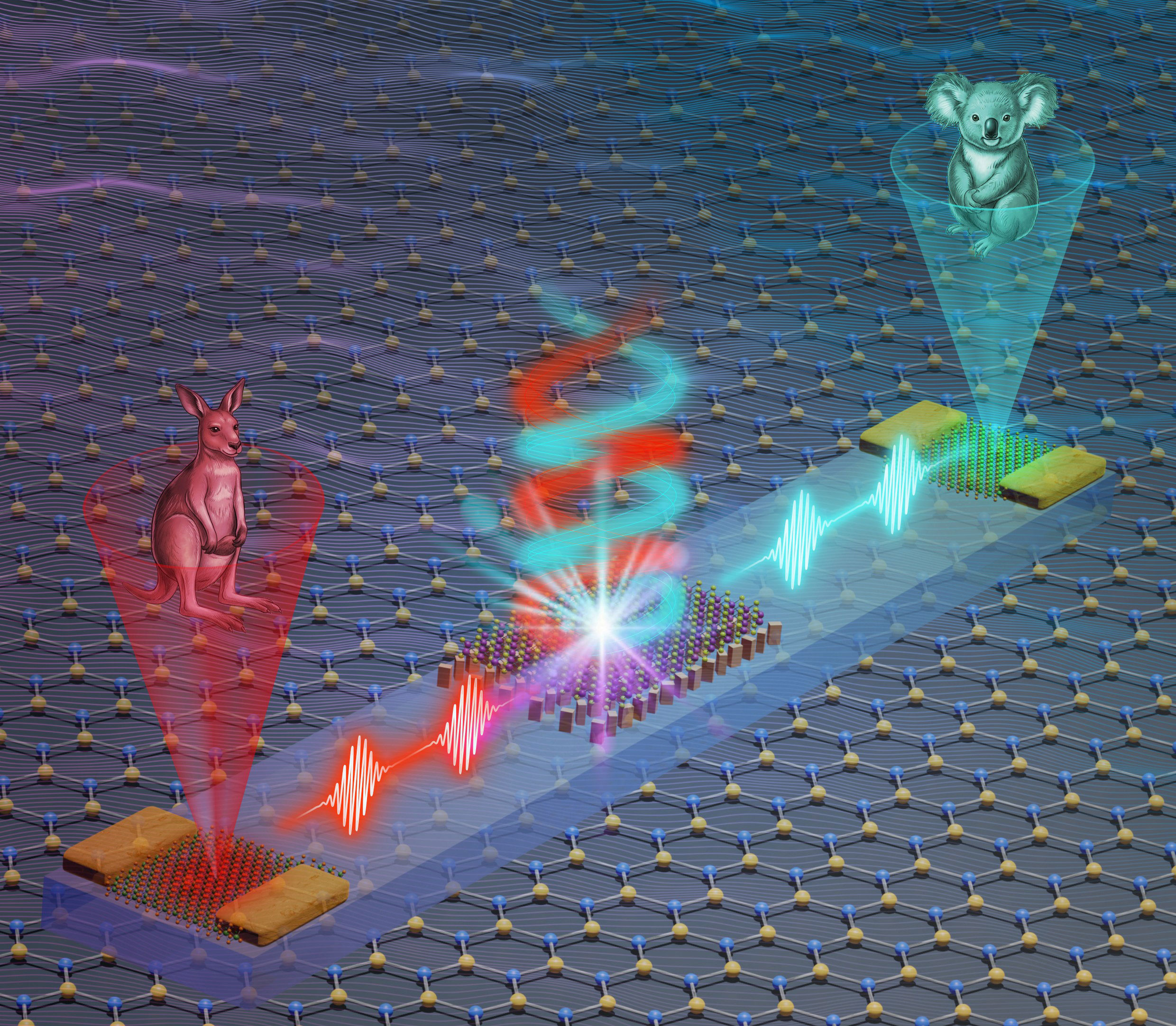
Researchers have created a compact chip that manipulates light-based quantum information with remarkable precision, advancing the development of next-generation photonic and quantum technologies.
What if computers could process information using light instead of electricity? Researchers at Monash University say they have taken an important step toward that future with a tiny new chip that can generate, control, and read light-based signals all in one device.
The breakthrough centers on an emerging field known as “valleytronics,” which aims to store and process information using quantum properties inside advanced materials. Scientists have long viewed the technology as a possible path toward faster computing, lower energy use, and more powerful communication systems. But one major challenge has held the field back: no one had successfully combined all the key functions into a single compact platform.
The Monash team says it has now solved that problem.
In a study published in Nature Photonics, researchers demonstrated a nanoscale circuit capable of creating specialized light signals, directing them with precision, and converting them into electrical signals on the same chip. The device uses the “valley degree of freedom,” a quantum property found in certain materials that can encode information in ways conventional electronics cannot.
Unlike traditional computer chips that rely on moving electrons through circuits, photonic systems use light to carry data. Because light can travel faster and generate less heat, researchers believe future photonic technologies could dramatically improve processing speeds while reducing energy demands in data centers, AI systems, and communication networks.
Lead author Dr. Chi Li said the new platform overcomes a major obstacle in valleytronics research.
“Until now, we could generate or detect these signals, but not do everything in one integrated device,” Dr. Li said.
“What we’ve built is a complete on-chip system that can create, route and read this information with very high precision.”
Ultra-Thin Materials Enable New Capabilities
The technology combines ultra-thin materials that are only a few atoms thick with engineered nanostructures known as metasurfaces, which can manipulate light at scales smaller than the width of a human hair.
Co-first author Dr. Kaijian Xing explained that the team used a layered stacking method to combine these materials without damaging their delicate structure, an issue that has complicated previous attempts to build practical valleytronic devices.
“We employ a straightforward stacking approach to integrate ultra-thin materials with metasurfaces, overcoming the technical challenges of direct material growth on photonic structures, and enabling further advances in valleytronics,” Dr. Xing said.
One of the most important aspects of the system is that it operates at room temperature. Many experimental quantum technologies require extremely cold environments to function, often using complex and expensive cooling equipment. By avoiding those conditions, the Monash device becomes far more practical for real-world applications.
The chip also demonstrates a level of miniaturization that could help future technologies move out of research laboratories and into commercial devices.
Why Light-Based Computing Matters
Senior author Dr. Haoran Ren, ARC Future Fellow and leader of the Monash NanoMeta Group, said the research could help enable a new generation of compact and programmable photonic technologies.
“This is a significant step toward scalable, chip-based technologies that use light instead of electricity to process information,” Dr. Ren said.
“Photonic devices use light to achieve massive bandwidths, ultra-fast data transmission speeds, and lower energy consumption, so what we have achieved has strong potential for applications in quantum computing, advanced imaging, and next-generation optical communication systems.”
To demonstrate the chip’s capabilities, the researchers encoded and processed two separate images simultaneously, showing that the system can manage multiple streams of information at the same time.
Professor Stefan A. Maier, head of the School of Physics and Astronomy and the Nanophotonics Laboratory at Monash, said the work represents an important step toward turning valleytronics into practical technology.
“This is an important step toward fully integrated valleytronic systems,” Professor Maier said. “By combining light and quantum materials on a chip, we can access new ways of encoding and processing information.”
Reference: “An on-chip programmable valley optoelectronic nanocircuit” by Chi Li, Kaijian Xing, Wenhao Zhai, Luca Sortino, Andreas Tittl, Igor Aharonovich, Michael S. Fuhrer, Kenji Watanabe, Takashi Taniguchi, Qingdong Ou, Zhaogang Dong, Stefan A. Maier and Haoran Ren, 25 May 2026, Nature Photonics.
DOI: 10.1038/s41566-026-01916-0
Funding: Australian Research Council
Never miss a breakthrough: Join the SciTechDaily newsletter.
Follow us on Google and Google News.
4 Comments
Am I the only one who remembers this from 40 years ago? Maybe the students from Monash ought to read old magazines in their spare time?
Photonic chips (light chips) were conceptualized in the 1980, I believe it was by Texas Instruments.
These Photonic Chips have actually been built. Aussies for the win!!
Actually it was Bell Labs and not TI, sorry for the misinformation.
By the time we twice in this case the second time it technology has matured way past any degree that week and imagine because they don’t really specify how far they come with it and really we know very little about it these boards statements of photonic tech has been out very long time