
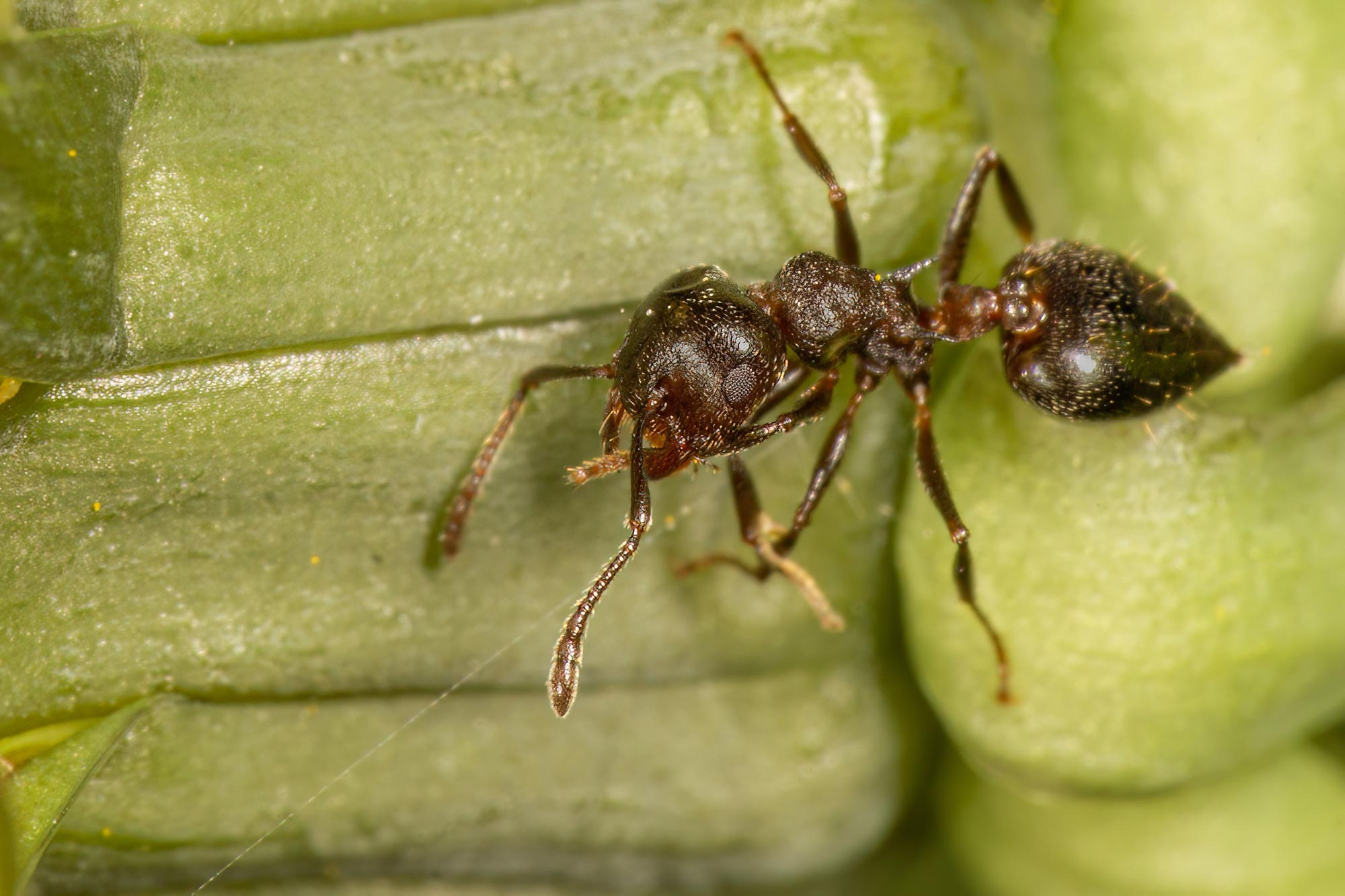
Wasps invading ant-plant systems are displacing ants in disturbed forests, potentially harming ecosystem stability and regeneration.
An international group of researchers from Queen Mary University of London, the Royal Botanic Gardens, Kew, the Biology Centre of the Czech Academy of Sciences, and other institutions has identified unexpected behavior in the tropical forests of Malaysian Borneo. Writing in PeerJ, the team reports that predatory wasps are increasingly occupying the hollow stems of the tropical plant Macaranga pearsonii—structures the tree evolved specifically to house protective ant colonies.
For millions of years, these “ant-plants” have depended on a close partnership with ants. The plants create specialized hollow chambers and produce nutrient-rich food bodies. In return, ants defend the plants from leaf-eating insects such as caterpillars. This mutually beneficial relationship has supported both organisms for at least 10 million years.
Now, however, this long-standing partnership appears to be breaking down.
Wasps Occupying Macaranga Tree Chambers
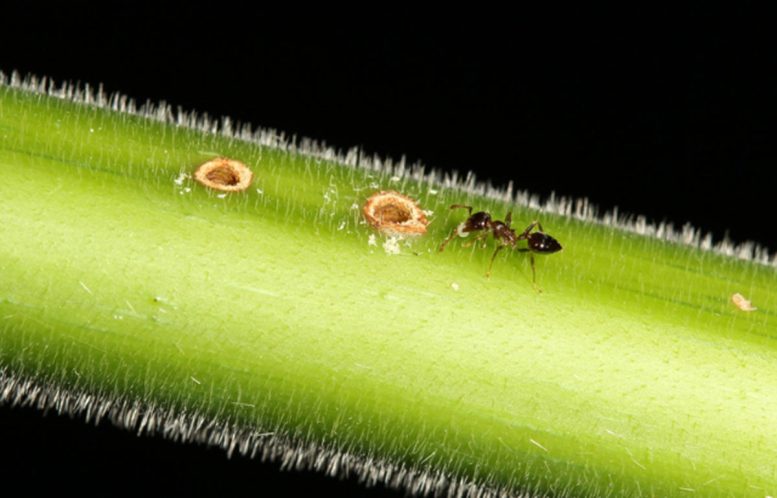
By examining young Macaranga pearsonii trees in logged forests and oil palm plantations, the researchers found that a species of wasp is taking over these hollow chambers for its own use, with important consequences.
Lead author Mr. Lestina explained:
“While surveying these ant‑plants, I noticed that many stems had been hollowed out in an unusual way. When we opened them, they were full of flies being eaten alive by wasp larvae. Adult wasps hunt and paralyze the flies, then store them inside the plant’s cavities as food for their young.”
Wasps Thriving in Disturbed Landscapes
The researchers found that plants growing in oil palm plantations were much more likely to host wasps than those in logged forests. Trees occupied by wasps consistently had smaller ant colonies, suggesting the insects may be displacing ants altogether, although further experiments are needed to confirm this.
Co‑author Dr. Kalsum M. Yusah explains:
“Human activities are transforming habitats worldwide, and this kind of shift in species interactions is exactly what we expect to see. We don’t yet know whether this wasp is native or introduced, but its spread is clearly linked to disturbed landscapes.”
Impact on Forest Regeneration and Plant Health
Because Macaranga species are among the first plants to recolonize cleared or damaged land, any decline in their health could affect broader forest recovery.
“If the plants lose their ant defenders and become less healthy, it could hinder forest recovery following disturbance,” Dr. Yusah added.
Broader Ecosystem Risks and Evolutionary Change
Senior author Dr. Fayle from Queen Mary University of London highlighted the wider evolutionary implications:
“When mutualistic benefits break down, it can drive long-term evolutionary change. If these structures become less valuable to the plants because wasps exploit them, the plants may stop investing in them. These subtle, long-term consequences of human activity are far less understood than straightforward biodiversity loss.”
The ant-plant partnership is just one of many tightly connected relationships in tropical ecosystems. If human disturbance allows new “invaders”, even native ones, more of these interactions could be disrupted, weakening plant defenses and shifting which species dominate forests. This research offers an early indication that delicate ecological relationships can unravel long before species disappear entirely.
Reference: “Exploitation of an ant-plant mutualism by a cavity-nesting wasp” by Dan Lestina, Mickal Houadria, Jasmine A. Gavin, Arthur Y.C. Chung, Kalsum Mohd Yusah, Michal Rindos, Klára Schlosserová, Heike Feldhaar and Tom M. Fayle, 15 April 2026, PeerJ.
DOI: 10.7717/peerj.20984
Never miss a breakthrough: Join the SciTechDaily newsletter.
Follow us on Google and Google News.