

The flowering plant tree of life, much like our own family tree, allows us to understand how different species are related to each other. The tree of life is revealed by comparing DNA sequences between different species to identify changes (mutations) that accumulate over time like a molecular fossil record. Our understanding of the tree of life is rapidly improving due to advances in DNA sequencing technology.
A vast DNA tree of life brings open access DNA sequences of more than 9,500 flowering plants was recently achieved by scientists from the Royal Botanic Gardens, Kew, together with collaborators from the Kunming Institute of Botany (KIB) of the Chinese Academy of Sciences and around the globe, this invaluable resource lets us answer key questions about modern plant life and look back in time to its origins. Their study was recently published in Nature.
Technological Advances in DNA Sequencing
A key advantage of the approach is that it can be used to sequence a wide range of plant material, old and new, even when the DNA is badly damaged. The vast treasure troves of dried plant material in the world’s herbarium collections, which include nearly 400 million scientific plant specimens, can now be studied genetically.
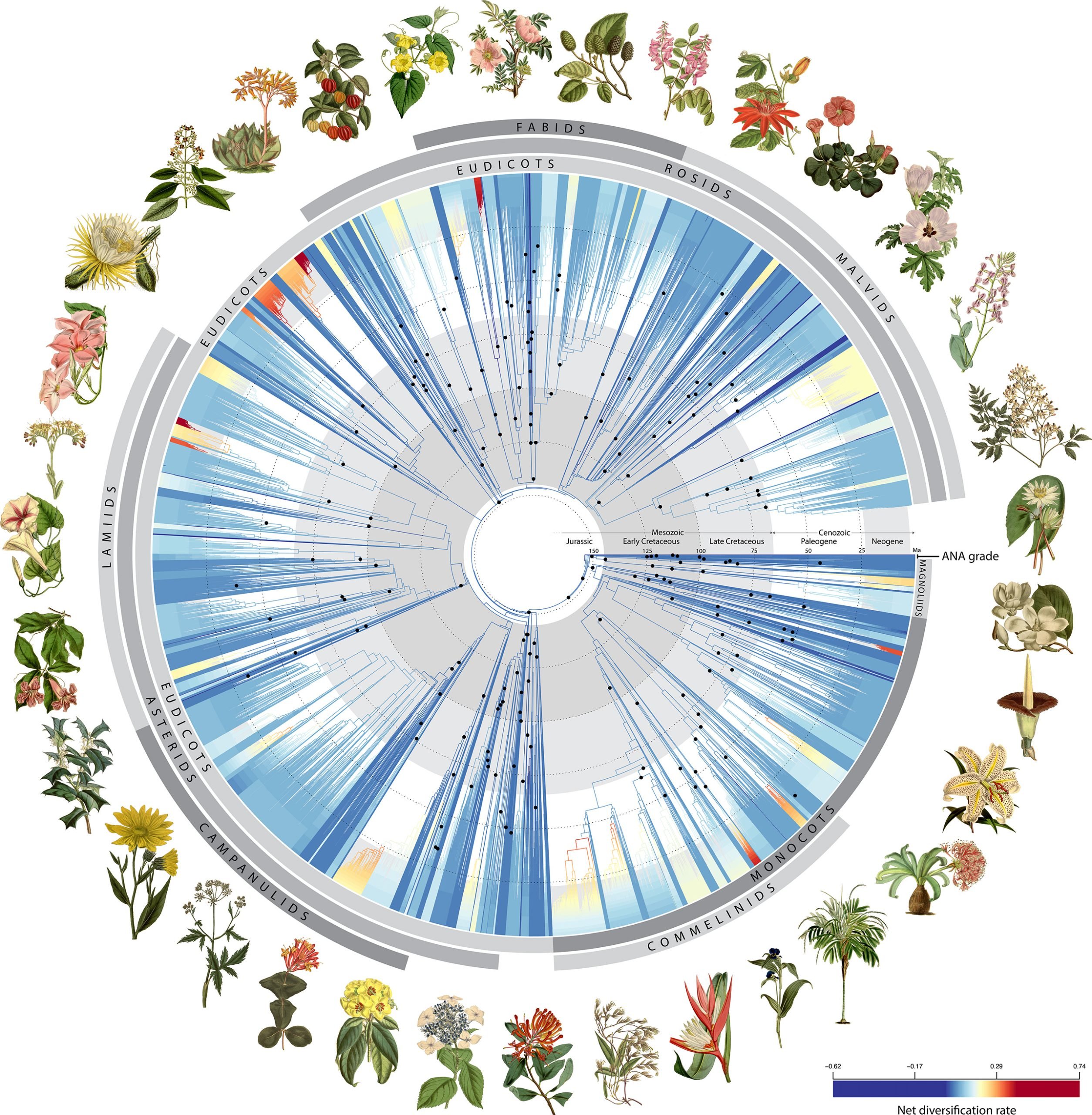
Using such specimens, the researchers sequenced a sandwort specimen (Arenaria globiflora) collected nearly 200 years ago in Nepal and, despite the poor quality of its DNA, were able to place it in the tree of life. They even analyzed extinct plants, such as the Guadalupe Island olive (Hesperelaea palmeri), which has not been seen alive since 1875. In fact, 511 of the species sequenced are already threatened with extinction, according to the International Union for Conservation of Nature Red List, including three more like Hesperelaea that are already extinct.
Global Collaboration and Novel Discoveries
Of the 9,506 species sequenced for this study, over 3,400 were derived from material sourced from 163 herbaria in 48 countries, with additional material from plant collections around the world (e.g., DNA banks, seeds, and living collections).
Among the species sequenced, more than 800 had never had their DNA sequenced before. This sequencing was essential to fill in important knowledge gaps and shed new light on the evolutionary history of flowering plants. The researchers also benefited from publicly available data for more than 1,900 species, highlighting the value of the open science approach to future genomic research.
Despite the contrasting biological properties of the nuclear and plastid genomes (e.g., size, copy number, mode of inheritance, recombination, and evolutionary rate), which can lead to conflicting phylogenic trees, the results largely support the mostly plastid-based phylogenetic classification of the Angiosperm Phylogeny Group IV. For example, 58 of the 64 currently accepted orders and 406 of the 416 families were recovered as monophyletic (excluding artifacts).
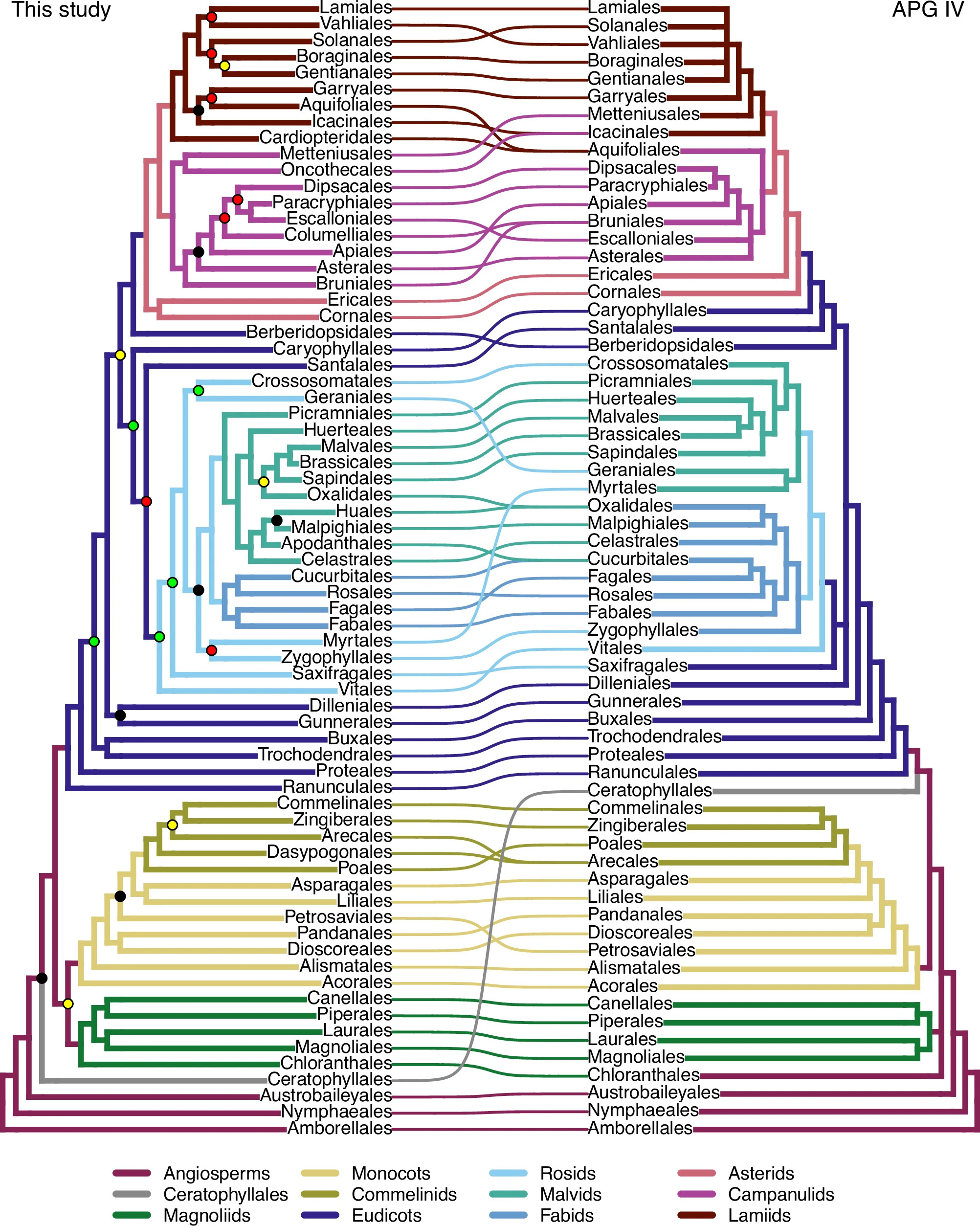
The most striking exception is the non-monophyly of Asteraceae, the largest angiosperm family, which includes sunflowers and their relatives. The tree produced by this study also confirms 85% of the relationships among families recovered by the phylogenomic angiosperm tree using plastomes by scientists from the KIB.
Darwin’s “Abominable Mystery” and Evolutionary Insights
Flowering plants originated over 140 million years ago, after which they rapidly overtook other vascular plants. Darwin was puzzled by the seemingly sudden appearance of such diversity in the fossil record and wrote: “The rapid development, as far as we can judge, of all the higher plants within recent geological times is an abominable mystery.”
Using 200 fossils, the researchers traced their tree of life back in time to show how flowering plants evolved over geological time. They found that early flowering plants did indeed explode in diversity, as Darwin noted. The rapid development of these plants gave rise, shortly after their origin, to over 80% of the major lineages that exist today. However, this trend then declined to a more stable rate for the next 100 million years, until another surge in diversification occurred about 40 million years ago, coinciding with a global drop in temperature.
These new findings would have fascinated Darwin and will surely help today’s scientists as they grapple with the challenges of understanding how and why species diversify.
The flowering plant tree of life has enormous potential for biodiversity research. This is because, just as one can predict the properties of an element based on its position in the periodic table, the location of a species in the tree of life allows us to predict its properties. The new data will therefore be invaluable in improving many areas of science and beyond.
To make this possible, the tree and all its underlying data have been made openly and freely available to both the public and the scientific community, including through the Kew Tree of Life Explorer. The researchers believe that such open access is key to democratizing access to scientific data around the world.
Open access will also help scientists make the most of the data, such as combining it with artificial intelligence to predict which plant species may contain molecules with medicinal potential. Similarly, the tree of life can be used to better understand and predict how pests and diseases will affect plants in the future. Ultimately, the researchers note, the applications of this data will be driven by the ingenuity of the scientists who access it.
Reference: “Phylogenomics and the rise of the angiosperms” by Alexandre R. Zuntini, Tom Carruthers, Olivier Maurin, Paul C. Bailey, Kevin Leempoel, Grace E. Brewer, Niroshini Epitawalage, Elaine Françoso, Berta Gallego-Paramo, Catherine McGinnie, Raquel Negrão, Shyamali R. Roy, Lalita Simpson, Eduardo Toledo Romero, Vanessa M. A. Barber, Laura Botigué, James J. Clarkson, Robyn S. Cowan, Steven Dodsworth, Matthew G. Johnson, Jan T. Kim, Lisa Pokorny, Norman J. Wickett, Guilherme M. Antar, Lucinda DeBolt, Karime Gutierrez, Kasper P. Hendriks, Alina Hoewener, Ai-Qun Hu, Elizabeth M. Joyce, Izai A. B. S. Kikuchi, Isabel Larridon, Drew A. Larson, Elton John de Lírio, Jing-Xia Liu, Panagiota Malakasi, Natalia A. S. Przelomska, Toral Shah, Juan Viruel, Theodore R. Allnutt, Gabriel K. Ameka, Rose L. Andrew, Marc S. Appelhans, Montserrat Arista, María Jesús Ariza, Juan Arroyo, Watchara Arthan, Julien B. Bachelier, C. Donovan Bailey, Helen F. Barnes, Matthew D. Barrett, Russell L. Barrett, Randall J. Bayer, Michael J. Bayly, Ed Biffin, Nicky Biggs, Joanne L. Birch, Diego Bogarín, Renata Borosova, Alexander M. C. Bowles, Peter C. Boyce, Gemma L. C. Bramley, Marie Briggs, Linda Broadhurst, Gillian K. Brown, Jeremy J. Bruhl, Anne Bruneau, Sven Buerki, Edie Burns, Margaret Byrne, Stuart Cable, Ainsley Calladine, Martin W. Callmander, Ángela Cano, David J. Cantrill, Warren M. Cardinal-McTeague, Mónica M. Carlsen, Abigail J. A. Carruthers, Alejandra de Castro Mateo, Mark W. Chase, Lars W. Chatrou, Martin Cheek, Shilin Chen, Maarten J. M. Christenhusz, Pascal-Antoine Christin, Mark A. Clements, Skye C. Coffey, John G. Conran, Xavier Cornejo, Thomas L. P. Couvreur, Ian D. Cowie, Laszlo Csiba, Iain Darbyshire, Gerrit Davidse, Nina M. J. Davies, Aaron P. Davis, Kor-jent van Dijk, Stephen R. Downie, Marco F. Duretto, Melvin R. Duvall, Sara L. Edwards, Urs Eggli, Roy H. J. Erkens, Marcial Escudero, Manuel de la Estrella, Federico Fabriani, Michael F. Fay, Paola de L. Ferreira, Sarah Z. Ficinski, Rachael M. Fowler, Sue Frisby, Lin Fu, Tim Fulcher, Mercè Galbany-Casals, Elliot M. Gardner, Dmitry A. German, Augusto Giaretta, Marc Gibernau, Lynn J. Gillespie, Cynthia C. González, David J. Goyder, Sean W. Graham, Aurélie Grall, Laura Green, Bee F. Gunn, Diego G. Gutiérrez, Jan Hackel, Thomas Haevermans, Anna Haigh, Jocelyn C. Hall, Tony Hall, Melissa J. Harrison, Sebastian A. Hatt, Oriane Hidalgo, Trevor R. Hodkinson, Gareth D. Holmes, Helen C. F. Hopkins, Christopher J. Jackson, Shelley A. James, Richard W. Jobson, Gudrun Kadereit, Imalka M. Kahandawala, Kent Kainulainen, Masahiro Kato, Elizabeth A. Kellogg, Graham J. King, Beata Klejevskaja, Bente B. Klitgaard, Ronell R. Klopper, Sandra Knapp, Marcus A. Koch, James H. Leebens-Mack, Frederic Lens, Christine J. Leon, Étienne Léveillé-Bourret, Gwilym P. Lewis, De-Zhu Li, Lan Li, Sigrid Liede-Schumann, Tatyana Livshultz, David Lorence, Meng Lu, Patricia Lu-Irving, Jaquelini Luber, Eve J. Lucas, Manuel Luján, Mabel Lum, Terry D. Macfarlane, Carlos Magdalena, Vidal F. Mansano, Lizo E. Masters, Simon J. Mayo, Kristina McColl, Angela J. McDonnell, Andrew E. McDougall, Todd G. B. McLay, Hannah McPherson, Rosa I. Meneses, Vincent S. F. T. Merckx, Fabián A. Michelangeli, John D. Mitchell, Alexandre K. Monro, Michael J. Moore, Taryn L. Mueller, Klaus Mummenhoff, Jérôme Munzinger, Priscilla Muriel, Daniel J. Murphy, Katharina Nargar, Lars Nauheimer, Francis J. Nge, Reto Nyffeler, Andrés Orejuela, Edgardo M. Ortiz, Luis Palazzesi, Ariane Luna Peixoto, Susan K. Pell, Jaume Pellicer, Darin S. Penneys, Oscar A. Perez-Escobar, Claes Persson, Marc Pignal, Yohan Pillon, José R. Pirani, Gregory M. Plunkett, Robyn F. Powell, Ghillean T. Prance, Carmen Puglisi, Ming Qin, Richard K. Rabeler, Paul E. J. Rees, Matthew Renner, Eric H. Roalson, Michele Rodda, Zachary S. Rogers, Saba Rokni, Rolf Rutishauser, Miguel F. de Salas, Hanno Schaefer, Rowan J. Schley, Alexander Schmidt-Lebuhn, Alison Shapcott, Ihsan Al-Shehbaz, Kelly A. Shepherd, Mark P. Simmons, André O. Simões, Ana Rita G. Simões, Michelle Siros, Eric C. Smidt, James F. Smith, Neil Snow, Douglas E. Soltis, Pamela S. Soltis, Robert J. Soreng, Cynthia A. Sothers, Julian R. Starr, Peter F. Stevens, Shannon C. K. Straub, Lena Struwe, Jennifer M. Taylor, Ian R. H. Telford, Andrew H. Thornhill, Ifeanna Tooth, Anna Trias-Blasi, Frank Udovicic, Timothy M. A. Utteridge, Jose C. Del Valle, G. Anthony Verboom, Helen P. Vonow, Maria S. Vorontsova, Jurriaan M. de Vos, Noor Al-Wattar, Michelle Waycott, Cassiano A. D. Welker, Adam J. White, Jan J. Wieringa, Luis T. Williamson, Trevor C. Wilson, Sin Yeng Wong, Lisa A. Woods, Roseina Woods, Stuart Worboys, Martin Xanthos, Ya Yang, Yu-Xiao Zhang, Meng-Yuan Zhou, Sue Zmarzty, Fernando O. Zuloaga, Alexandre Antonelli, Sidonie Bellot, Darren M. Crayn, Olwen M. Grace, Paul J. Kersey, Ilia J. Leitch, Hervé Sauquet, Stephen A. Smith, Wolf L. Eiserhardt, Félix Forest and William J. Baker, 24 April 2024, Nature.
DOI: 10.1038/s41586-024-07324-0
Never miss a breakthrough: Join the SciTechDaily newsletter.
Follow us on Google and Google News.