
Close Menu
    Facebook X (Twitter) Instagram
    SciTechDaily
    • Biology
    • Chemistry
    • Earth
    • Health
    • Physics
    • Science
    • Space
    • Technology
    Facebook X (Twitter) Pinterest YouTube RSS
    SciTechDaily
    Home»Space»Astronomers Use “X-Ray Magnifying Glass” To Enhance View of Distant Black Holes
    Space

    Astronomers Use “X-Ray Magnifying Glass” To Enhance View of Distant Black Holes

    By Chandra X-ray CenterSeptember 1, 20212 Comments4 Mins Read
    Facebook Twitter Pinterest Telegram LinkedIn WhatsApp Email Reddit
    Share
    Facebook Twitter LinkedIn Pinterest Telegram Email Reddit
    Gravitational Lensing Black Hole System
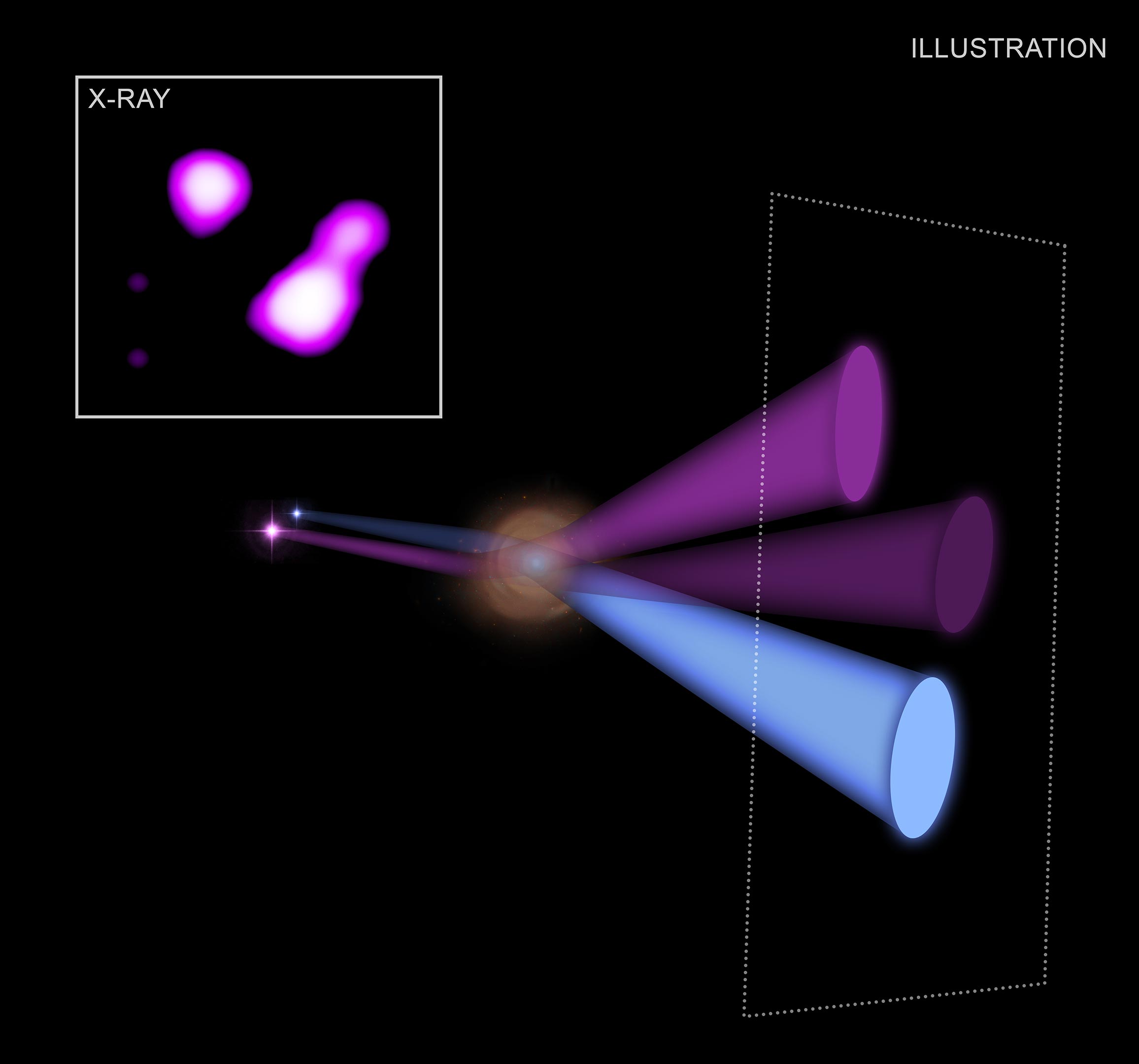
    Astronomers have used gravitational lensing to obtain an unprecedented look at a black hole system in the early Universe. An artist’s illustration shows how the X-ray light from one of the objects on the left (purple) has been warped by the gravity of an intervening galaxy to produce two sources detected in the Chandra image (dashed square on the right). The light from the fainter object (blue) has been amplified by the galaxy to be as much as 300 times brighter than it would have been without the lensing. The Chandra X-ray image is also shown in the second figure. The two objects are either two growing supermassive black holes, or one black hole and a jet. Credit: NASA/CXC/M. Weiss; X-ray (inset): NASA/CXC/SAO/D. Schwartz et al.
    • Astronomers have used an “X-ray magnifying glass” to study a black hole system in the early Universe.
    • The amplification and magnification of light by an intervening galaxy allowed the detection of two distant X-ray-emitting objects.
    • The objects are either two growing supermassive black holes, or one such black hole and a jet.
    • This result helps us understand the growth of black holes in the early Universe and the possible existence of systems with multiple black holes.

    A new technique using NASA’s Chandra X-ray Observatory has allowed astronomers to obtain an unprecedented look at a black hole system in the early Universe. This is providing a way for astronomers to look at faint and distant X-ray objects in more detail than had previously been possible.

    Astronomers used an alignment in space that shows “gravitational lensing” of light from two objects that are nearly 12 billion light years away. An artist’s illustration in the main part of this graphic shows how the paths of light from these distant objects are bent and amplified by a galaxy along the line of sight between Earth and the objects.

    The objects in this latest Chandra study are part of a system called MG B2016+112. The X-rays detected by Chandra were emitted by this system when the Universe was only 2 billion years old compared to its current age of nearly 14 billion years.

    Gravitational Lensing Black Hole System Labeled
    Credit: NASA/CXC/M. Weiss; X-ray (inset): NASA/CXC/SAO/D. Schwartz et al.

    Previous studies of radio emission from MG B2016+112 suggested that the system consisted of two separate supermassive black holes, each of which may also be producing a jet. Using a gravitational lensing model based on the radio data, Schwartz and his colleagues concluded that the three X-ray sources they detected from the MG B2016+112 system must have resulted from the lensing of two distinct objects.

    The X-ray light from one of the objects on the left (purple) has been warped by the gravity of the intervening galaxy to produce two beams and X-ray sources (“A” and “B” in a labeled version) detected in the Chandra image, which is represented by the dashed square on the right. The X-ray light from the fainter object (blue) produces an X-ray source (“C”) that has been amplified by the galaxy to be as much as 300 times brighter than it would have been without the lensing. The Chandra image is shown in the inset.

    A Rare Glimpse at Early Universe Supermassive Black Holes

    These two X-ray-emitting objects are likely a pair of growing supermassive black holes or a growing supermassive black hole and a jet. Previous Chandra measurements of pairs or trios of growing supermassive black holes have generally involved objects much closer to Earth, or with much larger separations between the objects.

    A paper describing these results appears in The Astrophysical Journal. The authors of the study are Dan Schwartz (Center for Astrophysics | Harvard and Smithsonian), Cristiana Spignola (INAF), and Anna Barnacka (CfA).

    Reference: “Resolving Complex Inner X-Ray Structure of the Gravitationally Lensed AGN MG B2016+112” by Daniel Schwartz, Cristiana Spingola and Anna Barnacka, 11 August 2021, The Astrophysical Journal.
    DOI: 10.3847/1538-4357/ac0909

    NASA’s Marshall Space Flight Center manages the Chandra program. The Smithsonian Astrophysical Observatory’s Chandra X-ray Center controls science from Cambridge, Massachusetts, and flight operations from Burlington, Massachusetts.

    Never miss a breakthrough: Join the SciTechDaily newsletter.
    Follow us on Google and Google News.

    Astronomy Astrophysics Black Hole Chandra X-ray Observatory Gravitational Lensing Harvard-Smithsonian Center for Astrophysics NASA Popular
    Share. Facebook Twitter Pinterest LinkedIn Email Reddit

    Related Articles

    “Mini” Monster Black Hole Discovery May Provide Clues to Astonishing Supermassive Growth

    Astronomers Spy Quartet of Enormous Cavities From Giant Black Holes

    “X-Ray Magnifying Glass” Provides Unprecedented Look at Black Hole in the Early Universe

    Astronomers Spot Unusual, Enormous Rings Around a Black Hole

    Chandra Catches Extraordinary “Slingshot” During Titanic Space Collision

    How Habitable Are Planets That Orbit Red Dwarfs – The Most Common Type of Stars in the Galaxy?

    How Do the Most Massive Stars Explode? Bubbles With Titanium Trigger Titanic Explosions

    Massive X-ray Jet – Extending for 160,000 Light-Years – Spied From Supermassive Black Hole in Early Universe

    Deepening Astronomical Mystery: On the Hunt for a Missing Giant Black Hole

    2 Comments

    1. BibhutibhusanPatel on September 1, 2021 11:33 pm

      Without any doubt facts are established for the gravitational waves and X-rays from the two or moŕe galaxies sýstem are eqùivaleñt with a constant ratio.All waves fòllow ĺaw of relativity mere deleting internal structure and proporties due to mass every facts can be observed.

      Reply
    2. BibhutibhusanPatel on September 2, 2021 2:21 am

      As X-rays and gravitational waves are eqùivalent with a constant of proportionality directly for the system of galaxies taken two or three togather.So by both methods identical system of galaxìrs can be imaged.

      Reply
    Leave A Reply Cancel Reply

    • Facebook
    • Twitter
    • Pinterest
    • YouTube

    Don't Miss a Discovery

    Subscribe for the Latest in Science & Tech!

    Trending News

    Collapsing Plasma May Hold the Key to Cosmic Magnetism

    This Breakthrough Solar Panel Generates Power From Both Sunlight and Raindrops

    Scientists Uncover New Metabolic Effects Beyond Weight Loss of Mounjaro

    Scientists Discover Cancer Tumors Are “Addicted” to This Common Antioxidant

    1,800 Miles Down: Scientists Uncover Mysterious Movements at the Edge of Earth’s Core

    Scientists Discover Hidden “Good Fats” in Green Rice That Could Transform Nutrition

    Your Child’s Clothes Could Contain Toxic Lead, Study Finds

    Researchers Break a 150-Year-Old Math Law With a Surprising Donut Discovery

    Follow SciTechDaily
    • Facebook
    • Twitter
    • YouTube
    • Pinterest
    • Newsletter
    • RSS
    SciTech News
    • Biology News
    • Chemistry News
    • Earth News
    • Health News
    • Physics News
    • Science News
    • Space News
    • Technology News
    Recent Posts
    • The Mystery of the Notes: Why No One Knows How This 120-Year-Old Song Should Sound
    • Scientists Discover 132-Million-Year-Old Dinosaur Tracks on South Africa’s Coast
    • Scientists Uncover the Secret Ingredient Behind the Spark That May Have Started Life on Earth
    • Natural Oils vs. Antibiotics: The Swine Study That Could Change Farming
    • The Biggest Volcanic Event in Earth’s History Transformed an Entire Oceanic Plate
    Copyright © 1998 - 2026 SciTechDaily. All Rights Reserved.
    • Science News
    • About
    • Contact
    • Editorial Board
    • Privacy Policy
    • Terms of Use

    Type above and press Enter to search. Press Esc to cancel.