
Close Menu
    Facebook X (Twitter) Instagram
    SciTechDaily
    • Biology
    • Chemistry
    • Earth
    • Health
    • Physics
    • Science
    • Space
    • Technology
    Facebook X (Twitter) Pinterest YouTube RSS
    SciTechDaily
    Home»Science»Planet-Sized Space Weather Explosions Discovered at Venus
    Science

    Planet-Sized Space Weather Explosions Discovered at Venus

    By Karen C. Fox, NASA's Goddard Space Flight Center: NASAFebruary 21, 2014No Comments3 Mins Read
    Facebook Twitter Pinterest Telegram LinkedIn WhatsApp Email Reddit
    Share
    Facebook Twitter LinkedIn Pinterest Telegram Email Reddit
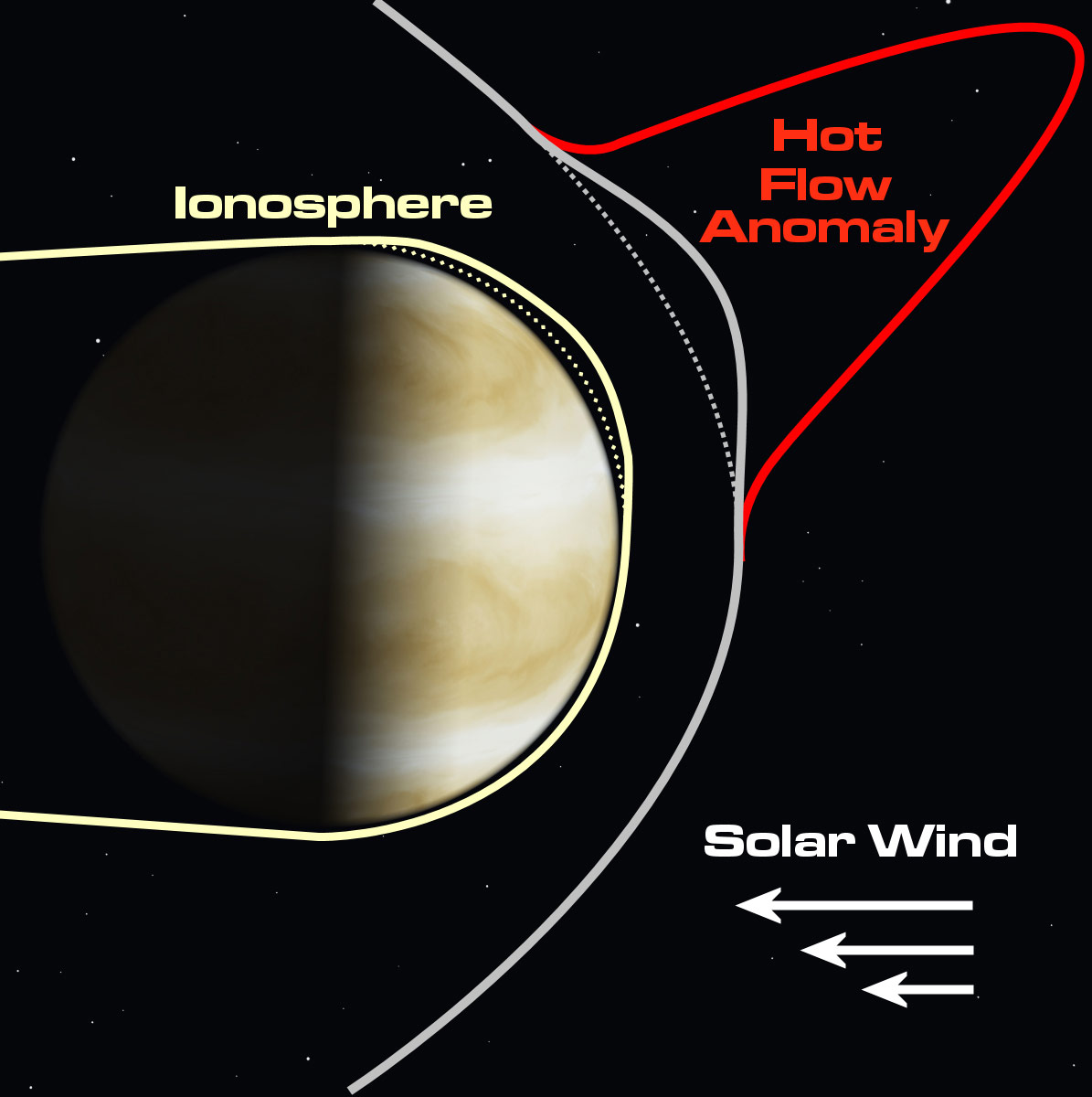
    Giant perturbations called hot flow anomalies in the solar wind near Venus can pull the upper layers of its atmosphere, the ionosphere, up and away from the surface of the planet.
    Giant perturbations called hot flow anomalies in the solar wind near Venus can pull the upper layers of its atmosphere, the ionosphere, up and away from the surface of the planet. Credit: NASA

    Using data from the European Space Agency’s Venus Express, astronomers have discovered planet-sized space weather explosions at Venus.

    Researchers recently discovered that a common space weather phenomenon on the outskirts of Earth’s magnetic bubble, the magnetosphere, has much larger repercussions for Venus. The giant explosions, called hot flow anomalies, can be so large at Venus that they’re bigger than the entire planet and they can happen multiple times a day.

    “Not only are they gigantic,” said Glyn Collinson, a space scientist at NASA’s Goddard Space Flight Center in Greenbelt, Maryland. “But as Venus doesn’t have a magnetic field to protect itself, the hot flow anomalies happen right on top of the planet. They could swallow the planet whole.”

    Collinson is the first author of a paper on these results that appeared online in the Journal of Geophysical Research in February 2014. The work is based on observations from the European Space Agency’s Venus Express. The results show just how large and how frequent this kind of space weather is on Venus.

    Earth is protected from the constant streaming solar wind of radiation by its magnetosphere. Venus, however, has no such luck. A barren, inhospitable planet, with an atmosphere so dense that spacecraft landing there are crushed within hours, Venus has no magnetic protection.

    Scientists like to compare the two: What happened differently on Earth to make it into the life-supporting planet it is today? What would Earth be like without its magnetic field?

    At Earth, hot flow anomalies do not make it inside the magnetosphere, but they release so much energy just outside that the solar wind is deflected, and can be forced to move back toward the sun. Without a magnetosphere, what happens at Venus is very different.

    Venus’s only protection from the solar wind is the charged outer layer of its atmosphere called the ionosphere. A sensitive pressure balance exists between the ionosphere and the solar wind, a balance easily disrupted by the giant energy rush of a hot flow anomaly. The hot flow anomalies may create dramatic, planet-scale disruptions, possibly sucking the ionosphere up and away from the surface of the planet.

    Reference: “A survey of hot flow anomalies at Venus” by G. A. Collinson, D. G. Sibeck, A. Masters, N. Shane, T. L. Zhang, A. Fedorov, S. Barabash, A. J. Coates, T. E. Moore, J. A. Slavin, V. M. Uritsky, S. Boardsen and M. Sarantos, 19 December 2013, Journal of Geophysical Research: Space Physics.
    DOI: 10.1002/2013JA018863

    Never miss a breakthrough: Join the SciTechDaily newsletter.
    Follow us on Google and Google News.

    Astronomy NASA Planetary Science Venus
    Share. Facebook Twitter Pinterest LinkedIn Email Reddit

    Related Articles

    Engineers Are Working on Automaton Rover for Extreme Environments (AREE)

    New Research From NASA Suggests Venus May Have Been Habitable

    NASA’s Curiosity Readies for First Drive on Mars

    Color HiRISE Image of Curiosity Rover on Mars

    First 360-Degree Color Panorama From NASA’s Curiosity Mars Rover

    Near Miss Asteroid – An Opportunity To Test a Rapid Response Program

    Arc of Venus May Reveal Secrets About Earth’s Sister Planet

    Transit of Venus Starts on June 5, 2012

    Hubble to Test Technique of Using the Moon as a Mirror

    Leave A Reply Cancel Reply

    • Facebook
    • Twitter
    • Pinterest
    • YouTube

    Don't Miss a Discovery

    Subscribe for the Latest in Science & Tech!

    Trending News

    Bone-Strengthening Discovery Could Reverse Osteoporosis

    Scientists Uncover Hidden Trigger Behind Stem Cell Aging

    Scientists Find Way to Reverse Fatty Liver Disease Without Changing Diet

    Could Humans Regrow Limbs? New Study Reveals Promising Genetic Pathway

    Scientists Reveal Eating Fruits and Vegetables May Increase Your Risk of Lung Cancer

    Scientists Reverse Brain Aging With Simple Nasal Spray

    Scientists Uncover Potential Brain Risks of Popular Fish Oil Supplements

    Scientists Discover a Surprising Way To Make Bread Healthier and More Nutritious

    Follow SciTechDaily
    • Facebook
    • Twitter
    • YouTube
    • Pinterest
    • Newsletter
    • RSS
    SciTech News
    • Biology News
    • Chemistry News
    • Earth News
    • Health News
    • Physics News
    • Science News
    • Space News
    • Technology News
    Recent Posts
    • 4,000-Year-Old Tablets Reveal Lost Magic, Medicine, and Ancient Kings
    • AI Meets Quantum Computing and the Predictions Get Scary Accurate
    • Wind Farms Are Disrupting Ocean Currents, Moving Millions of Tons of Mud Each Year
    • Scientists Discover Massive Magma Reservoir Beneath Tuscany
    • Scientists Create “Neurobots” – Living Machines With Their Own Nervous Systems
    Copyright © 1998 - 2026 SciTechDaily. All Rights Reserved.
    • Science News
    • About
    • Contact
    • Editorial Board
    • Privacy Policy
    • Terms of Use

    Type above and press Enter to search. Press Esc to cancel.