
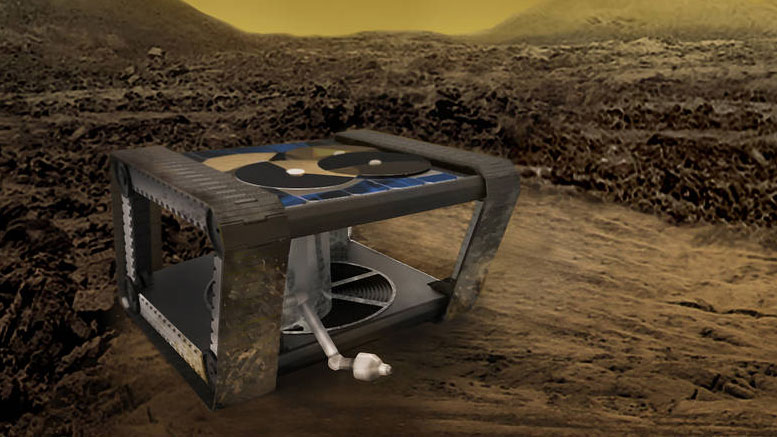
Mechanical computers could help explore an extremely unwelcoming planet.
Scientists are working on a rover that might be able to better explore Venus. The planet’s hellish atmosphere creates pressures that would crush most submarines. Its average surface temperature is 864 degrees Fahrenheit (462 degrees Celsius), high enough to melt lead.
A good watch can take a beating and keep on ticking. With the right parts, can a rover do the same on an inhospitable planet like Venus?
A design concept inspired by clockwork computers and World War I tanks could one day help us find out. The design is being explored at NASA’s Jet Propulsion Laboratory (JPL) in Pasadena, California.
The Automaton Rover for Extreme Environments (AREE) is funded for study by the NASA Innovative Advanced Concepts program. The program offers small grants to develop early-stage technology, allowing engineers to work out their ideas.
AREE was first proposed in 2015 by Jonathan Sauder, a mechatronics engineer at JPL. He was inspired by mechanical computers, which use levers and gears to make calculations rather than electronics.
By avoiding electronics, a rover might be able to better explore Venus. The planet’s hellish atmosphere creates pressures that would crush most submarines. Its average surface temperature is 864 degrees Fahrenheit (462 degrees Celsius), high enough to melt lead.
Steampunk computing
Mechanical computers have been used throughout history, most often as mathematical tools like adding machines. The most famous might be Charles Babbage’s Difference Engine, a 19th-century invention for calculating algebraic equations. The oldest known is the Antikythera mechanism, a device used by ancient Greeks to predict astronomical phenomena like eclipses.
Mechanical computers were also developed as works of art. For hundreds of years, clockwork mechanisms were used to create automatons for wealthy patrons. In the 1770s, a Swiss watchmaker named Pierre Jaquet-Droz created “The Writer,” an automaton that could be programmed to write any combination of letters.
Sauder said these analog technologies could help where electronics typically fail. In extreme environments like the surface of Venus, most electronics will melt in high temperatures or be corroded by sulfuric acid in the atmosphere.
“Venus is too inhospitable for kind of complex control systems you have on a Mars rover,” Sauder said. “But with a fully mechanical rover, you might be able to survive as long as a year.”
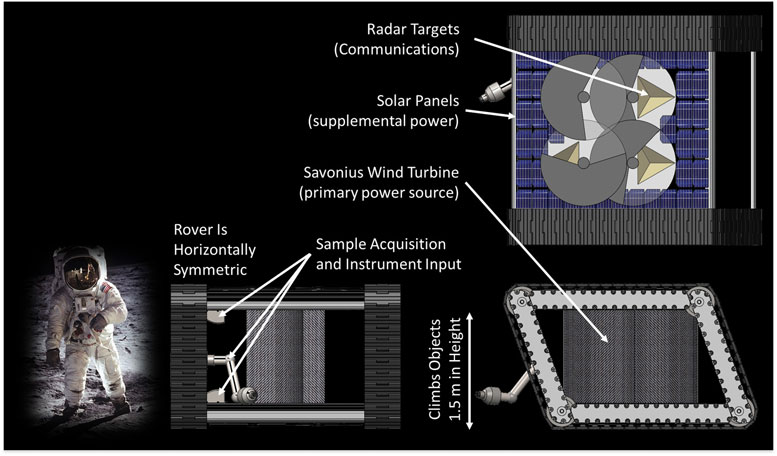
Wind turbines in the center of the rover would power these computers, allowing it to flip upside down and keep running. But the planet’s environment would offer plenty of challenges.
The extreme planet
No spacecraft has survived the Venusian surface for more than a couple of hours.
Venus’ last visitors were the Soviet Venera and Vega landers. In the 1970s and 1980s, they sent back a handful of images that revealed a craggy, gas-choked world.
“When you think of something as extreme as Venus, you want to think really out there,” said Evan Hilgemann, a JPL engineer working on high-temperature designs for AREE. “It’s an environment we don’t know much about beyond what we’ve seen in Soviet-era images.”
Sauder and Hilgemann are preparing to bake mechanical prototypes, allowing them to study how thermal expansion could affect their moving parts. Some components of the Soviet landers had actually been designed with this heat expansion in mind: their parts wouldn’t work properly until they were heated to Venusian temperatures.
Tank treads for Venus
AREE includes a number of other innovative design choices.
Mobility is one challenge, considering there are so many unknowns about the Venusian surface. Sauder’s original idea was inspired by the “Strandbeests” created by Dutch artist Theo Jansen. These spider-like structures have spindly legs that can carry their bulk across beaches, powered solely by wind.
Ultimately, they seemed too unstable for rocky terrain. Sauder started looking at World War I tank treads as an alternative. These were built to roll over trenches and craters.
Another problem will be communications. Without electronics, how would you transmit science data? Current plans are inspired by another age-old technology: Morse code.
An orbiting spacecraft could ping the rover using radar. The rover would have a radar target, which if shaped correctly, would act like “stealth technology in reverse,” Sauder said. Stealth planes have special shapes that disperse radar signals; Sauder is exploring how to shape these targets to brightly reflect signals instead. Adding a rotating shutter in front of the radar target would allow the rover to turn the bright, reflected spot on and off, communicating much like signal lamps on Navy ships.
Now in its second phase of NIAC development, the JPL team is selecting parts of the AREE concept to be refined and prototyped. Team members hope to flesh out a rover concept that will eventually be able to study the geology of Venus and perhaps drill a few samples.
For more information about AREE, go to: https://www.nasa.gov/directorates/spacetech/niac/2017_Phase_I_Phase_II/Automaton_Rover_Extreme_Environments
Never miss a breakthrough: Join the SciTechDaily newsletter.
Follow us on Google and Google News.