

Close Menu
    Facebook X (Twitter) Instagram
    SciTechDaily
    • Biology
    • Chemistry
    • Earth
    • Health
    • Physics
    • Science
    • Space
    • Technology
    Facebook X (Twitter) Pinterest YouTube RSS
    SciTechDaily
    Home»Space»Cassini Spacecraft Images Provide “Inside-Out” View of Saturn’s Rings
    Space

    Cassini Spacecraft Images Provide “Inside-Out” View of Saturn’s Rings

    By NASAAugust 29, 2017No Comments3 Mins Read
    Facebook Twitter Pinterest Telegram LinkedIn WhatsApp Email Reddit
    Share
    Facebook Twitter LinkedIn Pinterest Telegram Email Reddit
    Cassini Images Provide Inside-Out View of Saturn's Rings
    This movie sequence of images from NASA’s Cassini spacecraft offers a unique perspective on Saturn’s ring system. Cassini captured the images from within the gap between the planet and its rings, looking outward as the spacecraft made one of its final dives through the gap as part of the mission’s Grand Finale. Credit: NASA/JPL-Caltech/Space Science Institute

    This newly released movie sequence of images from NASA’s Cassini Spacecraft offers a unique perspective on Saturn’s ring system.

    Cassini captured the images from within the gap between the planet and its rings, looking outward as the spacecraft made one of its final dives through the gap as part of the mission’s Grand Finale.

    Using its wide-angle camera, Cassini took the 21 images in the sequence over a span of about four minutes during its dive through the gap on August 20, 2017. The images have an original size of 512 x 512 pixels; the smaller image size allowed for more images to be taken over the short span of time.
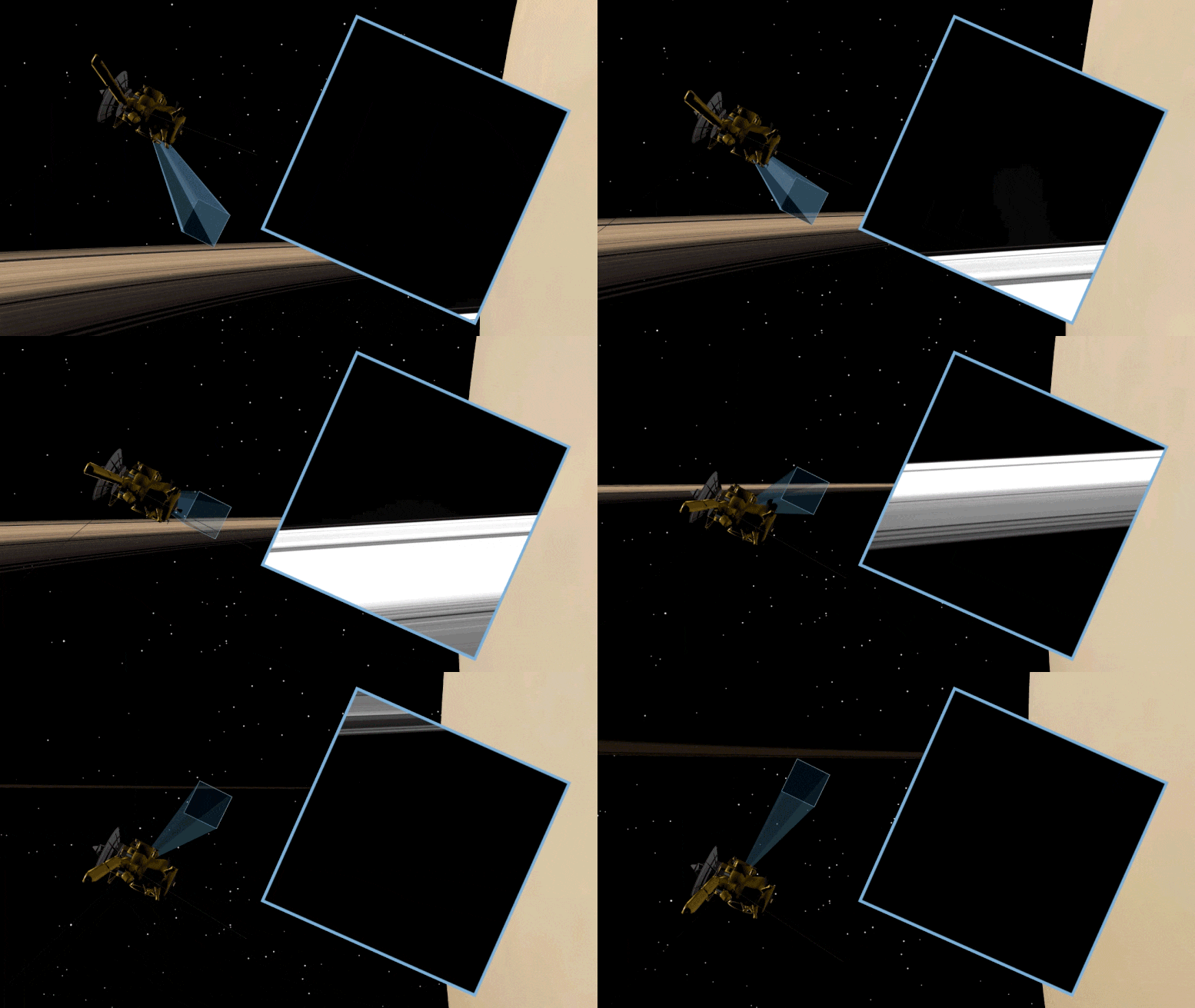
    Cassini Saturn Rings Movie Sequence
    Context animation showing Cassini’s point of view on the rings during the movie sequence. Credit: NASA/JPL-Caltech/Space Science Institute

    The entirety of the main rings can be seen here, but due to the low viewing angle, the rings appear extremely foreshortened. The perspective shifts from the sunlit side of the rings to the unlit side, where sunlight filters through. On the sunlit side, the grayish C ring looks larger in the foreground because it is closer; beyond it is the bright B ring and slightly less-bright A ring, with the Cassini Division between them. The F ring is also fairly easy to make out.

    Saturn's Rings Annotated
    A scan across Saturn’s incredible halo of ice rings yields a study in precision and order. This natural color mosaic was acquired by the Cassini spacecraft as it soared 39 degrees above the unilluminated side of the rings. Major named gaps are labeled at the top. The main rings themselves, along with the F ring, are labeled at the bottom, along with their inner and outer boundaries. Credit: NASA/JPL/Space Science Institute

    The Cassini mission is a cooperative project of NASA, ESA (the European Space Agency), and the Italian Space Agency. The Jet Propulsion Laboratory (JPL), a division of Caltech in Pasadena, manages the mission for NASA’s Science Mission Directorate, Washington. The Cassini orbiter and its two onboard cameras were designed, developed, and assembled at JPL. The imaging operations center is based at the Space Science Institute in Boulder, Colorado.

    Never miss a breakthrough: Join the SciTechDaily newsletter.
    Follow us on Google and Google News.

    Astronomy Cassini-Huygens Mission JPL NASA Saturn
    Share. Facebook Twitter Pinterest LinkedIn Email Reddit

    Related Articles

    Cassini Views Saturn’s Hexagonal Shaped Jet Stream

    New Cassini Images of Saturn and Its Moons

    Cassini Provides New View of Saturn and Earth

    Cassini Data Suggests Saturn’s Moons and Rings Are More Than 4 Billion Years Old

    Storm Spawns the Largest Tropospheric Vortex Ever Seen on Saturn

    New Cassini Image of Saturn and Its Rings

    NASA’s Cassini Spots Lightning in Saturn’s Northern Hemisphere

    Cassini Data Reveals Likely Subsurface Ocean on Titan

    Heat from Within the Planet Powers Saturn’s Jet Streams

    Leave A Reply Cancel Reply

    • Facebook
    • Twitter
    • Pinterest
    • YouTube

    Don't Miss a Discovery

    Subscribe for the Latest in Science & Tech!

    Trending News

    Largest-Ever Study Finds Medicinal Cannabis Ineffective for Anxiety, Depression, PTSD

    250-Million-Year-Old Egg Solves One of Evolution’s Biggest Mysteries

    Living With Roommates Might Be Changing Your Gut Microbiome Without You Knowing

    Century-Old Cleaning Chemical Linked to 500% Increased Risk of Parkinson’s Disease

    What if Your Memories Never Happened? Physicists Take a New Look at the Boltzmann Brain Paradox

    One of the Universe’s Largest Stars May Be Getting Ready To Explode

    Scientists Discover Enzyme That Could Supercharge Ozempic-Like Weight Loss Drugs

    Popular Sweetener Linked to DNA Damage – “It’s Something You Should Not Be Eating”

    Follow SciTechDaily
    • Facebook
    • Twitter
    • YouTube
    • Pinterest
    • Newsletter
    • RSS
    SciTech News
    • Biology News
    • Chemistry News
    • Earth News
    • Health News
    • Physics News
    • Science News
    • Space News
    • Technology News
    Recent Posts
    • Challenging the Narrative: New Study Shows U.S. Life Expectancy Is Rising Across All States
    • Mystery Illness Kills 5 in Burundi As Doctors Scramble for Answers
    • Bone-Strengthening Discovery Could Reverse Osteoporosis
    • The Most Elusive Number in Physics Just Got Even More Mysterious
    • Scientists Uncover Hidden Trigger Behind Stem Cell Aging
    Copyright © 1998 - 2026 SciTechDaily. All Rights Reserved.
    • Science News
    • About
    • Contact
    • Editorial Board
    • Privacy Policy
    • Terms of Use

    Type above and press Enter to search. Press Esc to cancel.