

The Cassini Spacecraft ended its journey on September 15 with a plunge into the atmosphere of Saturn, but analysis continues on the mountain of data the spacecraft sent during its long life. Some of the Cassini team’s freshest insights were presented during a news conference today at the American Astronomical Society Division for Planetary Science meeting in Provo, Utah.
Among the findings being shared:
Views from Cassini’s Grand Finale show the beauty of the rings and demonstrate processes similar to those that form planets.
During Cassini’s final months, the spacecraft’s cameras captured views from within the gap between the planet and the rings, and the mission is releasing two new image mosaics showing the rings from that unique perspective. One view, from May 28, 2017, shows the rings emerging from behind the planet’s hazy limb, while the planet itself is adorned with ring shadows. The other mosaic shows a panoramic view outward across the ringscape.
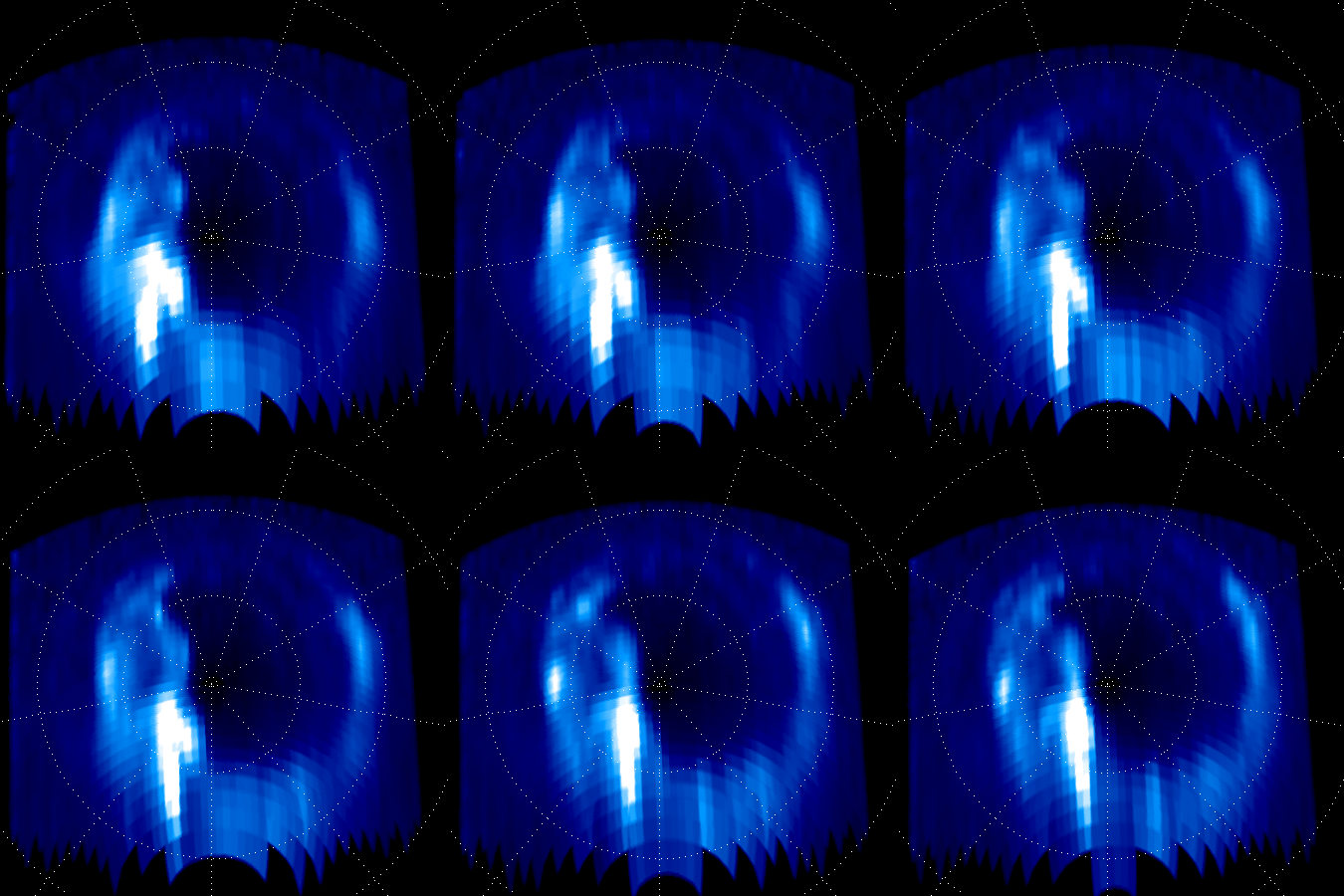
Researchers also shared a new movie of Saturn’s auroras in ultraviolet light that represents the final such view from the spacecraft’s Ultraviolet Imaging Spectrometer.
In addition, Cassini participating scientist and imaging team associate Matt Tiscareno of SETI Institute, Mountain View, California, provided new details about the whimsically named ring features called propellers, which are wakes in the rings created by small, unseen moonlets. The propellers are analogous to baby planets forming in disks around young stars, as they obey similar physical processes.
Tiscareno said that, in its last images of the rings (taken the day before the spacecraft’s plunge into Saturn), Cassini successfully imaged all six of the propellers whose orbits were being tracked over the last several years of the mission. These objects are named for famous aviators: Blériot, Earhart, Santos-Dumont, Sikorsky, Post and Quimby. During its Ring-Grazing Orbits — the four months of close orbits that preceeded the mission’s Grand Finale — Cassini obtained images showing swarms of smaller propellers, astounding Tiscareno and colleagues.

Cassini’s electronic “nose” hit the jackpot, finding many surprises as it sniffed the gases in the previously unexplored space between the planet and the rings.
The spacecraft’s Ion and Neutral Mass Spectrometer (INMS) returned a host of first-ever direct measurements of the components in Saturn’s upper atmosphere, which stretches almost to the rings. From these observations, the team sees evidence that molecules from the rings are raining down onto the atmosphere. This influx of material from the rings was expected, but INMS data show hints of ingredients more complex than just water, which makes up the bulk of the rings’ composition. In particular, the instrument detected methane, a volatile molecule that scientists would not expect to be abundant in the rings or found so high in Saturn’s atmosphere. Cassini participating scientist and INMS team associate Mark Perry from the Johns Hopkins University Applied Physics Laboratory, Laurel, Maryland, says the team is busy analyzing data from the final, lowest-altitude passes, which show even more complexity and variability. The INMS observations complement those by Cassini’s Cosmic Dust Analyzer instrument, which sampled solid particles in the gap during the Grand Finale.
Researchers continue trying to wrangle insights about the length of the planet’s day from measurements of Saturn’s magnetic field.
Michele Dougherty, leader of Cassini’s Magnetometer team from Imperial College London, provided an update on the team’s progress in trying to determine whether Saturn’s magnetic field has a detectable tilt. One aim of their work is to determine the precise length of time for the planet’s internal rotation, which would help researchers nail down the true length of the planet’s day. Dougherty says the sensitivity of Cassini’s magnetic field measurements nearly quadrupled over the course of the spacecraft’s 22 Grand Finale orbits — meaning that, if the tilt of Saturn’s field is greater than 0.016 degrees, researchers should be able to detect it. An extremely small tilt is challenging to explain with scientists’ current understanding of how planetary magnetic fields are generated, thus suggesting more sophisticated dynamics inside Saturn.
New theoretical research explains the forces that keep Saturn’s rings from spreading out and dispersing. It turns out to be a group effort.
Key among the questions scientists hope to answer using data from Cassini are the age and origins of the rings. Theoretical modeling has shown that, without forces to confine them, the rings would spread out over hundreds of millions of years — much younger than Saturn itself. This spreading happens because faster-moving particles that orbit closer to Saturn occasionally collide with slower particles on slightly farther-out orbits. When this happens, some momentum from the faster particles is transferred to the slower particles, speeding the latter up in their orbit and causing them to move farther outward. The inverse happens to the faster, inner particles.
Previous research had shown that gravitational tugs from the moon Mimas are solely responsible for halting the outward spread of Saturn’s B ring — that ring’s outer edge is defined by the dark region known as the Cassini Division. Ring scientists had thought the small moon Janus was responsible for confining the outer edge of the A ring. But a new modeling study led by Radwan Tajeddine of Cornell University, Ithaca, New York, shows that the A ring’s outward creep is kept in check by a confederation of moons, including Pan, Atlas, Prometheus, Pandora, Janus, Epimetheus and Mimas.
The insight was made possible by Cassini, which provided scientists with high-resolution views of intricate waves in the rings, along with precise determinations of the masses of Saturn’s moons. Analysis of these data led Tajeddine and colleagues to an understanding that a cumulative effect of waves from all these moons damps the outward transfer of momentum in the A ring and confines its edge.
Tajeddine will present these results in a poster at the DPS meeting, and they will be published Wednesday in the Astrophysical Journal.
“There are whole careers to be forged in the analysis of data from Cassini,” said Linda Spilker, the mission’s project scientist at NASA’s Jet Propulsion Laboratory, Pasadena, California. “In a sense, the work has only just begun.”
The Cassini-Huygens mission is a cooperative project of NASA, ESA (European Space Agency) and the Italian Space Agency. NASA’s Jet Propulsion Laboratory, a division of Caltech in Pasadena, manages the mission for NASA’s Science Mission Directorate, Washington. JPL designed, developed and assembled the Cassini orbiter.
Never miss a breakthrough: Join the SciTechDaily newsletter.
Follow us on Google and Google News.