
In an effort to test the technique of using the moon as a mirror, scientists will use Hubble to observe the transit of Venus across the sun’s face on June 5-6. If successful, this method could be used to detect the very faint fingerprints of an Earth-like planet outside our solar system that similarly transits its own star.
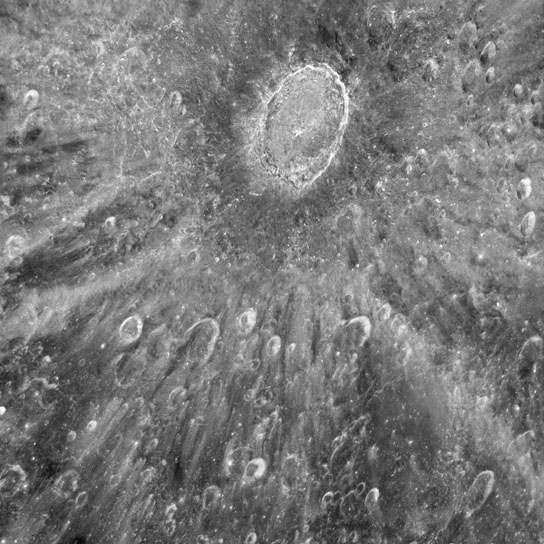
This mottled landscape showing the impact crater Tycho is among the most violent-looking places on our moon. Astronomers didn’t aim NASA’s Hubble Space Telescope to study Tycho, however. The image was taken in preparation to observe the transit of Venus across the sun’s face on June 5-6.
Hubble cannot look at the sun directly, so astronomers are planning to point the telescope at the Earth’s moon, using it as a mirror to capture reflected sunlight and isolate the small fraction of the light that passes through Venus’s atmosphere. Imprinted on that small amount of light are the fingerprints of the planet’s atmospheric makeup.
These observations will mimic a technique that is already being used to sample the atmospheres of giant planets outside our solar system passing in front of their stars. In the case of the Venus transit observations, astronomers already know the chemical makeup of Venus’s atmosphere, and that it does not show signs of life on the planet. But the Venus transit will be used to test whether this technique will have a chance of detecting the very faint fingerprints of an Earth-like planet, even one that might be habitable for life, outside our solar system that similarly transits its own star. , Venus is an excellent proxy because it is similar in size and mass to our planet.
The astronomers will use an arsenal of Hubble instruments, the Advanced Camera for Surveys, Wide Field Camera 3, and Space Telescope Imaging Spectrograph, to view the transit in a range of wavelengths, from ultraviolet to near-infrared light. During the transit, Hubble will snap images and perform spectroscopy, dividing the sunlight into its constituent colors, which could yield information about the makeup of Venus’s atmosphere.
Hubble will observe the moon for seven hours, before, during, and after the transit so the astronomers can compare the data. Astronomers need the long observation because they are looking for extremely faint spectral signatures. Only 1/100,000th of the sunlight will filter through Venus’s atmosphere and be reflected off the moon.
This image, taken with Hubble’s Advanced Camera for Surveys, reveals lunar features as small as roughly 560 feet (170 meters) across. The large “bulls-eye” near the top of the picture is the impact crater, caused by an asteroid strike about 100 million years ago. The bright trails radiating from the crater were formed by material ejected from the impact area during the asteroid collision. Tycho is about 50 miles (80 kilometers) wide and is circled by a rim of material rising almost 3 miles (5 kilometers) above the crater floor. The image measures 430 miles (700 kilometers) across, which is slightly larger than New Mexico.
Because the astronomers only have one shot at observing the transit, they had to carefully plan how the study would be carried out. Part of their planning included the test observations of the moon, made on Jan. 11, 2012, as shown in the release image.
Hubble will need to be locked onto the same location on the moon for more than seven hours, the transit’s duration. For roughly 40 minutes of each 96-minute orbit of Hubble around the Earth, the Earth occults Hubble’s view of the moon. So, during the test observations, the astronomers wanted to make sure they could point Hubble to precisely the same target area.
This is the last time this century that sky watchers can view Venus passing in front of the sun. The next transit won’t happen until 2117. Venus transits occur in pairs, separated by eight years. The last event was witnessed in 2004.
Never miss a breakthrough: Join the SciTechDaily newsletter.
Follow us on Google and Google News.