
New Measurements of the Sky’s Blackness Show Galaxies Only Number in the Hundreds of Billions
How dark is the sky, and what does that tell us about the number of galaxies in the visible universe? Astronomers can estimate the total number of galaxies by counting everything visible in a Hubble deep field and then multiplying them by the total area of the sky. But other galaxies are too faint and distant to directly detect. Yet while we can’t count them, their light suffuses space with a feeble glow.
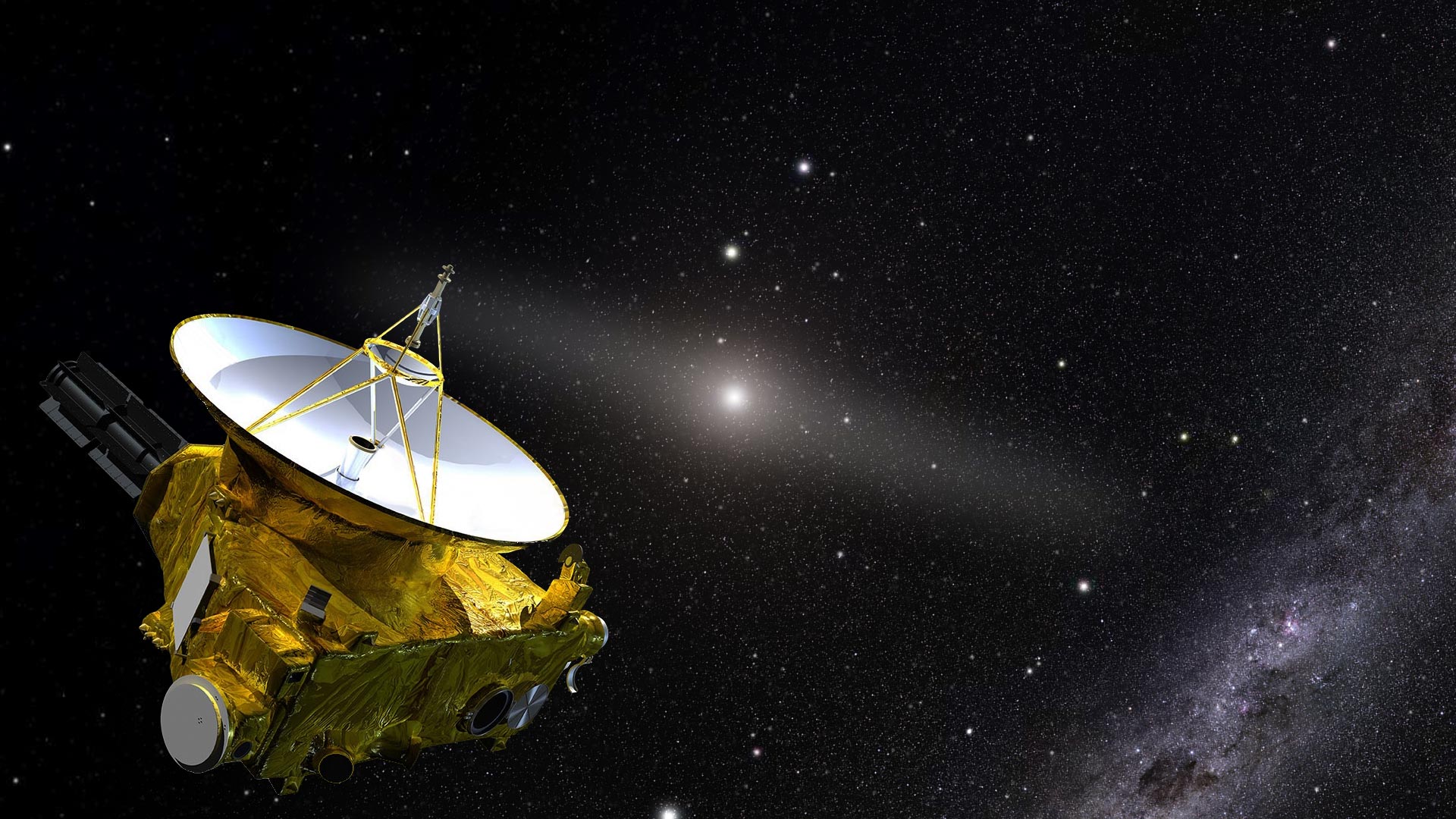
To measure that glow, astronomical satellites have to escape the inner solar system and its light pollution, caused by sunlight reflecting off dust. A team of scientists has used observations by NASA’s New Horizons mission to Pluto and the Kuiper Belt to determine the brightness of this cosmic optical background. Their result sets an upper limit to the abundance of faint, unresolved galaxies, showing that they only number in the hundreds of billions, not 2 trillion galaxies as previously believed.
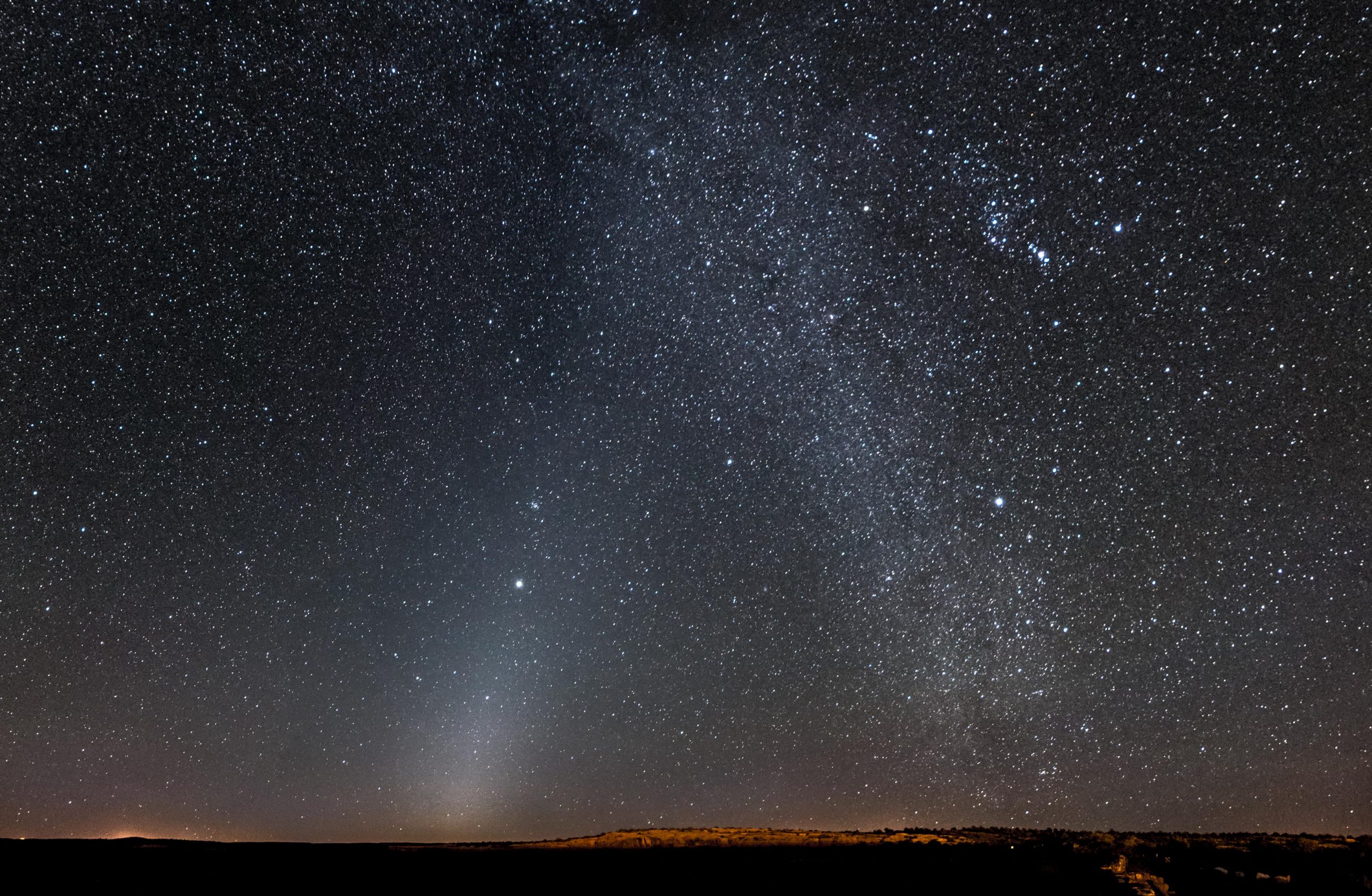
How dark does space get? If you get away from city lights and look up, the sky between the stars appears very dark indeed. Above the Earth’s atmosphere, outer space dims even further, fading to an inky pitch-black. And yet even there, space isn’t absolutely black. The universe has a suffused feeble glimmer from innumerable distant stars and galaxies.
New measurements of that weak background glow show that the unseen galaxies are less plentiful than some theoretical studies suggested, numbering only in the hundreds of billions rather than the previously reported two trillion galaxies.
“It’s an important number to know – how many galaxies are there?” said Marc Postman of the Space Telescope Science Institute in Baltimore, Maryland, a lead author on the study. “We simply don’t see the light from two trillion galaxies.”
The earlier estimate was extrapolated from very deep sky observations by NASA’s Hubble Space Telescope. It relied on mathematical models to estimate how many galaxies were too small and faint for Hubble to see. That team concluded that 90% of the galaxies in the universe were beyond Hubble’s ability to detect in visible light. The new findings, which relied on measurements from NASA’s distant New Horizons mission, suggest a much more modest number.
“Take all the galaxies Hubble can see, double that number, and that’s what we see – but nothing more,” said Tod Lauer of NSF’s NOIRLab, a lead author on the study.
These results will be presented on Wednesday, January 13th at a meeting of the American Astronomical Society, which is open to registered participants.
Measuring the Cosmic Optical Background
The cosmic optical background that the team sought to measure is the visible-light equivalent of the more well-known cosmic microwave background – the weak afterglow of the Big Bang itself, before stars ever existed.
“While the cosmic microwave background tells us about the first 450,000 years after the big bang, the cosmic optical background tells us something about the sum total of all the stars that have ever formed since then,” explained Postman. “It puts a constraint on the total number of galaxies that have been created, and where they might be in time.”
As powerful as Hubble is, the team couldn’t use it to make these observations. Although located in space, Hubble orbits Earth and still suffers from light pollution. The inner solar system is filled with tiny dust particles from disintegrated asteroids and comets. Sunlight reflects off those particles, creating a glow called the zodiacal light that can be observed even by skywatchers on the ground.
New Horizons’ Unique Vantage Point
To escape the zodiacal light, the team had to use an observatory that had escaped the inner solar system. Fortunately, the New Horizons spacecraft, which has delivered the closest ever images of Pluto and the Kuiper Belt object Arrokoth, is far enough to make these measurements. At its distance (more than 4 billion miles or 6.4 billion kilometers away when these observations were taken), New Horizons experiences an ambient sky 10 times darker than the darkest sky accessible to Hubble.
“These kinds of measurements are exceedingly difficult. A lot of people have tried to do this for a long time,” said Lauer. “New Horizons provided us with a vantage point to measure the cosmic optical background better than anyone has been able to do it.”
The team analyzed existing images from the New Horizons archives. To tease out the feeble background glow, they had to correct for a number of other factors. For example, they subtracted the light from the galaxies expected to exist that are too faint to be identifiable. The most challenging correction was removing light from Milky Way stars that was reflected off interstellar dust and into the camera.
The remaining signal, though extremely faint, was still measurable. Postman compared it to living in a remote area far from city lights, lying in your bedroom at night with the curtains open. If a neighbor a mile down the road opened their refrigerator looking for a midnight snack, and the light from their refrigerator reflected off the bedroom walls, it would be as bright as the background New Horizons detected.
What Might Be Behind the Mysterious Glow?
So, what could be the source of this leftover glow? It’s possible that an abundance of dwarf galaxies in the relatively nearby universe lie just beyond detectability. Or the diffuse halos of stars that surround galaxies might be brighter than expected. There might be a population of rogue, intergalactic stars spread throughout the cosmos. Perhaps most intriguing, there may be many more faint, distant galaxies than theories suggest. This would mean that the smooth distribution of galaxy sizes measured to date rises steeply just beyond the faintest systems we can see – just as there are many more pebbles on a beach than rocks.
NASA’s upcoming James Webb Space Telescope may be able to help solve the mystery. If faint, individual galaxies are the cause, then Webb ultra-deep field observations should be able to detect them.
This study is accepted for publication in the Astrophysical Journal.
Never miss a breakthrough: Join the SciTechDaily newsletter.
Follow us on Google and Google News.
5 Comments
Everything about space is just a slightly educated guess. Every other day there’s a new article about galaxies or exoplanets and how many and what they are made of and the next day or two and it all changes. Truth is we dont anything outside of what our visual telescopes can see. Anything outside of that is a guess.You can crunch all the data you want, whose to say the data your crunching is anywhere close to correct. The tic tac videos released by the U.S. Navy alone is enough evidence to tell us there are physics out there we aren’t even close to being aware of.
271,828,182,845 That’s my number and I’m sticking to it.
The Cloud of Unknowing is a mystical 14th C. Work of the monastics that perhaps may have preceded 20th. C. thought in its advancement on the Psyche(mind). I advice all modern day commentators on our briefing of the cosmological understanding of our(humanities) position in the universe to get a reading of it. This is also known as the ‘Great Unknown’ or ‘The Cosmic Unknown.’ Brian known as Geoff.
How can we as humans continue to pursue something that is infinitely unanswerable! Stop all space exploration!
The Zodiacal light DOES NOT reflect off the dust of asteroids and comets. The dust in question is blown off Mars.
Where does this misinformation come from? Is it lazy editing?