
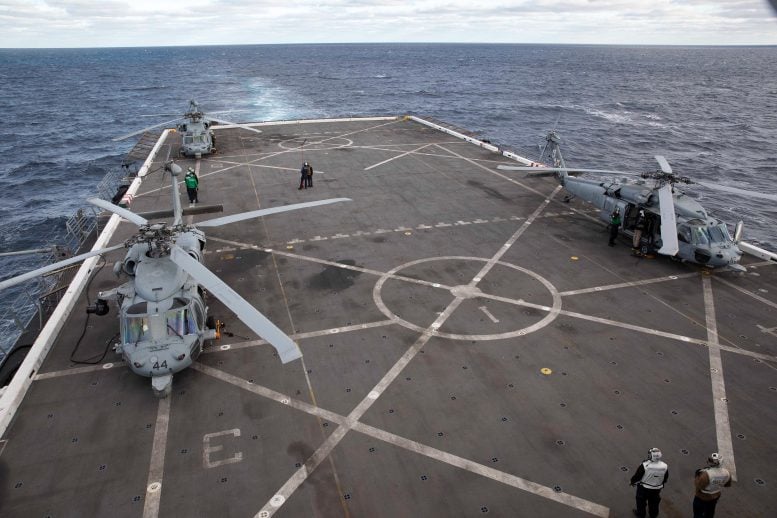
On Flight Day 24 of the Artemis I mission, NASA teams in Mission Control Houston conducted spacecraft system checks ahead of Orion’s planned splashdown on December 11. Meanwhile, the Exploration Ground Systems recovery team made its way toward the landing area off Mexico’s Baja Coast near Guadalupe Island in the Pacific Ocean.
As planned, flight controllers activated the crew module reaction control system heater and conducted a hot-fire test for each thruster. The five pulses for each thruster lasted 75 milliseconds each, and were conducted in opposing pairs to minimize attitude changes during the test. Thrust for the crew module propulsion system is generated from 12 monopropellant MR-104G engines. These engines are a variant of MR-104 thrusters, which have been used in other NASA spacecraft, including the interplanetary Voyagers 1 and 2.
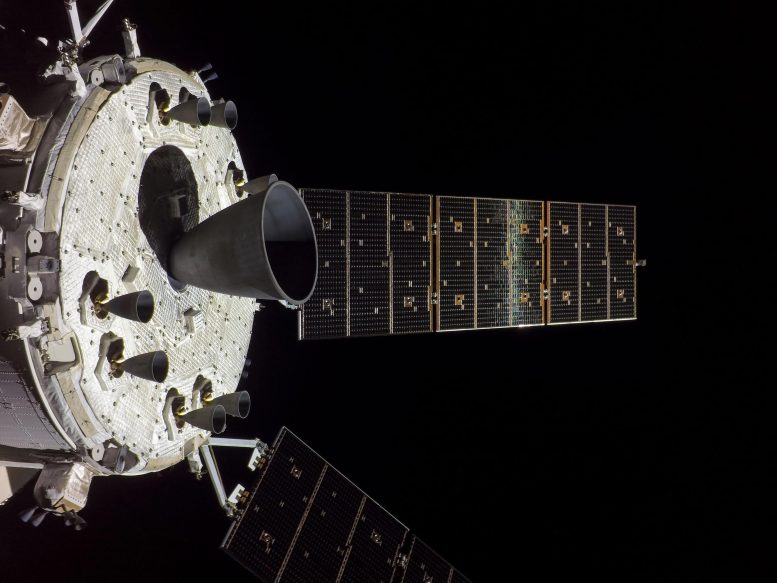
Thus far, approximately 12,100 pounds of propellant have been used, which is around 240 pounds less than was estimated prelaunch. This leaves a margin of 2,230 pounds over what is planned for use, 324 pounds more than prelaunch expectations.
On its way back to Earth, Orion will pass through a period of intense radiation as it travels through the Van Allen Belts that contain space radiation trapped around Earth by the planet’s magnetosphere. Outside the protection of Earth’s magnetic field, the deep space radiation environment includes energetic particles produced by the Sun during solar flares as well as particles from cosmic rays that come from outside the galaxy.
Orion was designed from the start to ensure the reliability of essential spacecraft systems during potential radiation events and can become a makeshift storm shelter when crew members use shielding materials to form a barrier against solar energetic particles.
For the uncrewed Artemis I mission, Orion is carrying several instruments and experiments to better understand the environment future crews will experience and provide valuable information for engineers developing additional protective measures. There are active sensors connected to power that can send readings to Earth during the flight, as well as passive detectors that require no power source to collect radiation dose information that will be analyzed after the flight.
Commander Moonikin Campos is equipped with two radiation sensors, as well as a sensor under the headrest and another behind the seat to record acceleration and vibration throughout the mission. The seat is positioned in a recumbent, or laid-back, position with elevated feet, which will help maintain blood flow to the head for crew members on future missions during ascent and entry. The position also reduces the chance of injury by allowing the head and feet to be held securely during launch and landing, and by distributing forces across the entire torso during high acceleration and deceleration periods, such as splashdown.
A crew is expected to experience two-and-a-half times the force of gravity during ascent and four times the force of gravity at two different points during the planned reentry profile. Engineers will compare Artemis I flight data with previous ground-based vibration tests with the same manikin, and human subjects, to correlate performance prior to Artemis II.
In addition to the sensors on the manikin and seat, Campos is wearing a first-generation Orion Crew Survival System pressure suit – a spacesuit astronauts will wear during launch, entry, and other dynamic phases of their missions. Even though it’s primarily designed for launch and reentry, the Orion suit can keep astronauts alive if Orion were to lose cabin pressure during the journey out to the Moon, while adjusting orbits in Gateway, or on the way back home. Astronauts could survive inside the suit for up to six days as they make their way back to Earth. The outer cover layer is orange to make crew members easily visible in the ocean should they ever need to exit Orion without the assistance of recovery personnel, and the suit is equipped with several features for fit and function.
Shortly before 2:30 p.m. CST on December 9, Orion was traveling 171,500 miles (276,000 km) from Earth and 214,200 miles (344,700 km) from the Moon, cruising at 2,100 mph (3,400 km/h).
Artemis All Access – Episode 6 Artemis All Access is your look at the latest in Artemis I, the people and technology behind the mission, and what is coming up next. This uncrewed flight test around the Moon will pave the way for a crewed flight test and future human lunar exploration as part of Artemis. Credit: NASA
Watch the latest episode of Artemis All Access (video embedded above) for a glimpse at the latest mission status and an inside look ahead of splashdown.
Live splashdown coverage will begin at 11 a.m. EST on Sunday, December 11. Splashdown is scheduled at 12:39 p.m., and coverage will continue through Orion’s handover from Mission Control in Houston to Exploration Ground Systems recovery teams in the Pacific Ocean. Coverage will be live on NASA TV, the agency’s website, and the NASA app.
Never miss a breakthrough: Join the SciTechDaily newsletter.
Follow us on Google and Google News.