
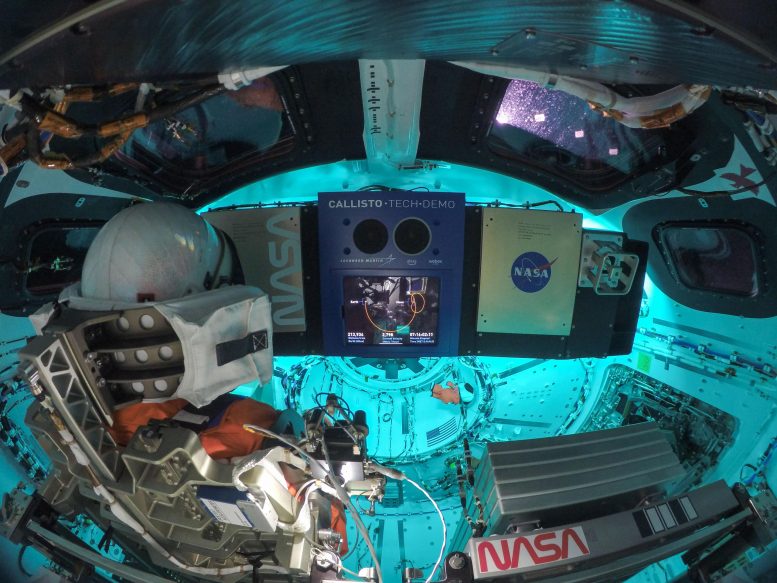
Artemis I launched on November 16, with the powerful Space Launch System rocket carrying Orion lifting off from Launch Pad 39B at NASA’s Kennedy Space Center in Florida at 1:47 a.m. EST. Later that day Orion sent back a picture of Earth as the spacecraft made its journey away from our planet. On the third day of its Artemis I journey, the Orion spacecraft was more than halfway to the Moon, and a review showed it was exceeding performance expectations. Day 5 saw Orion enter the lunar sphere of influence, and the spacecraft captured stunning views during a close lunar flyby on day 6. On Day 8, Orion exited the lunar sphere of influence, and on day 10 it entered distant retrograde orbit. On day 11 it set a record by surpassing the distance Apollo 13 reached from Earth, and on day 13 it hit the maximum distance it will reach from Earth during the mission.
During flight day 14, NASA engineers continued with the jet firing development flight test objective that began on flight day 12. Today, teams demonstrated the “low” portion of the reaction control thruster firing time range. This test objective is designed to exercise Orion’s reaction control system jets in a different configuration to model how thruster jets will be used during the Artemis II mission, furthering NASA’s understanding of spacecraft operations before they have crew onboard.
As part of planned testing throughout the mission, the guidance, navigation, and control officer, also known as GNC, performed the sixth of eight planned tests of the star trackers that support Orion’s navigation system. Star trackers are a navigation tool that measure the positions of stars to help the spacecraft determine its orientation. The star trackers continue to provide excellent data to develop our required navigation solutions.
Engineers will characterize the alignment between the star trackers that are part of the guidance, navigation and control system and the Orion inertial measurements units, by exposing different areas of the spacecraft to the Sun and activating the star trackers in different thermal states to determine if the temperature differences induce any changes. The inertial measurement units contain three devices, called gyros, used to measure spacecraft body rotation rates, and three accelerometers used to measure spacecraft accelerations.
Artemis All Access is your look at the latest in Artemis I, the people and technology behind the mission, and what is coming up next. This uncrewed flight test around the Moon will pave the way for a crewed flight test and future human lunar exploration as part of Artemis. Credit: NASA
A new flight test objective was added to flight day 14 to collect additional information on the thermal characterization of Orion. During a majority of the mission Orion is typically in a tail-to-sun attitude, meaning that the solar arrays face toward the sun to generate power. This flight test objective purposefully orients Orion outside of a perfect tail-to-sun attitude by up to 20 degrees in order to evaluate the spacecraft and gather additional data. Currently, when Orion is out of the tail-to-sun attitude for more than three hours, a ten-hour tail-to-sun recovery period is required. This additional flight test objective will help engineers understand the range of Orion’s thermal performance to incorporate into Artemis II and beyond.
Time in distant retrograde orbit allows engineers to test the spacecraft and its systems in a deep-space environment ahead of future missions with crew. Distant retrograde orbit is a highly stable orbit where little fuel is required to stay for an extended period. While visiting a distant retrograde orbit allows engineers to capitalize on an orbit that was comprehensively studied as part of mission planned for earlier agency efforts, future Artemis mission will visit different orbits.
On Artemis II, four astronauts in Orion will travel around the Moon and fly several thousand miles above the lunar far side before trekking back to Earth. On Artemis III, the first Artemis mission to the lunar surface, Orion will venture to near-rectilinear halo orbit, an orbit balanced between the Earth’s and Moon’s gravity that hangs almost like a necklace from the Moon. The orbit provides access to the Moon’s South Pole, where 13 candidate landing regions have been identified for future Artemis missions.
Just after 4 p.m. CST, Orion was over 264,000 miles (425,000 km) from Earth and nearly 46,000 miles (74,000 km) from the Moon, cruising at 1,790 mph (2,880 km/h).
Watch the latest episode of Artemis All Access to learn more about Orion’s journey so far.
Never miss a breakthrough: Join the SciTechDaily newsletter.
Follow us on Google and Google News.