
Close Menu
    Facebook X (Twitter) Instagram
    SciTechDaily
    • Biology
    • Chemistry
    • Earth
    • Health
    • Physics
    • Science
    • Space
    • Technology
    Facebook X (Twitter) Pinterest YouTube RSS
    SciTechDaily
    Home»Space»NASA Artemis I – Flight Day 12: Orion Tests Star Trackers and Reaction Control Thrusters
    Space

    NASA Artemis I – Flight Day 12: Orion Tests Star Trackers and Reaction Control Thrusters

    By NASANovember 28, 2022No Comments3 Mins Read
    Facebook Twitter Pinterest Telegram LinkedIn WhatsApp Email Reddit
    Share
    Facebook Twitter LinkedIn Pinterest Telegram Email Reddit
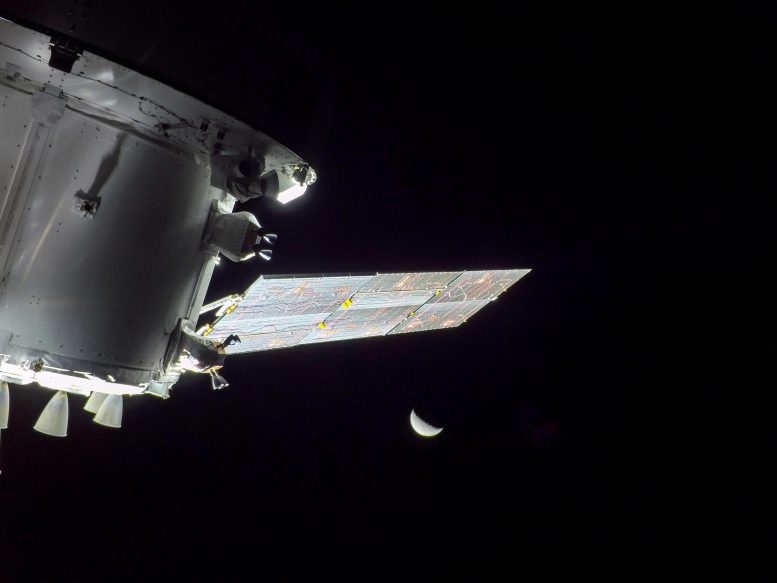
    European Service Module Solar Panels and Moon
    View of the Moon seen from ESA’s European Service Module that is powering NASA’s Orion spacecraft to the Moon and back, on flight day nine of the Artemis I mission, on November 24, 2022. At the time the spacecraft was en route to a distant retrograde orbit around the Moon. Credit: NASA

    As Orion continued along a distant retrograde orbit of the Moon on the 12th day of the Artemis I mission, team members conducted another planned test of the star trackers aboard the spacecraft. They also began another reaction control thruster flight test.

    Engineers hope to characterize the alignment between the star trackers and the Orion inertial measurement units by exposing different areas of the spacecraft to the Sun and activating the star trackers in different thermal states. Both of these are part of the guidance, navigation, and control system. Star trackers are navigation tools that measure the positions of stars to help the spacecraft determine its orientation. The inertial measurement units contain three devices, called gyros, used to measure spacecraft body rotation rates, and three accelerometers used to measure spacecraft accelerations.

    Together, the star tracker and inertial measurement unit data are used by Orion’s vehicle management computers to compute spacecraft position, velocity, and attitude. The measurements will help engineers understand how thermal states affect the accuracy of the navigation state, which ultimately affects the amount of propellant needed for spacecraft maneuvers. Read more about Orion’s guidance, navigation, and control system in the Artemis I reference guide.
    Orion and European Service Module Orbiting Moon
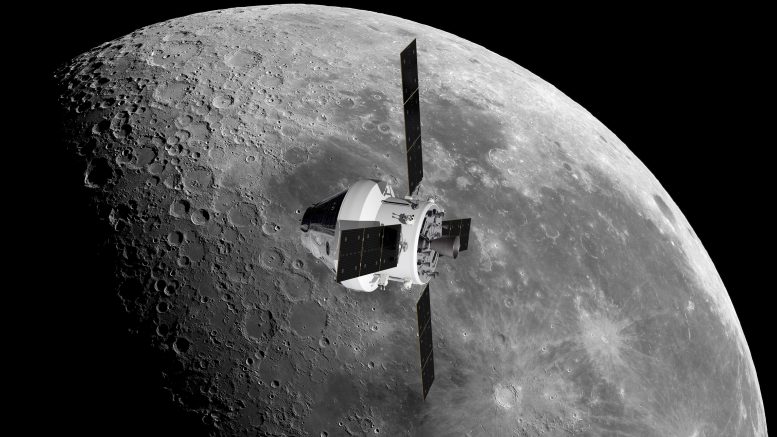
    Artist’s impression of Orion over the Moon. Orion is NASA’s next spacecraft to send humans into space. It is designed to send astronauts further into space than ever before, beyond the Moon to asteroids and even Mars. Credit: NASA/ESA/ATG Medialab

    Engineers began a development flight test objective today that changed the minimum jet firing time for the reaction control thrusters over a period of 24 hours. This test objective is designed to exercise the reaction control system jets in a different configuration to model how thruster jets will be used for the crewed Artemis II mission.

    Teams also activated and interacted with the Callisto payload, a technology demonstration from Lockheed Martin in collaboration with Amazon and Cisco. Callisto is located in the Orion cabin and will test voice activated and video technology in the deep space environment.

    Monday, November 28, Orion will reach its farthest distance from Earth when it is nearly 270,000 miles (435,000 km) from our home planet.

    As of 4:30 p.m. CST, Orion was over 264,000 miles (425,000 km) from Earth and 45,600 miles (73,400 km) from the Moon, cruising at 1,750 miles (2,800 km) per hour.

    To follow the mission real-time, you can track Orion during its mission around the Moon and back, and check the NASA TV schedule for updates on the next televised events.

    Never miss a breakthrough: Join the SciTechDaily newsletter.
    Follow us on Google and Google News.

    ARTEMIS Mission NASA Orion Spacecraft
    Share. Facebook Twitter Pinterest LinkedIn Email Reddit

    Related Articles

    NASA’s Super Guppy Arrives in California With Key Component for Artemis Moon Mission

    One Step Closer: Orion Spacecraft Stacked on Top SLS Rocket for NASA’s Artemis I Mission

    A European Push to the Moon and Beyond

    Artemis I: NASA’s Bold Plans to Travel Beyond the Moon [Video]

    Welding Underway on Orion Crew Module for First Artemis Mission Landing Astronauts on the Moon

    Orion Spacecraft Ready to Fuel Up for NASA’s Artemis I Mission Beyond the Moon

    NASA Selects New Orion Program Manager: Catherine Koerner

    Orion Spacecraft Passes Tests – Ready for Final Artemis I Launch Preparations

    Orion Spacecraft Returns to Kennedy Space Center for Final Preparations Before Artemis I Launch

    Leave A Reply Cancel Reply

    • Facebook
    • Twitter
    • Pinterest
    • YouTube

    Don't Miss a Discovery

    Subscribe for the Latest in Science & Tech!

    Trending News

    Breakthrough Bowel Cancer Trial Leaves Patients Cancer-Free for Nearly 3 Years

    Natural Compound Shows Powerful Potential Against Rheumatoid Arthritis

    100,000-Year-Old Neanderthal Fossils in Poland Reveal Unexpected Genetic Connections

    Simple “Gut Reset” May Prevent Weight Gain After Ozempic or Wegovy

    2.8 Days to Disaster: Scientists Warn Low Earth Orbit Could Suddenly Collapse

    Common Food Compound Shows Surprising Power Against Superbugs

    5 Simple Ways To Remember More and Forget Less

    The Atomic Gap That Could Cost the Semiconductor Industry Billions

    Follow SciTechDaily
    • Facebook
    • Twitter
    • YouTube
    • Pinterest
    • Newsletter
    • RSS
    SciTech News
    • Biology News
    • Chemistry News
    • Earth News
    • Health News
    • Physics News
    • Science News
    • Space News
    • Technology News
    Recent Posts
    • Powerful Antioxidant Found To Play a Key Role in Proper Protein Folding
    • MIT Laser Breakthrough Lets Scientists Watch Drugs Enter the Brain in Real Time
    • Study Reveals Malaria’s Hidden Role in Human Evolution
    • Scientists Print Artificial Neurons That Can Talk to the Brain
    • Bowel and Ovarian Cancers Are Dramatically Rising in Young Adults and Scientists Aren’t Sure Why
    Copyright © 1998 - 2026 SciTechDaily. All Rights Reserved.
    • Science News
    • About
    • Contact
    • Editorial Board
    • Privacy Policy
    • Terms of Use

    Type above and press Enter to search. Press Esc to cancel.