
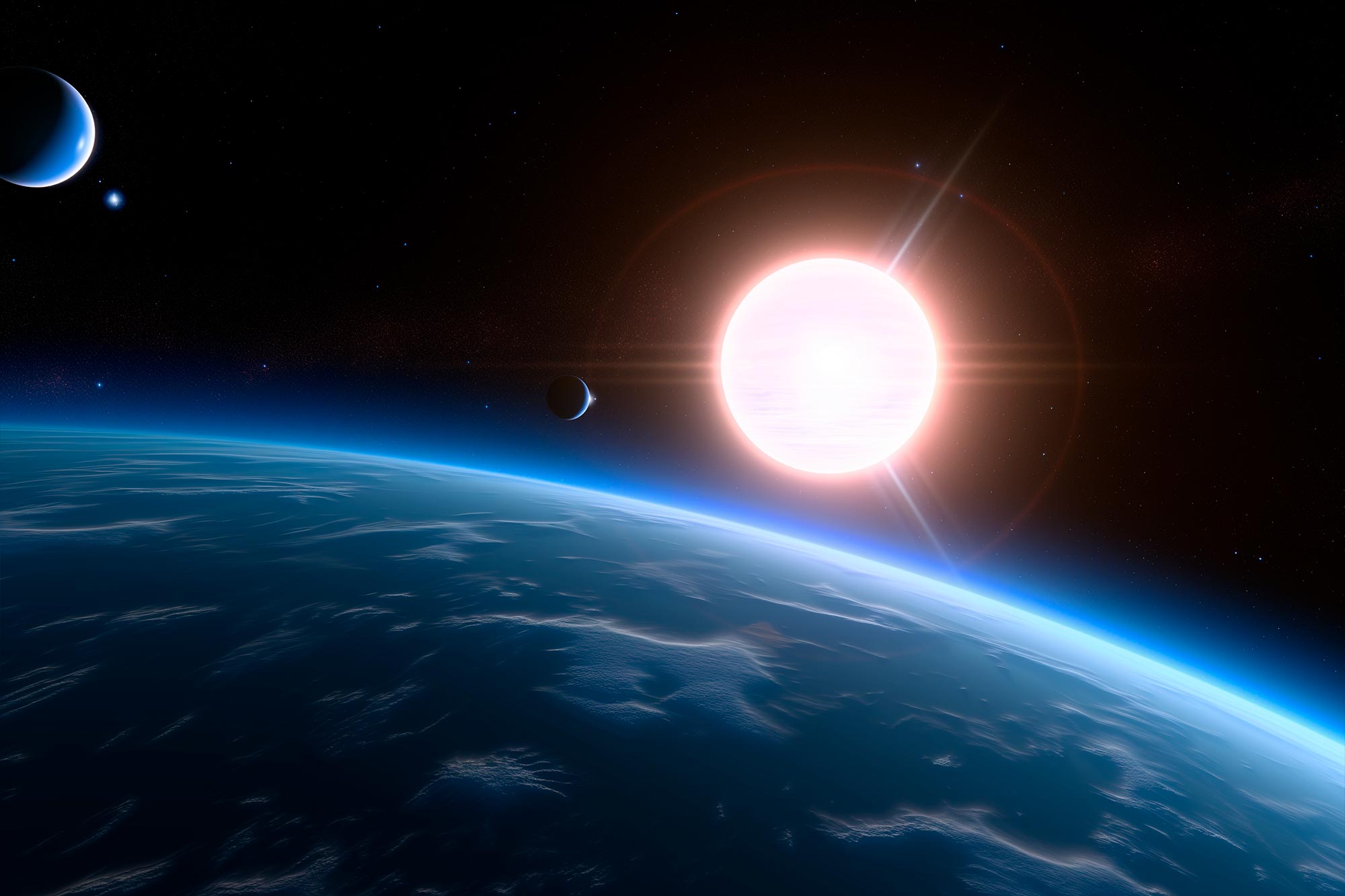
Steamy World Could Be a Sample of Water-Rich Planets Throughout Our Galaxy
The search for life in space goes hand-in-hand with the search for water on planets around other stars. Water is one of the most common molecules in the universe, and all life on Earth requires it. Water functions as a solvent by dissolving substances and enabling key chemical reactions in animal, plant, and microbial cells. It is much better at this than other liquids.
Astronomers are intrigued when finding evidence of water vapor on exoplanets. A recent target is the planet GJ 9827d, which may have a water-rich atmosphere around it. No bigger than twice Earth’s diameter, the planet could be an example of potential water-rich worlds elsewhere in our galaxy. But don’t plan on buying real estate on GJ 9827d. The planet is as hot as Venus, at 800 degrees Fahrenheit. This makes it a steamy world.
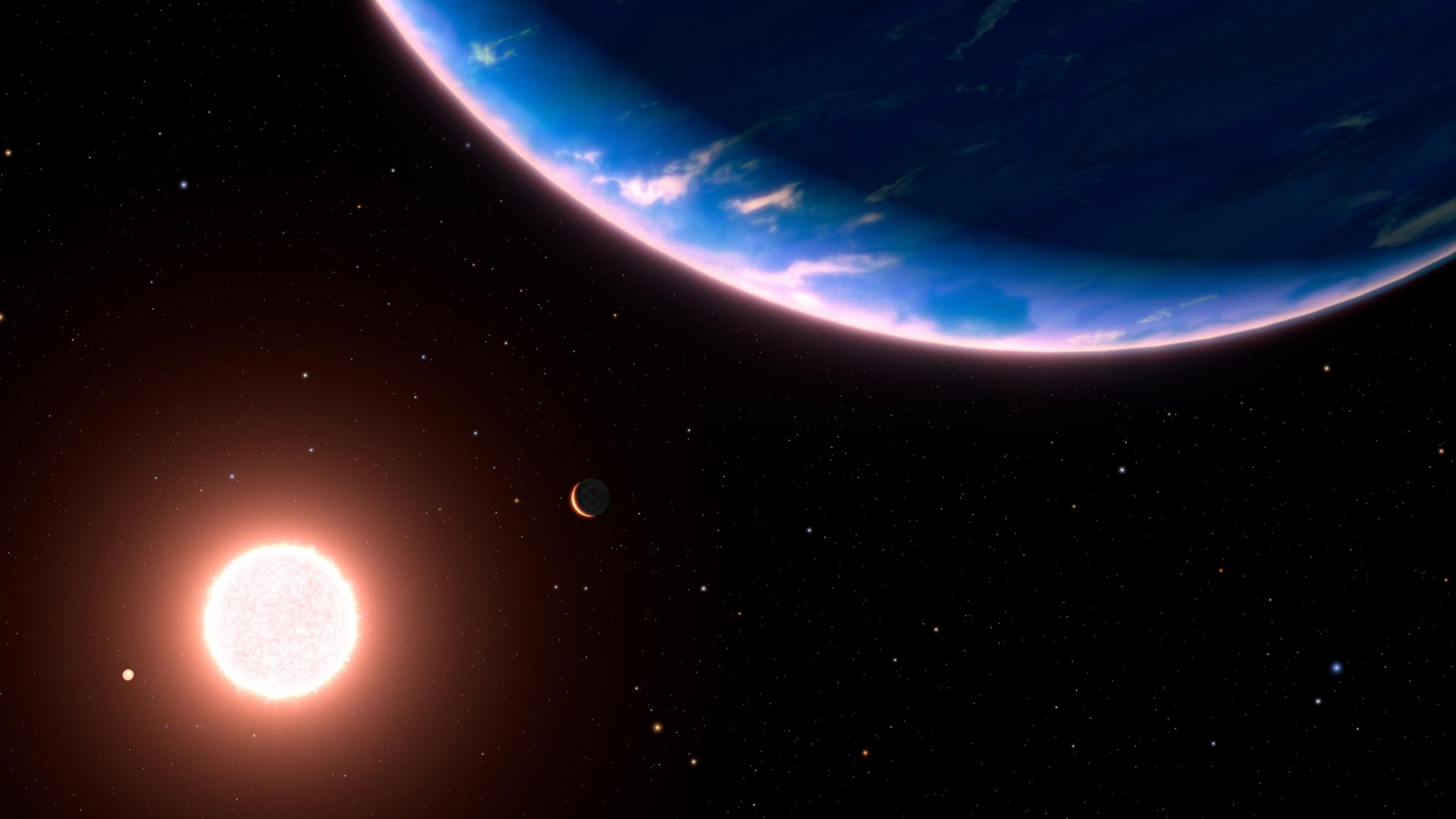
Hubble Space Telescope Finds Water Vapor in Small Exoplanet’s Atmosphere
Astronomers using NASA’s Hubble Space Telescope observed the smallest exoplanet where water vapor has been detected in the atmosphere. At only approximately twice Earth’s diameter, the planet GJ 9827d could be an example of potential planets with water-rich atmospheres elsewhere in our galaxy.
“This would be the first time that we can directly show through an atmospheric detection, that these planets with water-rich atmospheres can actually exist around other stars,” said team member Björn Benneke of the Trottier Institute for Research on Exoplanets at Université de Montréal. “This is an important step toward determining the prevalence and diversity of atmospheres on rocky planets.”
“Water on a planet this small is a landmark discovery,” added co-principal investigator Laura Kreidberg of Max Planck Institute for Astronomy in Heidelberg, Germany. “It pushes closer than ever to characterizing truly Earth-like worlds.”
Investigating the Planet’s Atmosphere
However, it remains too early to tell whether Hubble spectroscopically measured a small amount of water vapor in a puffy hydrogen-rich atmosphere, or if the planet’s atmosphere is mostly made of water, left behind after a primeval hydrogen/helium atmosphere evaporated under stellar radiation.
“Our observing program, led by principal investigator Ian Crossfield of Kansas University in Lawrence, Kansas, was designed specifically with the goal to not only detect the molecules in the planet’s atmosphere, but to actually look specifically for water vapor. Either result would be exciting, whether water vapor is dominant or just a tiny species in a hydrogen-dominant atmosphere,” said the science paper’s lead author, Pierre-Alexis Roy of the Trottier Institute for Research on Exoplanets at Université de Montréal.
“Until now, we had not been able to directly detect the atmosphere of such a small planet. And we’re slowly getting in this regime now,” added Benneke. “At some point, as we study smaller planets, there must be a transition where there’s no more hydrogen on these small worlds, and they have atmospheres more like Venus (which is dominated by carbon dioxide).”
Because the planet is as hot as Venus, at 800 degrees Fahrenheit, it definitely would be an inhospitable, steamy world if the atmosphere were predominantly water vapor.
Implications and Future Research
At present the team is left with two possibilities. One scenario is that the planet is still clinging to a hydrogen-rich atmosphere laced with water, making it a mini-Neptune. Alternatively, it could be a warmer version of Jupiter’s moon Europa, which has twice as much water as Earth beneath its crust. “The planet GJ 9827d could be half water, half rock. And there would be a lot of water vapor on top of some smaller rocky body,” said Benneke.
If the planet has a residual water-rich atmosphere, then it must have formed farther away from its host star, where the temperature is cold and water is available in the form of ice, than its present location. In this scenario, the planet would have then migrated closer to the star and received more radiation. The hydrogen was heated and escaped, or is still in the process of escaping the planet’s weak gravity. The alternative theory is that the planet formed close to the hot star, with a trace of water in its atmosphere.
The Hubble program observed the planet during 11 transits—events in which the planet crossed in front of its star—that were spaced out over three years. During transits, starlight is filtered through the planet’s atmosphere and has the spectral fingerprint of water molecules. If there are clouds on the planet, they are low enough in the atmosphere so that they don’t completely hide Hubble’s view of the atmosphere, and Hubble is able to probe water vapor above the clouds.
“Observing water is a gateway to finding other things,” said Thomas Greene, astrophysicist at NASA’s Ames Research Center in California’s Silicon Valley. “This Hubble discovery opens the door to future study of these types of planets by the James Webb Space Telescope. JWST can see much more with additional infrared observations, including carbon-bearing molecules like carbon monoxide, carbon dioxide, and methane. Once we get a total inventory of a planet’s elements, we can compare those to the star it orbits and understand how it was formed.”
GJ 9827d was discovered by NASA’s Kepler Space Telescope in 2017. It completes an orbit around a red dwarf star every 6.2 days. The star, GJ 9827, lies 97 light-years from Earth in the constellation Pisces.
Reference: “Water Absorption in the Transmission Spectrum of the Water World Candidate GJ 9827 d” by Pierre-Alexis Roy, Björn Benneke, Caroline Piaulet, Michael A. Gully-Santiago, Ian J. M. Crossfield, Caroline V. Morley, Laura Kreidberg, Thomas Mikal-Evans, Jonathan Brande, Simon Delisle, Thomas P. Greene, Kevin K. Hardegree-Ullman, Travis Barman, Jessie L. Christiansen, Diana Dragomir, Jonathan J. Fortney, Andrew W. Howard, Molly R. Kosiarek and Joshua D. Lothringer, 12 September 2023, The Astrophysical Journal Letters.
DOI: 10.3847/2041-8213/acebf0
The Hubble Space Telescope is a project of international cooperation between NASA and ESA. NASA’s Goddard Space Flight Center in Greenbelt, Maryland, manages the telescope. The Space Telescope Science Institute (STScI) in Baltimore, Maryland, conducts Hubble and Webb science operations. STScI is operated for NASA by the Association of Universities for Research in Astronomy, in Washington, D.C.
Never miss a breakthrough: Join the SciTechDaily newsletter.
Follow us on Google and Google News.
3 Comments
It seems to me that all stars and Planets will grow larger with elapsed time, so the
Habitability zone move outward away from the star, so Each Planet in turn will have its
period of time when it could have life forms on its surface. Because Stars grow faster than planets, the Habitability zone moves away from the star faster than the Planets move away from the star. This would imply the Venus was once Habitable, then it was Earth’s turn and eventually it will be Mars turn to become Habitable.
None.
To the person who mentioned Venus: It is within that range known as the habitable zone, still. The extreme high temperature conditions there are almost certainly attributable to the runaway greenhouse effect – not its position. Temperatures on Venus are higher than in Mercury, even though the latter is significantly closer to our solar system’s star.