
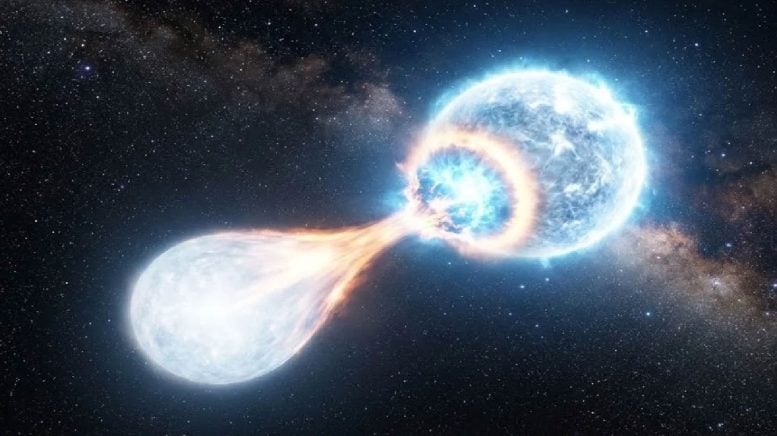
A pair of white dwarfs race around each other every 374 seconds, creating a rhythmic X-ray beacon that could reveal powerful gravitational waves.
Every 6.2 minutes, two dead stars complete an entire orbit around each other.
The system, eRASSU J060839.5–704014, or eRASSU J0608, is so compact that material from one white dwarf appears to strike the other directly, producing a strong X-ray pulse on every orbit. Astronomers have now found that the orbit is also shrinking unusually fast, making the system a promising target for future gravitational wave observatories.
A Six-Minute Stellar Orbit
eRASSU J0608 was discovered in eROSITA observations in the direction of the Large Magellanic Cloud. Follow-up data from NICER, Einstein Probe, and XMM-Newton showed that its 374-second X-ray cycle comes from two white dwarfs in an ultracompact orbit.
The stars are so close that transferred material appears to hit one white dwarf directly instead of forming an accretion disk. This rare setup, known as direct-impact accretion, helps explain the system’s sharply pulsed X-rays.
The Orbit Is Shrinking
Using observations spanning about 3.5 years, researchers measured an orbital period of 374.15013 seconds and found that it is decreasing faster than in HM Cnc and V407 Vul, two well-known systems of the same general type.
The decline is consistent with energy and angular momentum being carried away by gravitational waves. The inferred “chirp mass” is about 0.43 solar masses, placing eRASSU J0608 among the more massive known binaries in this class.
A Strong LISA Candidate
Its short orbit produces gravitational waves at roughly 5.3 millihertz, well below the range of current ground-based detectors but suited to future space observatories such as LISA.
The main unknown is distance. The system lies in the direction of the Large Magellanic Cloud, but astronomers do not yet know whether it is actually that far away. If it is close enough, LISA could detect its gravitational waves directly.
Because its orbit can already be tracked precisely with X-ray telescopes, eRASSU J0608 could become a valuable gravitational wave “verification source,” giving astronomers a signal they can predict before a future detector measures it.
Reference: “Rapid Orbital Decay in the Ultracompact Double-degenerate Binary eRASSU J060839.5–704014” by Rahul Sharma, Chandreyee Maitra, Frank Haberl, Joheen Chakraborty, Susanne Friedrich, Yong-Feng Huang, Chichuan Jin, Zhaosheng Li, Georgios Vasilopoulos, Yanjun Xu, Haonan Yang and Weimin Yuan, 10 August 2026, The Astrophysical Journal Letters.
DOI: 10.3847/2041-8213/ae8cf7
Never miss a breakthrough: Join the SciTechDaily newsletter.
Follow us on Google and Google News.
1 Comment
Lost*
Not Dead