
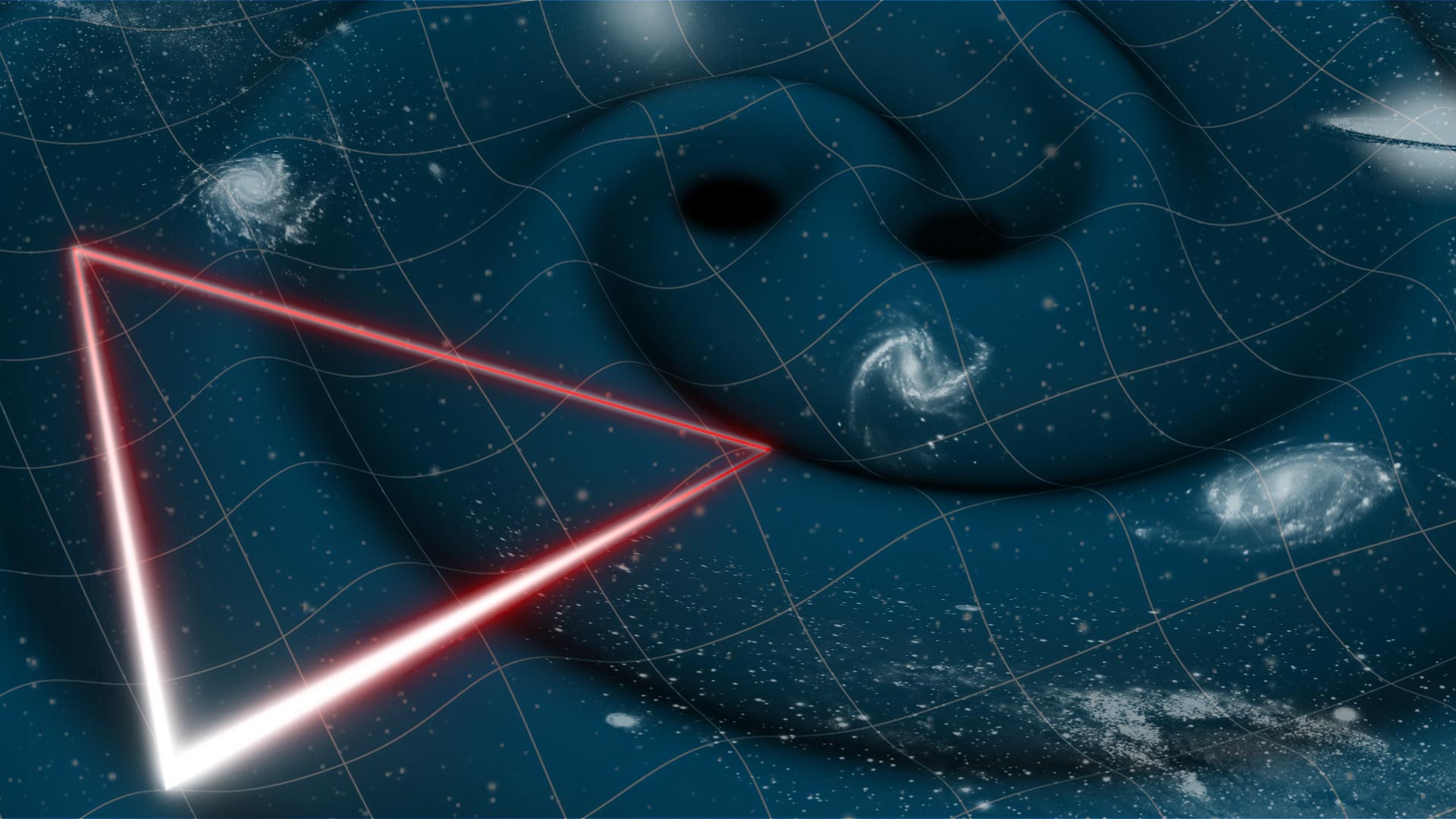
Nijmegen master’s students predict that LISA, an upcoming space antenna project by the ESA, will detect stronger gravitational waves from white dwarfs than from black holes. This finding could enhance our understanding of star evolution in distant galaxies.
Gravitational waves from orbiting white dwarf stars are predicted to create background noise even stronger than that from binary black holes, according to two scientific publications by two Nijmegen master’s students and their supervisor. This surprising discovery anticipates findings from the upcoming LISA space mission, which had not initially factored in the “noise” from white dwarfs. Fortunately, this noise can be filtered out, potentially revealing new information about these stars.
The Laser Interferometer Space Antenna (LISA), scheduled for launch by the European Space Agency (ESA) in the mid-2030s, will be a powerful tool for studying gravitational waves from various cosmic sources, including compact binary stars, double white dwarfs, supermassive black holes, and other exotic objects in the universe. The Netherlands plays a major role in developing LISA’s components, such as its “eyes,” software, guidance systems, and readout electronics. In addition to primary observations, LISA will detect background noise from billions of ancient, merged black holes.
Innovations in Gravitational Wave Models
Gijs Nelemans is an astronomer at Radboud University (Nijmegen, the Netherlands). He is involved in the Dutch contribution to LISA. Together with now-graduated master students Seppe Staelens and Sophie Hofman, he developed models to see if the background noise of white dwarfs could be captured in the same way as the background noise of black holes.
Staelens, who came to Nijmegen as an exchange student from Leuven and is now a Ph.D. student at Cambridge, started with simple models. Hofman, who has just graduated and is doing a traineeship in industry, then expanded the models.
Stellar Evolution Insights Through LISA
The models showed that the background noise from white dwarfs is stronger than that from black holes. “Our supervisor thought that LISA would never be able to detect the collective signal from white dwarfs,” says Staelens. “And now our models show that the white dwarfs are dwarfing the black holes. Ha!”
Astronomers see the background noise of white dwarfs as an opportunity to study the evolution of stars like our Sun in distant galaxies. “With telescopes, you can only study white dwarfs in our own Milky Way, but with LISA we can listen to white dwarfs from other galaxies,” says Nelemans. “Moreover, in addition to the background noise of black holes and the noise of white dwarfs, perhaps other exotic processes from the early universe can be detected.”
Hofman adds: “I think it’s really cool that with my master’s research, we’re contributing to the expected discoveries of such an important mission as LISA.”
References:
“Uncertainty of the white dwarf astrophysical gravitational wave background” by Sophie Hofman and Gijs Nelemans, 21 October 2024, Astronomy & Astrophysics.
DOI: 10.1051/0004-6361/202451510
“Likelihood of white dwarf binaries to dominate the astrophysical gravitational wave background in the mHz band” by Seppe Staelens and Gijs Nelemans, 15 March 2024, Astronomy & Astrophysics.
DOI: 10.1051/0004-6361/202348429
Never miss a breakthrough: Join the SciTechDaily newsletter.
Follow us on Google and Google News.