
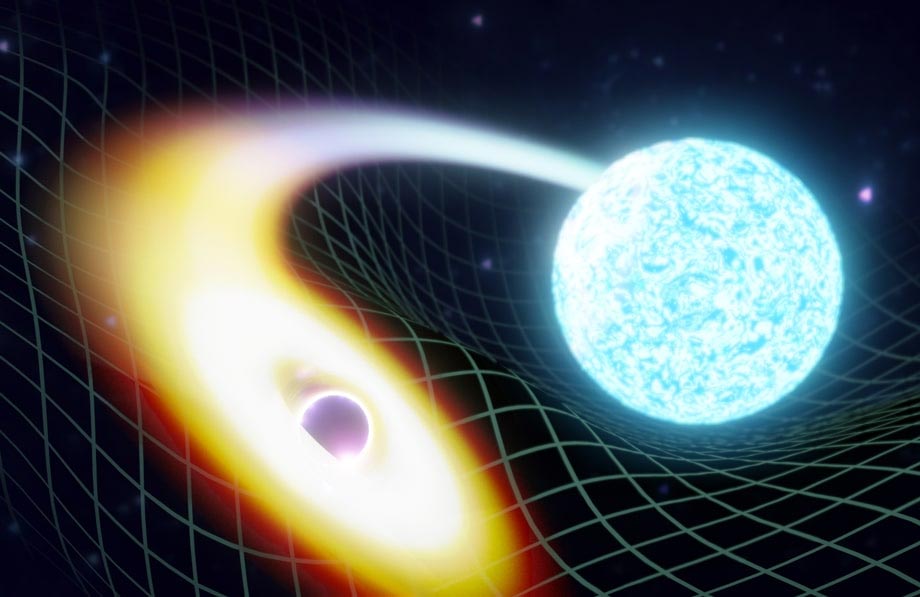
Researchers have detected, for the first time, gravitational waves from mergers between a neutron star and a black hole.
Two gravitational wave signals from an entirely new class of cosmic collisions have been discovered by researchers working on the Advanced LIGO and Advanced Virgo detectors. Each of the signals came from the merger of a black hole with a neutron star.
The first signal was first detected on January 5, 2020. Astoundingly, just 10 days later, the gravitational waves from a second neutron star-black hole binary merger were observed. A paper describing the findings was published on June 29, 2021, in The Astrophysical Journal Letters.
Previously, Advanced LIGO and Virgo had observed more than 50 signals from the merger of pairs of black holes and pairs of neutron stars, but never before from a mixed pair. Although neutron star-black hole binaries have been one of the most exciting theoretical predictions from astrophysicists for many decades, they have eluded observational efforts until now.
Dr. Geraint Pratten, a member of the LIGO Team at the Institute for Gravitational Wave Astronomy in Birmingham, worked on producing a theoretical model of this anticipated event. He said: “Neutron star-black hole binaries are one of the final pieces of the puzzle that we had yet to observe. We now have convincing observational evidence of this event and to see my theoretical model for the observed gravitational waves play a key role in the analysis is a really special moment.”
The first of the two new observations, GW200105, resulted from the merger of a black hole 8.9 times the mass of the sun with a neutron star 1.9 times the mass of the sun. The second observation, GW200115, was a slightly lighter system, consisting of two objects with masses 5.6 and 1.5 times the mass of the sun.
New Avenues for Astrophysics and Stellar Evolution
“With these extraordinary discoveries gravitational-wave astronomy has reached yet another milestone,” said Dr. Patricia Schmidt, Lecturer at the Institute for Gravitational Wave Astronomy. “These detections have strong repercussions for our understanding of the formation of such mixed binaries and the role they potentially play as a source of gamma-ray bursts.”
These highly energetic flashes of light were, however, not observed for these events. This is not surprising as the black holes were significantly heavier than the neutron stars in both systems, and therefore no significant shedding of matter from the neutron star that could light up these gamma-ray bursts would be expected. Additionally, astronomers from around the globe would have had a tough job discovering them: the distance to the systems combined with the gravitational wave instruments’ limited ability to precisely identify the sources’ location in the sky made it particularly difficult for telescopes to monitor the area from which such a burst could have come.
With these new detections, astrophysicists can seriously start to get their teeth into the many possible ways in which stars evolve, pair up and eventually form these kinds of systems.
A Window into the Lives of “Impossible Couples”
“These are the impossible couples,” said Riccardo Buscicchio, a PhD student in the Birmingham LIGO team. “Pictured in one of their last dances, their families are always divided by boundaries: with one too heavy for the other. On one side the black holes: dangerous, attractive, dark souls. It’s all or nothing, with them. You either let yourself go or they will tear you apart. On the other side neutron stars: very bright at times, crusty on the surface, but they could hide a soft, gentle spirit.”
Lucy Thomas, a PhD student working on LIGO observations at the Institute for Gravitational Wave Astronomy in Birmingham, wonders: “How squishy are the neutron stars? How and where do mixed binaries like this form?” This is just the beginning of the search for answers. Studying these binaries will keep Lucy Thomas and Natalie Williams, both PhD students at Birmingham, busy during their studies: “By studying these mergers and hearing the final cries of a neutron star before it plunges into a black hole, we can start piecing together theoretical predictions with real observations and solve the many mysteries surrounding these exotic objects,” says Natalie.
LIGO and Virgo are scheduled to resume science observations in about a year, after a commissioning break to further improve their sensitivity. “When we started observing in 2015, I was convinced it would take till the 2020s to observe even a single gravitational wave,” says Alberto Vecchio, Director of the Institute for Gravitational Wave Astronomy at Birmingham. “Six years later, we have observed many of the different kinds of binary systems astrophysicists have predicted: for once, it’s very pleasing to be proven so spectacularly wrong. With even better instruments starting to listen to the sky again next year, I think we are now on the hook to discover something completely unexpected. I’ll stick my neck out: it’ll take more than a decade. Of course, I’m looking forward to be wrong once more.”
For more on this research:
- A New Type of Cataclysmic Event in the Cosmos: Astrophysicists Detect First Black Hole-Neutron Star Mergers
- The Final Dance of Mixed Neutron Star-Black Hole Pairs: A New Type of Cataclysmic Event in the Cosmos
- Gravitational-Wave Observatories Detect Rare Mergers of Black Holes With Neutron Stars for the First Time
Reference: “Observation of Gravitational Waves from Two Neutron Star–Black Hole Coalescences” by R. Abbott, T. D. Abbott, S. Abraham, F. Acernese, K. Ackley, A. Adams, C. Adams, R. X. Adhikari, V. B. Adya, C. Affeldt […] A. B. Zimmerman, Y. Zlochower, M. E. Zucker, J. Zweizig and the LIGO Scientific Collaboration, the Virgo Collaboration, and the KAGRA Collaboration, 29 June 2021, The Astrophysical Journal Letters.
DOI: 10.3847/2041-8213/ac082e
Never miss a breakthrough: Join the SciTechDaily newsletter.
Follow us on Google and Google News.