
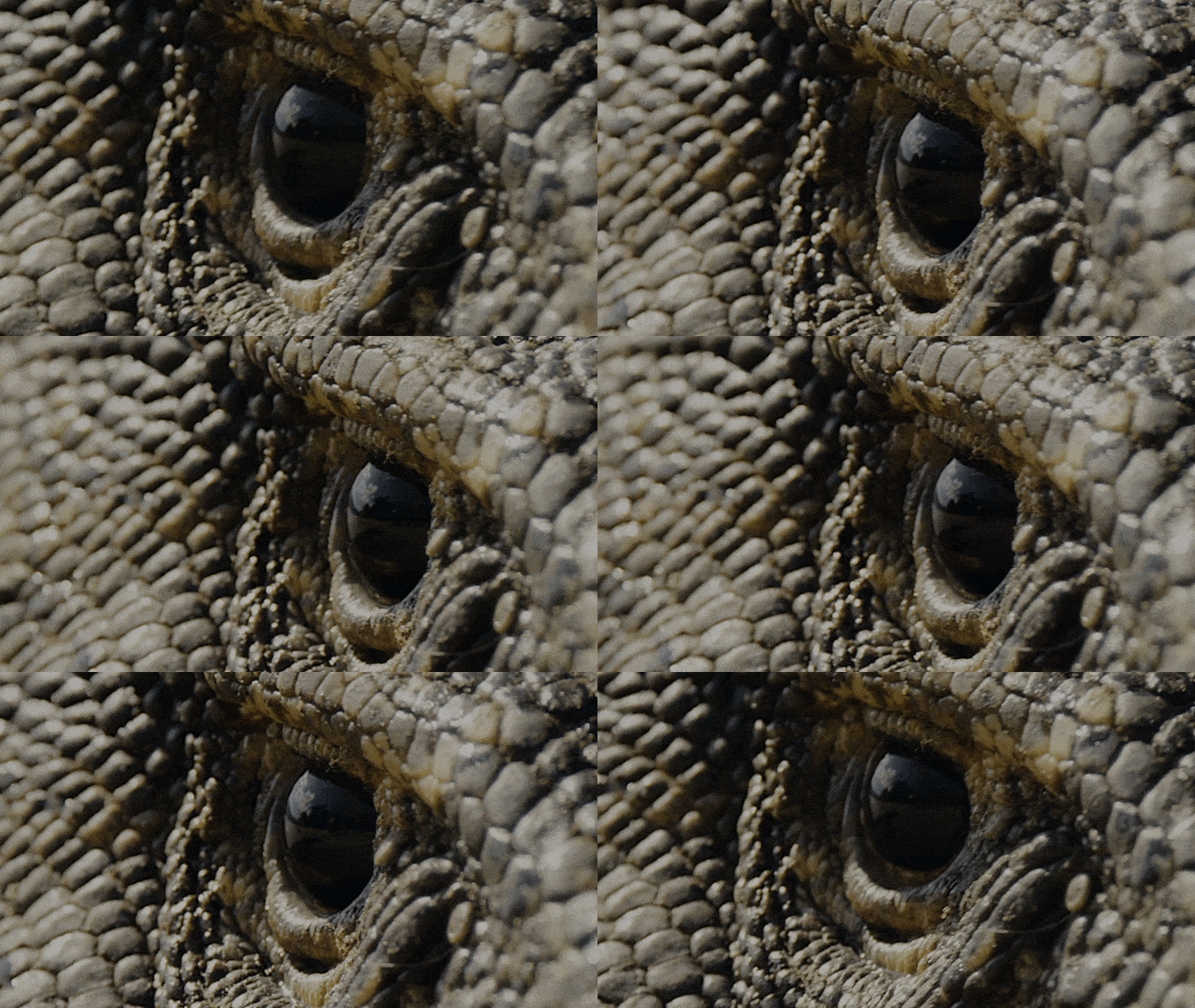
Researchers at Lund University found that visual perspective taking, the cognitive ability to follow an obstructed gaze, originated in the dinosaur lineage about 60 million years before appearing in mammals. This finding challenges the notion that complex cognition evolved primarily in mammals and highlights the cognitive abilities of birds and their dinosaur ancestors.
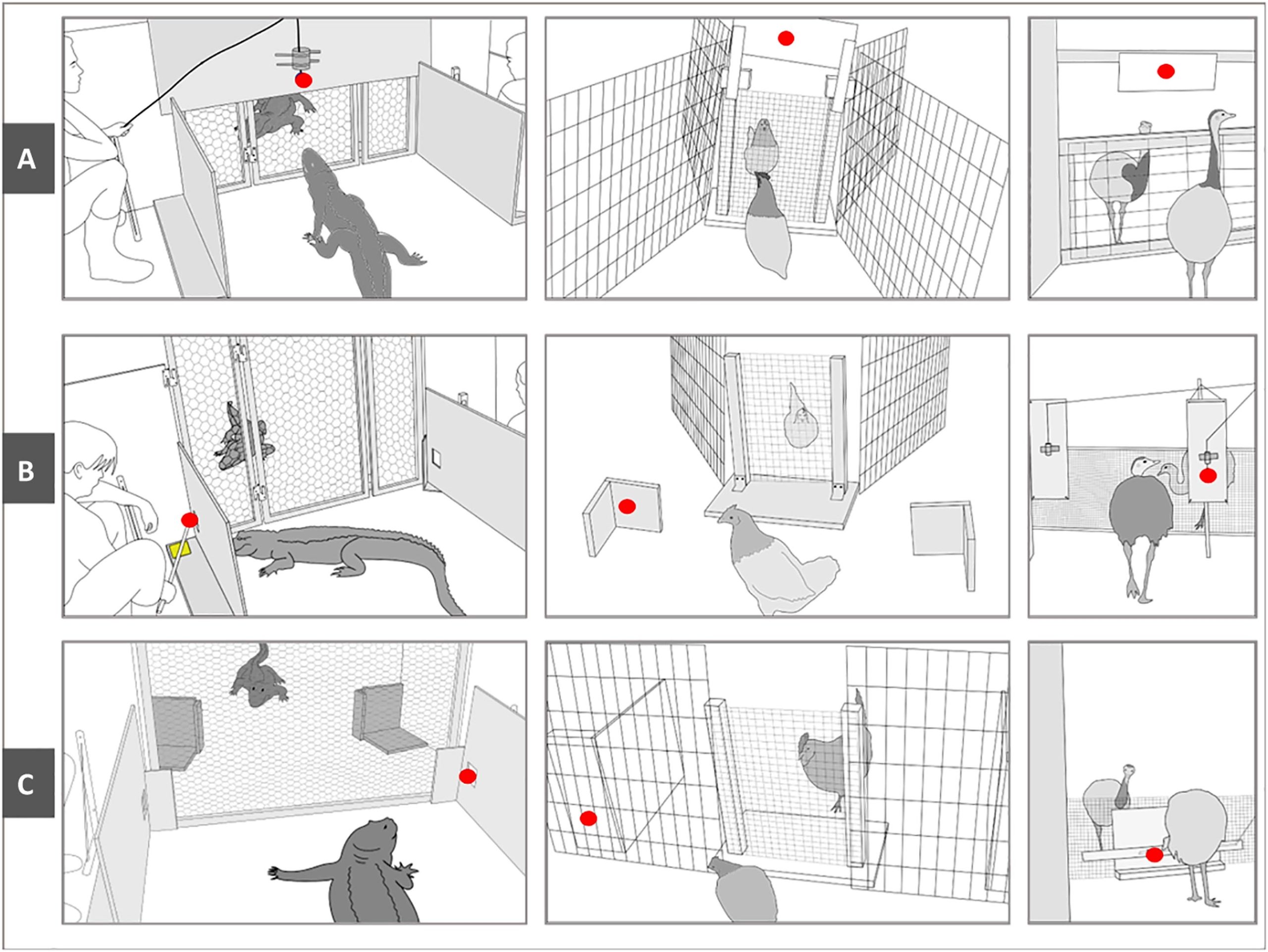
When someone near you turns their head towards something in the environment, you likely can’t help to follow their gaze direction. This reaction is observed in mammals, birds, and even reptiles alike. It’s an effective way to gather information about what caught the attention of your fellow, which you might otherwise have missed. However, a far more advanced behavior is to follow someone’s gaze to a location that is initially obstructed from your view. By repositioning yourself to see what the other person is looking at, you demonstrate an understanding that the other has a different perspective. This ability, known as visual perspective taking develops in children between the ages of one-and-a-half to two years and serves as the foundation for later comprehending referential communication and that others have minds that differ from your own.
Visual perspective taking has, to date, only been found in very few species. Mainly in apes and some monkeys, but also in dogs and crow birds. However, there is limited knowledge regarding the evolutionary origins of this crucial social skill. A team of researchers from Lund University aimed to investigate a potential early emergence of visual perspective taking in dinosaurs. Through a comparison of alligators with the most primitive existing birds, known as palaeognaths, they discovered that visual perspective taking originated in the dinosaur lineage likely 60 million years, or more, prior to its appearance in mammals.
Investigating Dinosaurs’ Social Skills
Crocodilians are the closest living relatives to birds. Their neuroanatomy has remained largely unchanged for hundreds of millions of years, and is similar to that of the common ancestor of dinosaurs and crocodilians. Palaeognath birds comprise the ostrich birds, such as emus and rheas, but also the flighted tinamous. Their brains are in large parts comparable to their forebearers, the non-avian paravian dinosaurs, which feature such celebrities as the velociraptors. Comparing these two groups of animals creates a bracket around the extinct lineage of dinosaurs leading up to modern birds.
The study revealed that alligators do not demonstrate visual perspective taking, although they do follow gaze to a visible location. In contrast, all tested bird species exhibited visual perspective taking. Additionally, the birds engaged in a behavior called “checking back,” where the observer looks back into the eyes of the gazer, and re-tracks the gaze, when unable to find anything in the direction of their gaze the first time. This behavior indicates an expectation that the gaze is referring to a target in the environment. Previously, this has only been observed in humans, apes and monkeys, and ravens.
Evolutionary Origins of Perspective Taking
Palaeognath birds emerged 110 million years ago, predating the two mammal groups endowed with visual perspective taking – primates and dogs – with 60 million years. Considering the neuroanatomical similarities between these birds and their non-avian forebearers, it is plausible that the skill originated even earlier in the dinosaur lineage. However, it is less likely to have been present among the earliest dinosaurs, which had more alligator-like brains. Maybe future research will show the ability to be more widespread among mammals than currently known, but even if that would be the case it will most probably still be predated by the dinosaur origin. Nevertheless, it is not surprising that visual perspective taking emerged earlier in the dinosaurs, which include the birds, given their superior vision compared to most mammals, that historically relied on nocturnal adaptations. It was only with the emergence of the primates and certain carnivores that our visual capabilities improved.
This is yet another finding that calls into question the prevailing view that mammals drove the evolution of complex cognition, and that they are the cognitive yardstick to which other animals should be compared. An increasing number of studies show the remarkable neurocognition of the avian dinosaurs, the birds, which might prompt a rethinking of the natural history of cognition.
Comments from the authors:
Senior author, prof. Mathias Osvath:
“Early in my career, crow birds earned the nickname “feathered apes,” due to numerous research findings that showcased their remarkable cognition. However, I’m beginning to question whether it would be more fitting to consider primates as honorary birds.”
First author (then PhD-student), Dr. Claudia Zeiträg:
“Birds are commonly being overlooked when it comes to their cognitive skills. Our findings show that they do not only have several cognitive skills on par with those of apes, but that their forebearers most likely had these skills long before they evolved in mammals.”
Middle author, Dr. Stephan Reber:
“Crocodilians are ideal models to study the evolutionary origins of cognitive capacities in birds. What they share most probably existed in the common ancestor of dinosaurs and crocodilians. If crocodilians lack an ability birds possess, it likely evolved in the dinosaur lineage after the split. This approach allows us to study the cognition of extinct species.”
Reference: “Gaze following in Archosauria—Alligators and palaeognath birds suggest dinosaur origin of visual perspective taking” by Claudia Zeiträg, Stephan A. Reber and Mathias Osvath, 19 May 2023, Science Advances.
DOI: 10.1126/sciadv.adf0405
Never miss a breakthrough: Join the SciTechDaily newsletter.
Follow us on Google and Google News.
4 Comments
How many dinosaurs did the researchers interview?
They interview the most advance dinosaur ever the alligator the mesoeucrocodylia dinosaur the great spinosauridae dinosaur .birds are not dinosaur I know because I am going to writer 4 new evidence utahraptor had a occified sternum ancestor
This article is replete with conjectural phrases such as “most likely”, ‘most probably”, and “it likely”. It, therefore, has no scientific validity. Rather, it is more in the realm of fairy tale.
I see my cat demonstrating complex cognition, with me or her companion cat. I look out the window, and she looks too [cannot rule out hearing], but moves to get a better view, often on my shoulder. Same with the other cat – she follows his gaze, and then moves if she doesn’t have a good view.
Someone should assess cats – in comfortable circumstances, not the cage and run kind of management, because all cat owners know they simple shut down if treated that way.