
Faulty versions of the Foxp2 gene disrupt neurons’ ability to form synapses in brain regions involved in speech, a new study shows.
Mutations of a gene called Foxp2 have been linked to a type of speech disorder called apraxia that makes it difficult to produce sequences of sound. A new study from MIT and National Yang Ming Chiao Tung University sheds light on how this gene controls the ability to produce speech.
In a study of mice, the researchers found that mutations in Foxp2 disrupt the formation of dendrites and neuronal synapses in the brain’s striatum, which plays important roles in the control of movement. Mice with these mutations also showed impairments in their ability to produce the high-frequency sounds that they use to communicate with other mice.
Those malfunctions arise because Foxp2 mutations prevent the proper assembly of motor proteins, which move molecules within cells, the researchers found.
“These mice have abnormal vocalizations, and in the striatum there are many cellular abnormalities,” says Ann Graybiel, an MIT Institute Professor, a member of MIT’s McGovern Institute for Brain Research, and an author of the paper. “This was an exciting finding. Who would have thought that a speech problem might come from little motors inside cells?”
Fu-Chin Liu PhD ’91, a professor at National Yang Ming Chiao Tung University in Taiwan, is the senior author of the study, which was published on May 4 in the journal Brain. Liu and Graybiel also worked together on a 2016 study of the potential link between Foxp2 and autism spectrum disorder. The lead authors of the new Brain paper are Hsiao-Ying Kuo and Shih-Yun Chen of National Yang Ming Chiao Tung University.
Speech Control
Children with Foxp2-associated apraxia tend to begin speaking later than other children, and their speech is often difficult to understand. The disorder is believed to arise from impairments in brain regions, such as the striatum, that control the movements of the lips, mouth, and tongue. Foxp2 is also expressed in the brains of songbirds such as zebra finches and is critical to those birds’ ability to learn songs.
Foxp2 encodes a transcription factor, meaning that it can control the expression of many other target genes. Many species express Foxp2, but humans have a special form of Foxp2. In a 2014 study, Graybiel and colleagues found evidence that the human form of Foxp2, when expressed in mice, allowed the mice to accelerate the switch from declarative to procedural types of learning.
In that study, the researchers showed that mice engineered to express the human version of Foxp2, which differs from the mouse version by only two DNA base pairs, were much better at learning mazes and performing other tasks that require turning repeated actions into behavioral routines. Mice with human-like Foxp2 also had longer dendrites — the slender extensions that help neurons form synapses — in the striatum, which is involved in habit formation as well as motor control.
In the new study, the researchers wanted to explore how the Foxp2 mutation that has been linked with apraxia affects speech production, using ultrasonic vocalizations in mice as a proxy for speech. Many rodents and other animals such as bats produce these vocalizations to communicate with each other.
While previous studies, including the work by Liu and Graybiel in 2016, had suggested that Foxp2 affects dendrite growth and synapse formation, the mechanism for how that occurs was not known. In the new study, led by Liu, the researchers investigated one proposed mechanism, which is that Foxp2 affects motor proteins.
One of these molecular motors is the dynein protein complex, a large cluster of proteins that is responsible for shuttling molecules along microtubule scaffolds within cells.
“All kinds of molecules get shunted around to different places in our cells, and that’s certainly true of neurons,” Graybiel says. “There’s an army of tiny molecules that move molecules around in the cytoplasm or put them into the membrane. In a neuron, they may send molecules from the cell body all the way down the axons.”
A Delicate Balance
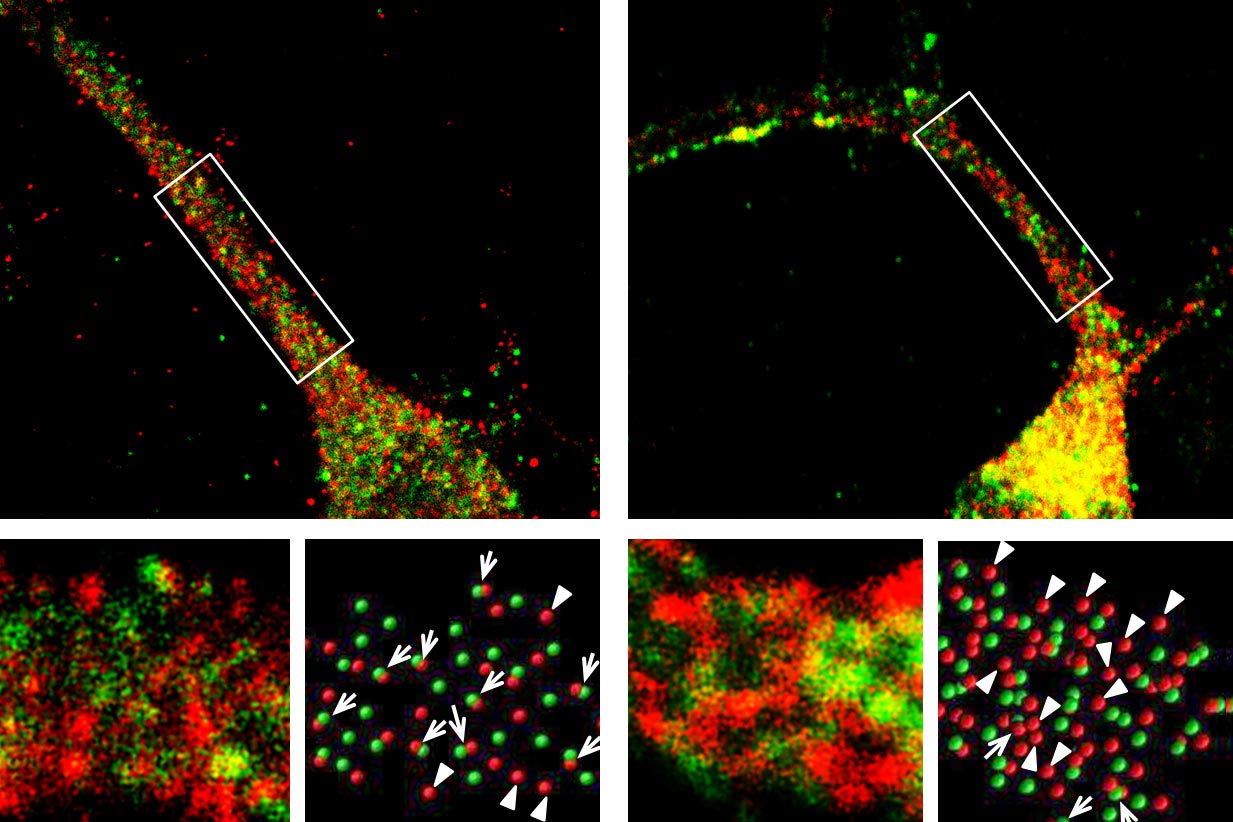
The dynein complex is made up of several other proteins. The most important of these is a protein called dynactin1, which interacts with microtubules, enabling the dynein motor to move along microtubules. In the new study, the researchers found that dynactin1 is one of the major targets of the Foxp2 transcription factor.
The researchers focused on the striatum, one of the regions where Foxp2 is most often found, and showed that the mutated version of Foxp2 is unable to suppress dynactin1 production. Without that brake in place, cells generate too much dynactin1. This upsets the delicate balance of dynein-dynactin1, which prevents the dynein motor from moving along microtubules.
Those motors are needed to shuttle molecules that are necessary for dendrite growth and synapse formation on dendrites. With those molecules stranded in the cell body, neurons are unable to form synapses to generate the proper electrophysiological signals they need to make speech production possible.
Mice with the mutated version of Foxp2 had abnormal ultrasonic vocalizations, which typically have a frequency of around 22 to 50 kilohertz. The researchers showed that they could reverse these vocalization impairments and the deficits in the molecular motor activity, dendritic growth, and electrophysiological activity by turning down the gene that encodes dynactin1.
Mutations of Foxp2 can also contribute to autism spectrum disorders and Huntington’s disease, through mechanisms that Liu and Graybiel previously studied in their 2016 paper and that many other research groups are now exploring. Liu’s lab is also investigating the potential role of abnormal Foxp2 expression in the subthalamic nucleus of the brain as a possible factor in Parkinson’s disease.
Reference: “Speech- and language-linked FOXP2 mutation targets protein motors in striatal neurons” by Hsiao-Ying Kuo, Shih-Yun Chen, Rui-Chi Huang, Hiroshi Takahashi, Yen-Hui Lee, Hao-Yu Pang, Cheng-Hsi Wu, Ann M Graybiel and Fu-Chin Liu, 4 May 2023, Brain.
DOI: 10.1093/brain/awad090
The research was funded by the Ministry of Science and Technology of Taiwan, the Ministry of Education of Taiwan, the U.S. National Institute of Mental Health, the Saks Kavanaugh Foundation, the Kristin R. Pressman and Jessica J. Pourian ’13 Fund, and Stephen and Anne Kott.
Never miss a breakthrough: Join the SciTechDaily newsletter.
Follow us on Google and Google News.