
Close Menu
    Facebook X (Twitter) Instagram
    SciTechDaily
    • Biology
    • Chemistry
    • Earth
    • Health
    • Physics
    • Science
    • Space
    • Technology
    Facebook X (Twitter) Pinterest YouTube RSS
    SciTechDaily
    Home»Space»A New Calibration Source for Gravitational Wave Missions
    Space

    A New Calibration Source for Gravitational Wave Missions

    By Harvard-Smithsonian Center for AstrophysicsAugust 22, 2014No Comments3 Mins Read
    Facebook Twitter Pinterest Telegram LinkedIn WhatsApp Email Reddit
    Share
    Facebook Twitter LinkedIn Pinterest Telegram Email Reddit
    Researchers Discover a New Gravitational Wave Source
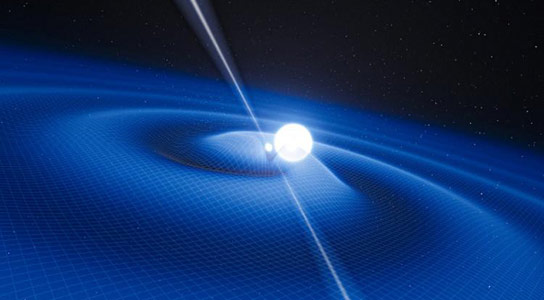
    An artist’s impression of a binary star system containing a pulsar (the smaller object seen with jets of light) and one white dwarf star. The result of their mutual orbit generates gravitational waves, shown schematically as the ripples in space. Credit: Luis Calçada/European Southern Observatory

    Astronomers from the Harvard-Smithsonian Center for Astrophysics have detected a pair of white dwarf stars that orbit in about 20 minutes and that can be used as a verification source for gravitational wave missions.

    Einstein’s general theory of relativity predicts that accelerating masses should radiate gravity waves in a roughly similar way that accelerating electrical charges radiate electromagnetic (light) waves. One notable difference is that the gravitational force is intrinsically about trillion trillion trillion times weaker than the electromagnetic force, and so gravity waves are phenomenally weak. In fact, none has ever been measured in the laboratory, although their presence has been reliably inferred from the decaying orbital energy of binary stars as they radiate these waves into space. Astronomers expect that new generations of gravity wave detectors being built for space will be able not only to test relativity in new regimes, but also measure many important astrophysical phenomena that are otherwise mysterious, from the motion, growth, and evolution of black holes to binary star evolution, and even details of the early universe.

    The primary space gravity-wave mission planned is called eLISA (“evolved Laser Interferometer Space Antenna”). It is not scheduled for launch for another decade or more, but a proof-of-concept mission is scheduled for launch in 2015. One of the many issues facing the new gravity-wave instruments is their accurate testing and calibration. White-dwarf binary stars are expected to play this role. When a star like our Sun gets too old, in another seven billion years or so, it will no longer be able to sustain burning its nuclear fuel. With only about half of its mass remaining it will shrink to a fraction of its radius and become a white dwarf star. White dwarfs are common, either isolated or in a multi-star system of some kind, the most famous one being the companion to the brightest star in the sky, Sirius.

    Scientists estimate that there are about one hundred million detectable white dwarf stars in binary systems in our galaxy. As they orbit around each other they should emit considerable gravitational radiation. Today, however, only eight confirmed candidates are known. CfA astronomers Warren Brown and Scott Kenyon and four colleagues used the MMT and Gemini telescopes to identify a new member of this select group, a pair of white dwarf stars that orbit each other in only about 20 minutes (recall that the Earth’s orbital period is one year!), making it the second fastest known system. A third star appears to be near them and may be physically related; further observations are needed to resolve this possibility, but if it is part of the system, then the predicted gravity waves from the new triple source will make it one of the strongest prospective emitters of gravity waves.

    Reference: “A New Gravitational Wave Verification Source” by Mukremin Kilic, Warren R. Brown, A. Gianninas, J. J. Hermes, Carlos Allende Prieto and S. J. Kenyon, 23 July 2014, MNRAS.
    DOI: 10.1093/mnrasl/slu093
    arXiv: 1406.3346

    Never miss a breakthrough: Join the SciTechDaily newsletter.
    Follow us on Google and Google News.

    Astronomy Astrophysics Gravitational Waves Harvard-Smithsonian Center for Astrophysics White Dwarf
    Share. Facebook Twitter Pinterest LinkedIn Email Reddit

    Related Articles

    New Research Shows LIGO’s Twin Black Holes Might Have Been Born Inside a Single Star

    DES Results of First Search for Visible Light Associated with Gravitational Waves

    Kepler Discovers a Planetary Object Being Vaporized by a White Dwarf

    Astronomers Discover Companions of Millisecond Pulsars

    Gemini Reveals a Hidden Gravitational Wave Source

    Researchers Discover the First Direct Evidence of Cosmic Inflation

    Evidence of Extraterrestrial Life Might Come From Planets Orbiting White Dwarfs

    Pair of Eclipsing White Dwarfs Produce Gravitational Waves

    Origins of Type Ia Supernovae

    Leave A Reply Cancel Reply

    • Facebook
    • Twitter
    • Pinterest
    • YouTube

    Don't Miss a Discovery

    Subscribe for the Latest in Science & Tech!

    Trending News

    Wasp Colonies Explode Into Violence After Losing Their Queen

    Scientists Create “Living Plastic” That Self-Destructs in Just Six Days

    Your Blood May Carry a 700-Million-Year-Old Secret

    Scientists Discover Some “Zombie Cells” May Actually Help You Live Longer

    Earth May Be Seeding Venus With Life, According to New Research

    What Scientists Found Inside a 117-Year-Old Woman Reveals New Clues to Long Life

    Scientists Discover Mysterious Creature Living in the Great Salt Lake – and It Exists Nowhere Else on Earth

    It’s Alive? Surprising Discovery Changes What We Know About Fog

    Follow SciTechDaily
    • Facebook
    • Twitter
    • YouTube
    • Pinterest
    • Newsletter
    • RSS
    SciTech News
    • Biology News
    • Chemistry News
    • Earth News
    • Health News
    • Physics News
    • Science News
    • Space News
    • Technology News
    Recent Posts
    • Scientists Turn Seawater Into Drinking Water Without Toxic Brine
    • A Psychologist Explains Why 40% of People Are Avoiding the News
    • Scientists Discover Alzheimer’s-Linked Proteion’s Surprising Role in Making Memories Last
    • Vitamin D Drug Shows Surprising Promise Against One of the Deadliest Cancers
    • Scientists Crack Major Ammonia Problem With a Platinum Catalyst Breakthrough
    Copyright © 1998 - 2026 SciTechDaily. All Rights Reserved.
    • Science News
    • About
    • Contact
    • Editorial Board
    • Privacy Policy
    • Terms of Use

    Type above and press Enter to search. Press Esc to cancel.