
Neutron star collision cooks up exotic elements, gravitational waves
When some people get in the kitchen, they create a delicious meal but leave behind a chaotic mess of splattered food and dirty dishes. Cosmic cookery can be just as messy. While a star can create chemical elements as heavy as iron within its core, anything heavier needs a more powerful source like a stellar explosion or the collision of two neutron stars.
Colliding neutron stars can yield gold, plutonium, and a variety of other elements. Theoretically, they also generate gravitational waves as they spiral together at breakneck speed before merging. The first gravitational wave signal from a neutron star merger was detected on August 17. It was accompanied by gamma rays and other light, allowing astronomers to locate a gravitational wave source for the first time.
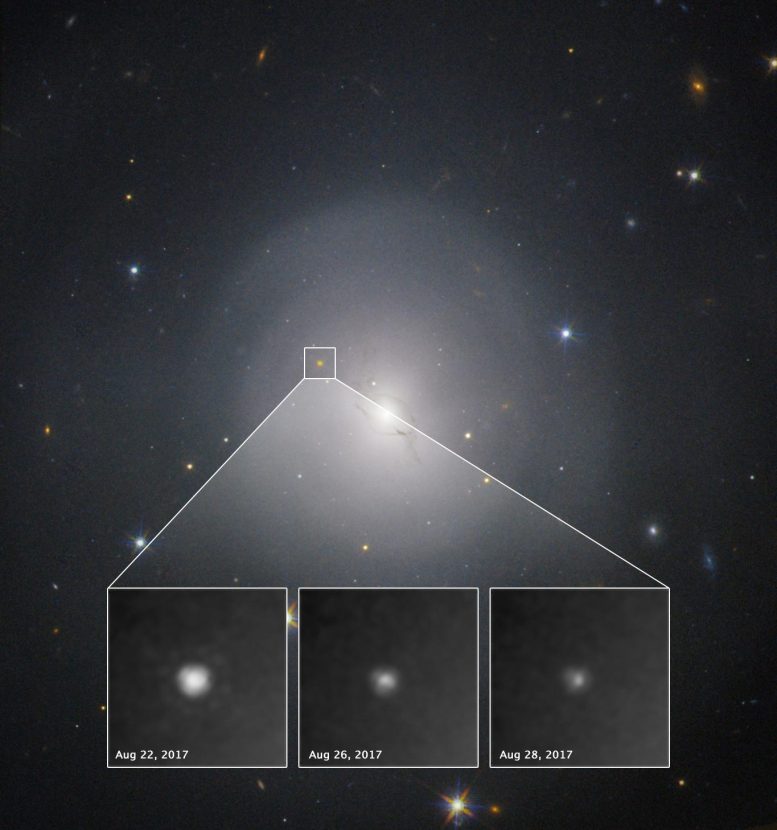
Hubble photographed the glow from this titanic collision, shining within the galaxy NGC 4993 at a distance of 130 million light-years. Hubble also obtained an infrared spectrum that may yield signs of exotic, radioactive elements. The analysis will continue while astronomers wait for the gravitational wave source to emerge from behind the Sun from Earth’s point of view, where it slipped just days after discovery.
This animation captures phenomena observed over the course of nine days following the neutron star merger known as GW170817. They include gravitational waves (pale arcs), a near-light-speed jet that produced gamma rays (magenta), expanding debris from a kilonova that produced ultraviolet (violet), optical and infrared (blue-white to red) emission, and, once the jet directed toward us expanded into our view from Earth, X-rays (blue). Credit: NASA’s Goddard Space Flight Center/CI Lab
NASA Missions Catch First Light from a Gravitational-Wave Event
For the first time, scientists from NASA have detected light tied to a gravitational-wave event, thanks to two merging neutron stars in the galaxy NGC 4993, located about 130 million light-years from Earth in the constellation Hydra.
Shortly after 8:41 a.m. EDT on August 17, NASA’s Fermi Gamma-ray Space Telescope picked up a pulse of high-energy light from a powerful explosion, which was immediately reported to astronomers around the globe as a short gamma-ray burst. The scientists at the National Science Foundation’s Laser Interferometer Gravitational-wave Observatory (LIGO) detected gravitational waves dubbed GW170817 from a pair of smashing stars tied to the gamma-ray burst, encouraging astronomers to look for the aftermath of the explosion. Shortly thereafter, the burst was detected as part of a follow-up analysis by ESA’s (European Space Agency’s) INTEGRAL satellite.
NASA’s Swift, Hubble, Chandra, and Spitzer missions, along with dozens of ground-based observatories, including the NASA-funded Pan-STARRS survey, later captured the fading glow of the blast’s expanding debris.

“This is extremely exciting science,” said Paul Hertz, director of NASA’s Astrophysics Division at the agency’s headquarters in Washington. “Now, for the first time, we’ve seen light and gravitational waves produced by the same event. The detection of a gravitational-wave source’s light has revealed details of the event that cannot be determined from gravitational waves alone. The multiplier effect of study with many observatories is incredible.”
Neutron stars are the crushed, leftover cores of massive stars that previously exploded as supernovas long ago. The merging stars likely had masses between 10 and 60 percent greater than that of our Sun, but they were no wider than Washington, D.C. The pair whirled around each other hundreds of times a second, producing gravitational waves at the same frequency. As they drew closer and orbited faster, the stars eventually broke apart and merged, producing both a gamma-ray burst and a rarely seen flare-up called a “kilonova.”

“This is the one we’ve all been waiting for,” said David Reitze, executive director of the LIGO Laboratory at Caltech in Pasadena, California. “Neutron star mergers produce a wide variety of light because the objects form a maelstrom of hot debris when they collide. Merging black holes — the types of events LIGO and its European counterpart, Virgo, have previously seen — very likely consume any matter around them long before they crash, so we don’t expect the same kind of light show.”
“The favored explanation for short gamma-ray bursts is that they’re caused by a jet of debris moving near the speed of light produced in the merger of neutron stars or a neutron star and a black hole,” said Eric Burns, a member of Fermi’s Gamma-ray Burst Monitor team at NASA’s Goddard Space Flight Center in Greenbelt, Maryland. “LIGO tells us there was a merger of compact objects, and Fermi tells us there was a short gamma-ray burst. Together, we know that what we observed was the merging of two neutron stars, dramatically confirming the relationship.”
Within hours of the initial Fermi detection, LIGO and the Virgo detector at the European Gravitational Observatory near Pisa, Italy, greatly refined the event’s position in the sky with additional analysis of gravitational wave data. Ground-based observatories then quickly located a new optical and infrared source — the kilonova — in NGC 4993.
To Fermi, this appeared to be a typical short gamma-ray burst, but it occurred less than one-tenth as far away as any other short burst with a known distance, making it among the faintest known. Astronomers are still trying to figure out why this burst is so odd, and how this event relates to the more luminous gamma-ray bursts seen at much greater distances.
NASA’s Swift, Hubble, and Spitzer missions followed the evolution of the kilonova to better understand the composition of this slower-moving material, while Chandra searched for X-rays associated with the remains of the ultra-fast jet.

When Swift turned to the galaxy shortly after Fermi’s gamma-ray burst detection, it found a bright and quickly fading ultraviolet (UV) source.
“We did not expect a kilonova to produce bright UV emission,” said Goddard’s S. Bradley Cenko, principal investigator for Swift. “We think this was produced by the short-lived disk of debris that powered the gamma-ray burst.”
Over time, material hurled out by the jet slows and widens as it sweeps up and heats interstellar material, producing so-called afterglow emission that includes X-rays.
But the spacecraft saw no X-rays — a surprise for an event that produced higher-energy gamma rays.
NASA’s Chandra X-ray Observatory clearly detected X-rays nine days after the source was discovered. Scientists think the delay was a result of our viewing angle, and it took time for the jet directed toward Earth to expand into our line of sight.
“The detection of X-rays demonstrates that neutron star mergers can form powerful jets streaming out at near light speed,” said Goddard’s Eleonora Troja, who led one of the Chandra teams and found the X-ray emission. “We had to wait for nine days to detect it because we viewed it from the side, unlike anything we had seen before.”
On August 22, NASA’s Hubble Space Telescope began imaging the kilonova and capturing its near-infrared spectrum, which revealed the motion and chemical composition of the expanding debris.
“The spectrum looked exactly like how theoretical physicists had predicted the outcome of the merger of two neutron stars would appear,” said Andrew Levan at the University of Warwick in Coventry, England, who led one of the proposals for Hubble spectral observations. “It tied this object to the gravitational wave source beyond all reasonable doubt.”
Astronomers think a kilonova’s visible and infrared light primarily arises through heating from the decay of radioactive elements formed in the neutron-rich debris. Crashing neutron stars may be the universe’s dominant source for many of the heaviest elements, including platinum and gold.
Because of its Earth-trailing orbit, Spitzer was uniquely situated to observe the kilonova long after the Sun moved too close to the galaxy for other telescopes to see it. Spitzer’s September 30 observation captured the longest-wavelength infrared light from the kilonova, which unveils the quantity of heavy elements forged.
“Spitzer was the last to join the party, but it will have the final word on how much gold was forged,” says Mansi Kasliwal, Caltech assistant professor and principal investigator of the Spitzer observing program.
Numerous scientific papers describing and interpreting these observations have been published in Science, Nature, Physical Review Letters and The Astrophysical Journal.
Gravitational waves were directly detected for the first time in 2015 by LIGO, whose architects were awarded the 2017 Nobel Prize in physics for the discovery.
Never miss a breakthrough: Join the SciTechDaily newsletter.
Follow us on Google and Google News.