
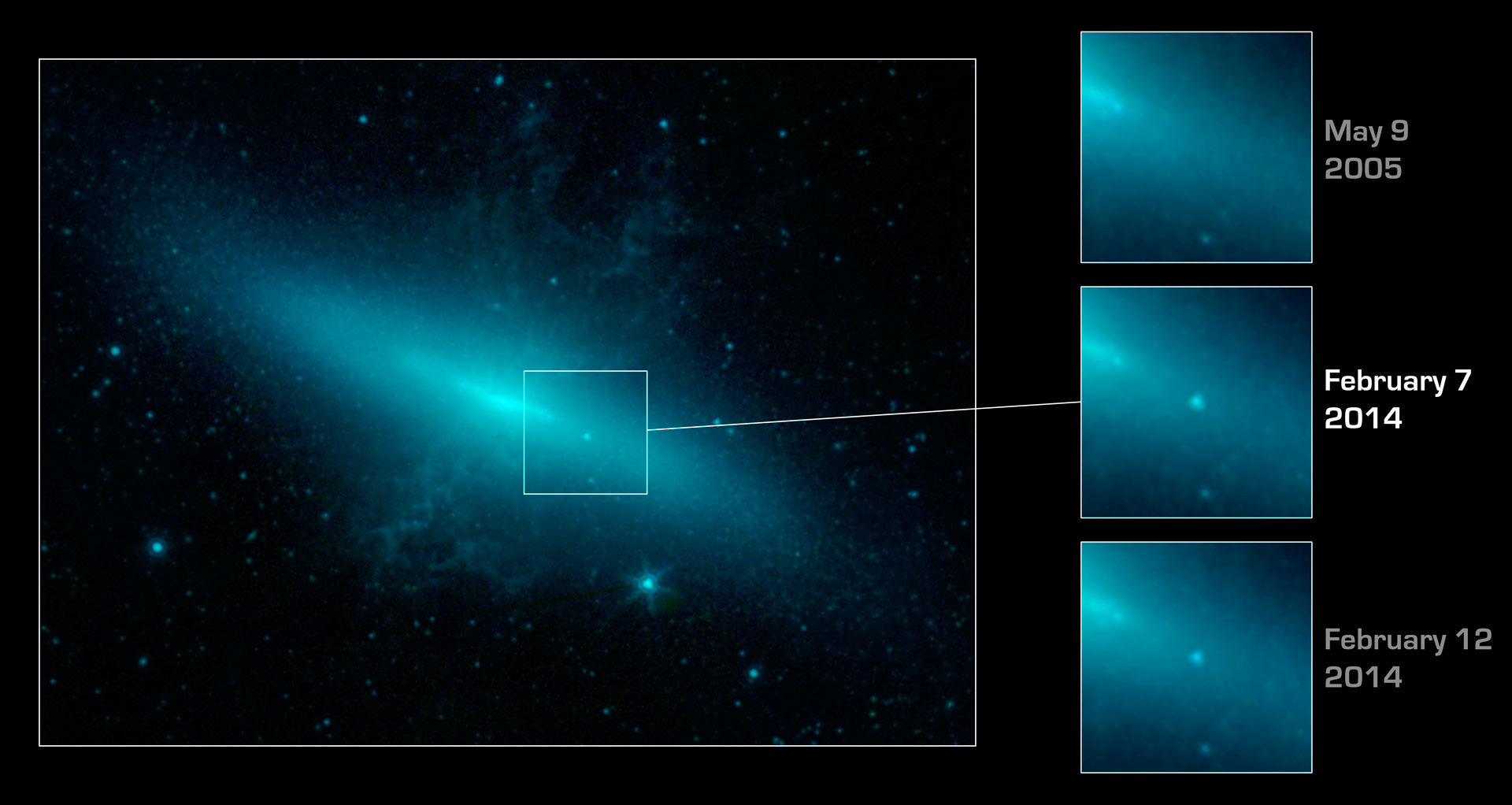
This newly released Spitzer image shows the supernova in galaxy M82, the closest supernova of its kind to be observed in the last few decades.
The closest supernova of its kind to be observed in the last few decades has sparked a global observing campaign involving legions of instruments on the ground and in space, including NASA’s Spitzer Space Telescope. With its dust-piercing infrared vision, Spitzer brings an important perspective to this effort by peering directly into the heart of the aftermath of the stellar explosion.
Dust in the supernova’s host galaxy M82, also called the “Cigar galaxy,” partially obscures observations in optical and high-energy forms of light. Spitzer can, therefore, complement all the other observatories taking part in painting a complete portrait of a once-in-a-generation supernova, which was first spotted in M82 on January 21, 2014. A supernova is a tremendous explosion that marks the end of life for some stars.
“At this point in the supernova’s evolution, observations in infrared let us look the deepest into the event,” said Mansi Kasliwal, Hubble Fellow and Carnegie-Princeton Fellow at the Observatories of the Carnegie Institution for Science and the principal investigator for the Spitzer observations. “Spitzer is really good for bypassing the dust and nailing down what’s going on in and around the star system that spawned this supernova.”
Supernovas are among the most powerful events in the universe, releasing so much energy that a single outburst can outshine an entire galaxy. The new supernova, dubbed SN 2014J, is of a particular kind known as a Type Ia. This type of supernova results in the complete destruction of a white dwarf star—the small, dense, aged remnant of a typical star like our sun. Two scenarios are theorized to give rise to Type Ia supernovas. First, in a binary star system, a white dwarf gravitationally pulls in matter from its companion star, accruing mass until the white dwarf crosses a critical threshold and blows up. In the second, two white dwarfs in a binary system spiral inward toward each other and eventually collide explosively.
Type Ia supernovas serve a critically important role in gauging the expansion of the universe because they explode with almost exactly the same amount of energy, shining with a near-uniform peak brightness. The fainter a Type Ia supernova looks from our vantage point, the farther away it must be. Accordingly, Type Ia supernovas are referred to as “standard candles,” which allow astronomers to pin down the distances to nearby galaxies. Studying SN 2014J will help with understanding the processes behind Type Ia detonations to further refine theoretical models.

Fortuitously, Spitzer had already been scheduled to observe M82 on January 28, a week after students and staff from University College London first spotted SN 2014J on January 21. Subsequent observations, also part of Kasliwal’s SPIRITS (SPitzer InfraRed Intensive Transients Survey) program, took place on February 7, 12, 19, and 24 and are slated for March 3.
The supernova is glowing very brightly in the infrared light that Spitzer sees. The telescope was able to observe the supernova before and after it reached its peak brightness. Such early observations with an infrared telescope have only been obtained for a few Type Ia supernovas in the past. Researchers are currently using the data to learn more about how these explosions occur.
Among the other major space-based observatories used in the M82 viewing campaign are NASA’s Hubble Space Telescope, Chandra X-ray Observatory, Nuclear Spectroscopic Telescope Array (NuSTAR), Fermi Gamma-ray Space Telescope, and Swift Gamma Ray Burst Explorer. In addition to Spitzer, key infrared observations are being collected by the airplane-borne Stratospheric Observatory for Infrared Astronomy (SOFIA).
NASA’s Jet Propulsion Laboratory, Pasadena, California, manages the Spitzer Space Telescope mission for NASA’s Science Mission Directorate, Washington. Science operations are conducted at the Spitzer Science Center at the California Institute of Technology in Pasadena. Spacecraft operations are based at Lockheed Martin Space Systems Company, Littleton, Colorado. Data are archived at the Infrared Science Archive housed at the Infrared Processing and Analysis Center at Caltech. Caltech manages JPL for NASA.
Never miss a breakthrough: Join the SciTechDaily newsletter.
Follow us on Google and Google News.