
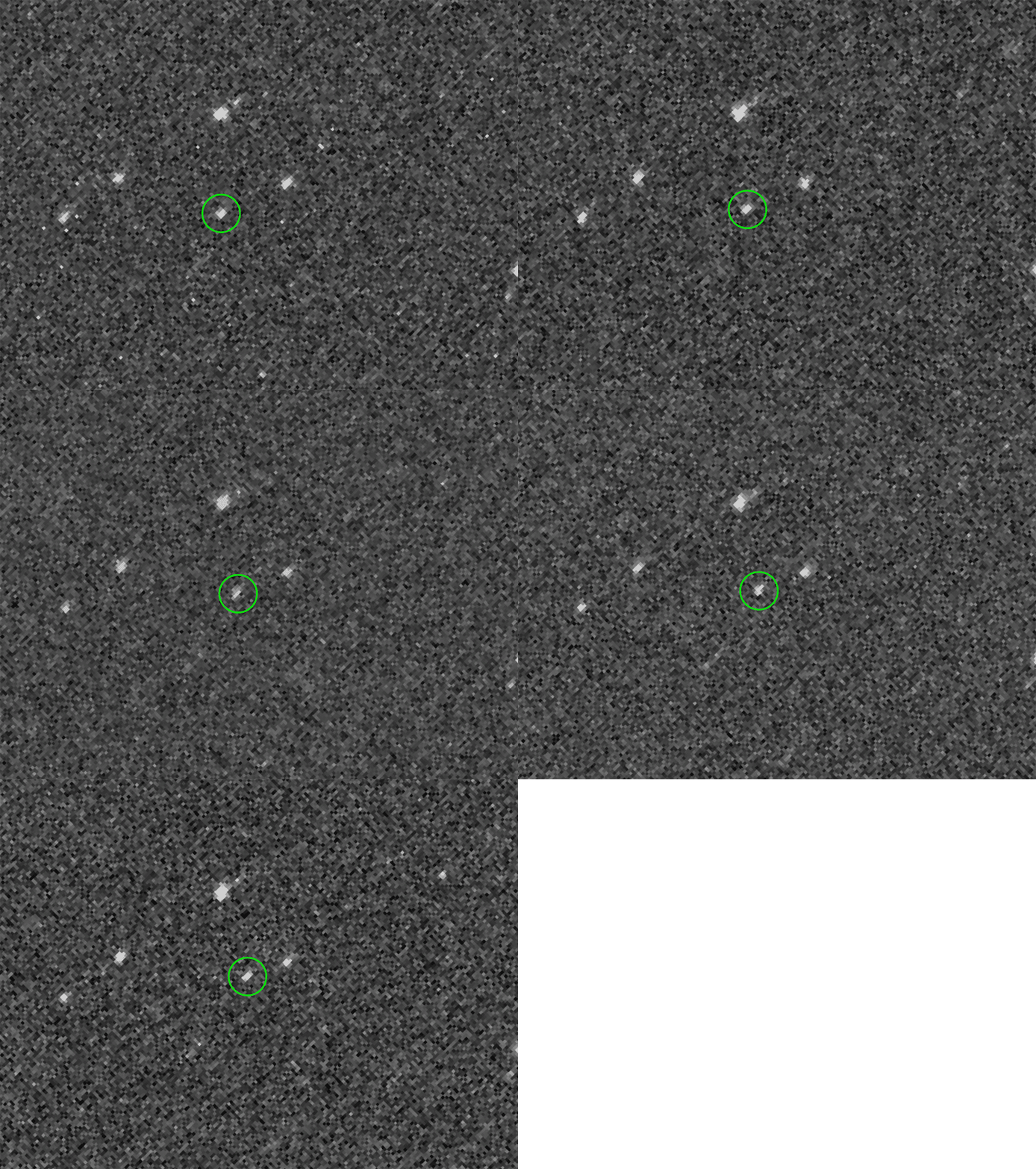
After an almost two-year journey, NASA’s asteroid sampling spacecraft, the Origins, Spectral Interpretation, Resource Identification, Security-Regolith Explorer (OSIRIS-REx), caught its first glimpse of asteroid Bennu last week and began the final approach toward its target. Kicking off the mission’s asteroid operations campaign on August 17, the spacecraft’s PolyCam camera obtained the image from a distance of 1.4 million miles (2.2 million km).
OSIRIS-REx is NASA’s first mission to visit a near-Earth asteroid, survey the surface, collect a sample and deliver it safely back to Earth. The spacecraft has traveled approximately 1.1 billion miles (1.8 billion km) since its September 8, 2016, launch and is scheduled to arrive at Bennu on December 3.
NASA’s OSIRIS-REx asteroid sample return mission launched in 2016 and now (August, 2018) is entering its approach phase. OSIRIS-REx will arrive at asteroid Bennu in December, 2018. OSIRIS-REx will help unveil the mysteries of our solar system’s formation. Credit: NASA’s Goddard Space Flight Center/Katrina Jackson
“Now that OSIRIS-REx is close enough to observe Bennu, the mission team will spend the next few months learning as much as possible about Bennu’s size, shape, surface features, and surroundings before the spacecraft arrives at the asteroid,” said Dante Lauretta, OSIRIS-REx principal investigator at the University of Arizona, Tucson. “After spending so long planning for this moment, I can’t wait to see what Bennu reveals to us.”
As OSIRIS-REx approaches the asteroid, the spacecraft will use its science instruments to gather information about Bennu and prepare for arrival. The spacecraft’s science payload comprises the OCAMS camera suite (PolyCam, MapCam, and SamCam), the OTES thermal spectrometer, the OVIRS visible and infrared spectrometer, the OLA laser altimeter, and the REXIS x-ray spectrometer.
During the mission’s approach phase, OSIRIS-REx will:
- regularly observe the area around the asteroid to search for dust plumes and natural satellites, and study Bennu’s light and spectral properties;
- execute a series of four asteroid approach maneuvers, beginning on October 1, slowing the spacecraft to match Bennu’s orbit around the Sun;
- jettison the protective cover of the spacecraft’s sampling arm in mid-October and subsequently extend and image the arm for the first time in flight, and
- use OCAMS to reveal the asteroid’s overall shape in late October and begin detecting Bennu’s surface features in mid-November.
NASA’s OSIRIS-REx asteroid sample return mission launched in 2016 and now (August, 2018) is entering its approach phase. Credit: NASA’s Goddard Space Flight Center/Katrina Jackson
After arrival at Bennu, the spacecraft will spend the first month performing flybys of Bennu’s north pole, equator, and south pole, at distances ranging between 11.8 and 4.4 miles (19 and 7 km) from the asteroid. These maneuvers will allow for the first direct measurement of Bennu’s mass as well as close-up observations of the surface. These trajectories will also provide the mission’s navigation team with experience navigating near the asteroid.
“Bennu’s low gravity provides a unique challenge for the mission,” said Rich Burns, OSIRIS-REx project manager at NASA’s Goddard Space Flight Center in Greenbelt, Maryland. “At roughly 0.3 miles [500 meters] in diameter, Bennu will be the smallest object that any spacecraft has ever orbited.”
The spacecraft will extensively survey the asteroid before the mission team identifies two possible sample sites. Close examination of these sites will allow the team to pick one for sample collection, scheduled for early July 2020. After sample collection, the spacecraft will head back toward Earth before ejecting the Sample Return Capsule for landing in the Utah desert in September 2023.
NASA’s Goddard Space Flight Center provides overall mission management, systems engineering, and safety and mission assurance for OSIRIS-REx. Dante Lauretta of the University of Arizona, Tucson, is the principal investigator, and the University of Arizona also leads the science team and the mission’s science observation planning and data processing. Lockheed Martin Space in Denver built the spacecraft and is providing flight operations. Goddard and KinetX Aerospace are responsible for navigating the OSIRIS-REx spacecraft. OSIRIS-REx is the third mission in NASA’s New Frontiers Program. NASA’s Marshall Space Flight Center in Huntsville, Alabama, manages the agency’s New Frontiers Program for its Science Mission Directorate in Washington.
Never miss a breakthrough: Join the SciTechDaily newsletter.
Follow us on Google and Google News.