
Close Menu
    Facebook X (Twitter) Instagram
    SciTechDaily
    • Biology
    • Chemistry
    • Earth
    • Health
    • Physics
    • Science
    • Space
    • Technology
    Facebook X (Twitter) Pinterest YouTube RSS
    SciTechDaily
    Home»Space»NASA’s OSIRIS-REx Mission to Collect Asteroid Sample Moves Into Development Phase
    Space

    NASA’s OSIRIS-REx Mission to Collect Asteroid Sample Moves Into Development Phase

    By NASAMay 17, 2013No Comments3 Mins Read
    Facebook Twitter Pinterest Telegram LinkedIn WhatsApp Email Reddit
    Share
    Facebook Twitter LinkedIn Pinterest Telegram Email Reddit
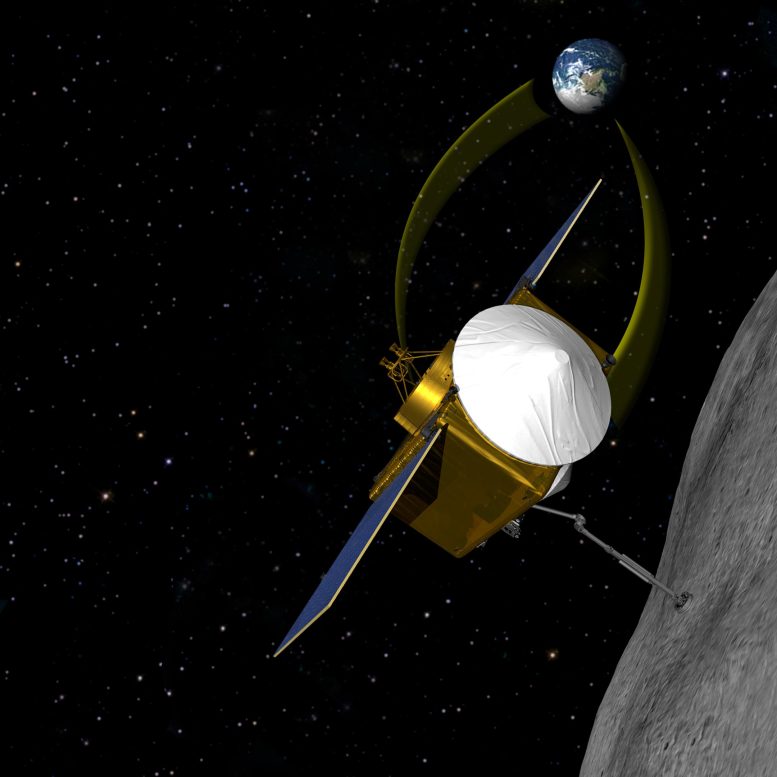
    OSIRIS-REx Conceptual Image
    Conceptual image of OSIRIS-REx. Credit: NASA/Goddard/University of Arizona

    NASA’s mission to bring a sample of an asteroid back to Earth is underway. OSIRIS-REx is scheduled to launch in 2016 and will rendezvous with the asteroid Bennu in 2018, returning with a sample of it to Earth in 2023.

    NASA’s first mission to sample an asteroid is moving ahead into development and testing in preparation for its launch in 2016.

    The Origins-Spectral Interpretation Resource Identification Security Regolith Explorer (OSIRIS-REx) passed a confirmation review Wednesday called Key Decision Point (KDP)-C. NASA officials reviewed a series of detailed project assessments and authorized the spacecraft’s continuation into the development phase.


    This narrated video provides an overview of the OSIRIS-REx mission, which will observe asteroid Bennu, collect a sample and return it to Earth for study. Credit: NASA’s Goddard Space Flight Center

    OSIRIS-REx will rendezvous with the asteroid Bennu in 2018 and return a sample of it to Earth in 2023.

    “Successfully passing KDP-C is a major milestone for the project,” said Mike Donnelly, OSIRIS-REx project manager at NASA’s Goddard Space Flight Center in Greenbelt, Md. “This means NASA believes we have an executable plan to return a sample from Bennu. It now falls on the project and its development team members to execute that plan.”

    Bennu could hold clues to the origin of the solar system. OSIRIS-REx will map the asteroid’s global properties, measure non-gravitational forces and provide observations that can be compared with data obtained by telescope observations from Earth. OSIRIS-REx will collect a minimum of 2 ounces (60 grams) of surface material.

    “The entire OSIRIS-REx team has worked very hard to get to this point,” said Dante Lauretta, OSIRIS-REx principal investigator at the University of Arizona in Tucson. “We have a long way to go before we arrive at Bennu, but I have every confidence when we do, we will have built a supremely capable system to return a sample of this primitive asteroid.”

    The mission will be a vital part of NASA’s plans to find, study, capture and relocate an asteroid for exploration by astronauts. NASA recently announced an asteroid initiative proposing a strategy to leverage human and robotic activities for the first human mission to an asteroid while also accelerating efforts to improve detection and characterization of asteroids.

    NASA’s Goddard Space Flight Center in Greenbelt, Md., will provide overall mission management, systems engineering and safety and mission assurance. The University of Arizona in Tucson is the principal investigator institution. Lockheed Martin Space Systems of Denver will build the spacecraft. OSIRIS-REx is the third mission in NASA’s New Frontiers Program. NASA’s Marshall Space Flight Center in Huntsville, Alabama, manages New Frontiers for NASA’s Science Mission Directorate in Washington.

    Never miss a breakthrough: Join the SciTechDaily newsletter.
    Follow us on Google and Google News.

    Asteroid Astronomy NASA NASA Goddard Space Flight Center OSIRIS-REx
    Share. Facebook Twitter Pinterest LinkedIn Email Reddit

    Related Articles

    Vesta Meteorites Discovered on Asteroid Bennu by NASA’s OSIRIS-REx Spacecraft

    OSIRIS-REx Swoops Over Sample Site Nightingale on Asteroid Bennu

    Unexpected Glimpse of Newly Discovered Black Hole Caught by NASA’s OSIRIS-REx

    NASA’s OSIRIS-REx Spacecraft Completes Osprey Flyover – But There Was a Problem

    Closest Flyover of Asteroid Sample Site Nightingale Completed by OSIRIS-REx

    NASA Selects Nightingale Crater on Bennu for Asteroid Sample Collection

    Daring Rescue of Monumental Asteroid Mission – Here’s How Engineers Pulled It Off

    Asteroid Bennu’s Mysterious Particle Events Explained by NASA’s OSIRIS-REx [Video]

    New NASA Animation Follows Long, Strange Trip of Asteroid Bennu

    Leave A Reply Cancel Reply

    • Facebook
    • Twitter
    • Pinterest
    • YouTube

    Don't Miss a Discovery

    Subscribe for the Latest in Science & Tech!

    Trending News

    Scientists May Have Found the Key to Jupiter and Saturn’s Moon Mystery

    Scientists Uncover Brain Changes That Link Pain to Depression

    Saunas May Do More Than Raise Body Temperature – They Activate Your Immune System

    Exercise in a Pill? Metformin Shows Surprising Effects in Cancer Patients

    Hidden Oceans of Magma Could Be Protecting Alien Life

    New Study Challenges Alzheimer’s Theories: It’s Not Just About Plaques

    Artificial Sweeteners May Harm Future Generations, Study Suggests

    Splashdown! NASA Artemis II Returns From Record-Breaking Moon Mission

    Follow SciTechDaily
    • Facebook
    • Twitter
    • YouTube
    • Pinterest
    • Newsletter
    • RSS
    SciTech News
    • Biology News
    • Chemistry News
    • Earth News
    • Health News
    • Physics News
    • Science News
    • Space News
    • Technology News
    Recent Posts
    • As Cities Invade the Amazon, Yellow Fever Makes a Dangerous Comeback
    • “Asian Flush” May Be a Hidden Trigger for Deadly Heart Damage
    • AI Could Detect Early Signs of Alzheimer’s in Under a Minute – Far Before Traditional Tests
    • What if Dark Matter Has Two Forms? Bold New Hypothesis Could Explain a Cosmic Mystery
    • Researchers Expose Hidden Chemistry of “Ore-Forming” Elements in Biology
    Copyright © 1998 - 2026 SciTechDaily. All Rights Reserved.
    • Science News
    • About
    • Contact
    • Editorial Board
    • Privacy Policy
    • Terms of Use

    Type above and press Enter to search. Press Esc to cancel.