
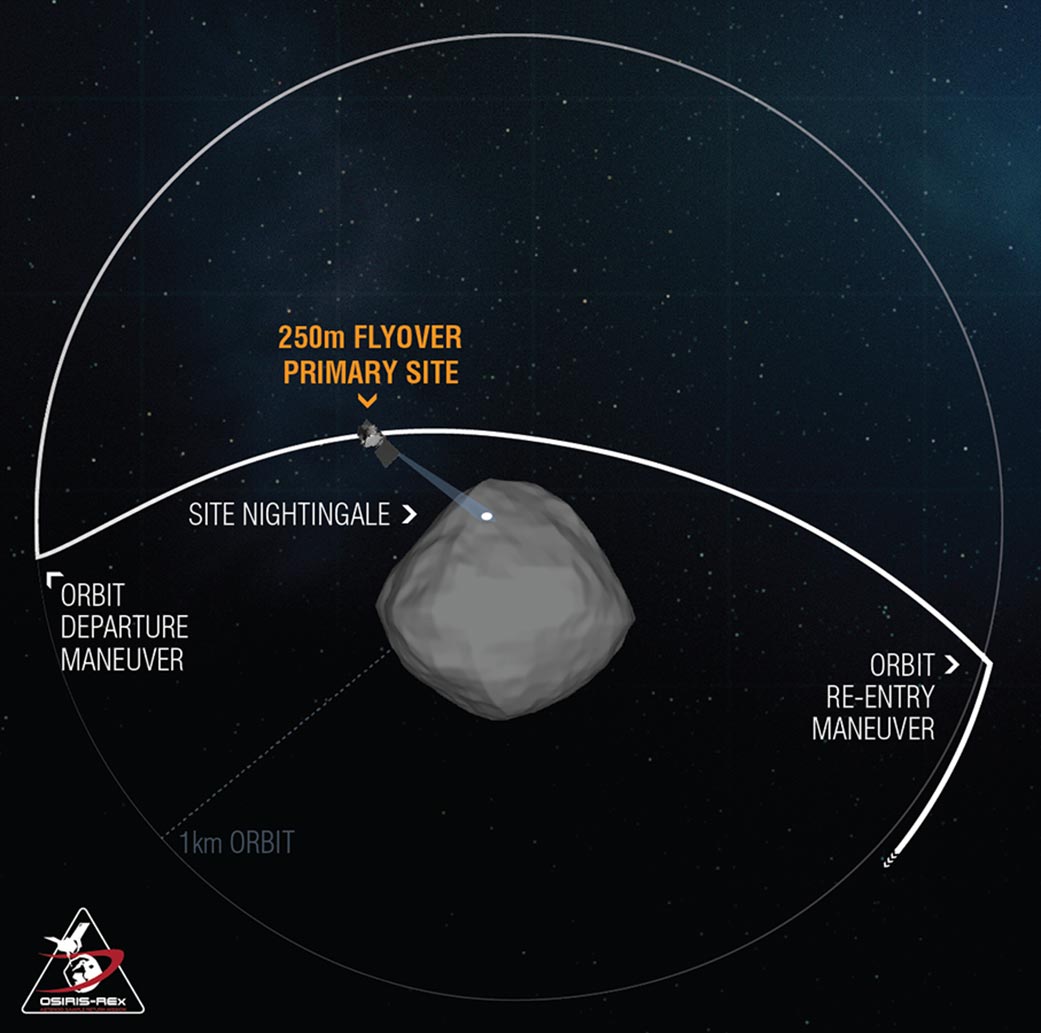
NASA’s first asteroid-sampling spacecraft just got its best look yet at asteroid Bennu. Yesterday, the Origins, Spectral Interpretation, Resource Identification, Security-Regolith Explorer (OSIRIS-REx) spacecraft executed a very low pass over sample site Nightingale, taking observations from an altitude of 820 feet (250 m), which is the closest that OSIRIS-REx has flown over the asteroid so far. Nightingale, OSIRIS-REx’s primary sample collection site, is located within a crater in Bennu’s northern hemisphere.
To perform the 5-hour flyover, the spacecraft left its 0.6-mile (1-km) safe-home orbit and aimed its science instruments toward the 52-ft (16-m) wide sample site. The science observations from this pass are the closest taken of Bennu to date.
The main goal of yesterday’s low flyover was to collect high-resolution imagery of the site’s surface material. The spacecraft’s sample collection mechanism is designed to pick up small rocks less than 0.8 inches (2 cm) in size, and the PolyCam images from this low pass are very detailed, allowing the team to identify and locate rocks of this size. Several of the spacecraft’s other instruments also took observations of the Nightingale site during the flyover event, including the OSIRIS-REx Thermal Emissions Spectrometer (OTES), the OSIRIS-REx Visual and InfraRed Spectrometer (OVIRS), the OSIRIS-REx Laser Altimeter (OLA), and the MapCam color imager.
After completing the flyover, the spacecraft returned to orbit – but for the first time, OSIRIS-REx reversed the direction of its safe-home orbit and is now circling Bennu clockwise (as viewed from the Sun). This shift in orbital direction positioned the spacecraft for its next close encounter with the asteroid – its first rehearsal for the sample collection event.
This spring, the mission will perform two rehearsals in preparation for the sample collection event. The first rehearsal, scheduled for April 14, navigates the spacecraft down to 410 feet (125 m) over Bennu’s surface. At this altitude, the spacecraft will execute the Checkpoint maneuver, designed to put the spacecraft on a descent trajectory toward the sample collection site on the surface. The spacecraft will stop its descent ten minutes later at an altitude of approximately 164 ft (50 m) by executing a maneuver to back away from the asteroid. The second rehearsal, scheduled for June, follows the same trajectory but takes the spacecraft to a lower altitude of 164 feet (50 m), where it will perform the Matchpoint maneuver, designed to slow the spacecraft’s descent rate. Subsequent to this burn the spacecraft will execute a back away maneuver between 131 ft (40 m) and 82 ft (25 m) from Bennu’s surface. The spacecraft will venture all the way to the asteroid’s surface in late August, for its first attempt to collect a sample. During this event, OSIRIS-REx’s sampling mechanism will touch Bennu’s surface and fire a charge of pressurized nitrogen to disturb the surface and collect its sample before the spacecraft backs away.
NASA’s Goddard Space Flight Center in Greenbelt, Maryland, provides overall mission management, systems engineering, and the safety and mission assurance for OSIRIS-REx. Dante Lauretta of the University of Arizona, Tucson, is the principal investigator, and the University of Arizona also leads the science team and the mission’s science observation planning and data processing. Lockheed Martin Space in Denver built the spacecraft and provides flight operations. Goddard and KinetX Aerospace are responsible for navigating the OSIRIS-REx spacecraft. OSIRIS-REx is the third mission in NASA’s New Frontiers Program, which is managed by NASA’s Marshall Space Flight Center in Huntsville, Alabama, for the agency’s Science Mission Directorate in Washington.
Never miss a breakthrough: Join the SciTechDaily newsletter.
Follow us on Google and Google News.