
Close Menu
    Facebook X (Twitter) Instagram
    SciTechDaily
    • Biology
    • Chemistry
    • Earth
    • Health
    • Physics
    • Science
    • Space
    • Technology
    Facebook X (Twitter) Pinterest YouTube RSS
    SciTechDaily
    Home»Space»Unexpected Glimpse of Newly Discovered Black Hole Caught by NASA’s OSIRIS-REx
    Space

    Unexpected Glimpse of Newly Discovered Black Hole Caught by NASA’s OSIRIS-REx

    By University of ArizonaMarch 3, 2020No Comments4 Mins Read
    Facebook Twitter Pinterest Telegram LinkedIn WhatsApp Email Reddit
    Share
    Facebook Twitter LinkedIn Pinterest Telegram Email Reddit
    X-ray Outburst Black Hole MAXI J0637-043
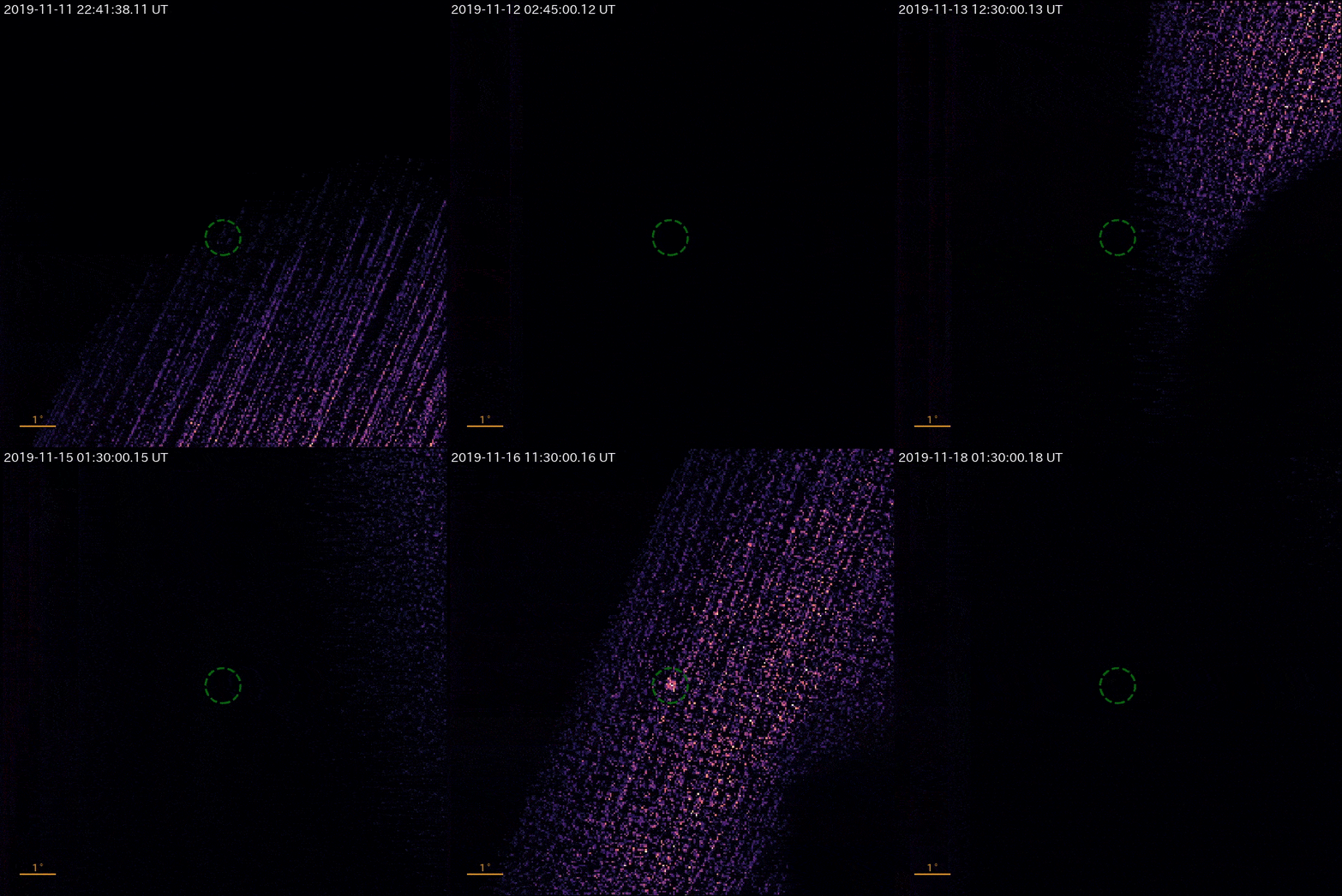
    This image shows the X-ray outburst from the black hole MAXI J0637-043, detected by the REXIS instrument on NASA’s OSIRIS-REx spacecraft. The image was constructed using data collected by the X-ray spectrometer while REXIS was making observations of the space around asteroid Bennu on November 11, 2019. The outburst is visible in the center of the image, and the image is overlaid with the limb of Bennu (lower right) to illustrate REXIS’s field of view. Credit: NASA/Goddard/University of Arizona/MIT/Harvard

    University students and researchers working on a NASA mission orbiting a near-Earth asteroid have made an unexpected detection of a phenomenon 30 thousand light-years away. Last fall, the student-built Regolith X-Ray Imaging Spectrometer (REXIS) onboard NASA’s OSIRIS-REx spacecraft detected a newly flaring black hole in the constellation Columba while making observations off the limb of asteroid Bennu.

    REXIS, a shoebox-sized student instrument, was designed to measure the X-rays that Bennu emits in response to incoming solar radiation. X-rays are a form of electromagnetic radiation, like visible light, but with much higher energy. REXIS is a collaborative experiment led by students and researchers at MIT and Harvard, who proposed, built, and operate the instrument.

    On November 11, 2019, while the REXIS instrument was performing detailed science observations of Bennu, it captured X-rays radiating from a point off the asteroid’s edge. “Our initial checks showed no previously cataloged object in that position in space,” said Branden Allen, a Harvard research scientist and student supervisor who first spotted the source in the REXIS data.


    Last fall, the student-built Regolith X-Ray Imaging Spectrometer (REXIS) aboard NASA’s OSIRIS-REx spacecraft detected a newly flaring black hole in the constellation Columba while making observations off the limb of asteroid Bennu. Credit: NASA’s Goddard Space Flight Center

    The glowing object turned out to be a newly flaring black hole X-ray binary – discovered just a week earlier by Japan’s MAXI telescope – designated MAXI J0637-430. NASA’s Neutron Star Interior Composition Explorer (NICER) telescope also identified the X-ray blast a few days later. Both MAXI and NICER operate aboard NASA’s International Space Station and detected the X-ray event from low Earth orbit. REXIS, on the other hand, detected the same activity millions of miles from Earth while orbiting Bennu, the first such outburst ever detected from interplanetary space.

    “Detecting this X-ray burst is a proud moment for the REXIS team. It means our instrument is performing as expected and to the level required of NASA science instruments,” said Madeline Lambert, an MIT graduate student who designed the instrument’s command sequences that serendipitously revealed the black hole.
    X-ray Outburst Black Hole MAXI J0637-043
    This visualization simulates an X-ray outburst from the black hole MAXI J0637-043, detected by the REXIS instrument on NASA’s OSIRIS-REx spacecraft, as it moves through REXIS’s line of sight. At first, the outburst is visibly intense, but it gradually fades as it subsides. The animation was constructed using data collected by the X-ray spectrometer while REXIS was making observations of the space around asteroid Bennu on November 11, 2019. Credit: NASA/Goddard/University of Arizona/MIT/Harvard

    X-ray blasts, like the one emitted from the newly discovered black hole, can only be observed from space since Earth’s protective atmosphere shields our planet from X-rays. These X-ray emissions occur when a black hole pulls in matter from a normal star that is in orbit around it. As the matter spirals onto a spinning disk surrounding the black hole, an enormous amount of energy (primarily in the form of X-rays) is released in the process.

    “We set out to train students how to build and operate space instruments,” said MIT professor Richard Binzel, instrument scientist for the REXIS student experiment. “It turns out, the greatest lesson is to always be open to discovering the unexpected.”

    The main purpose of the REXIS instrument is to prepare the next generation of scientists, engineers, and project managers in the development and operations of spaceflight hardware. Nearly 100 undergraduate and graduate students have worked on the REXIS team since the mission’s inception.

    NASA’s Goddard Space Flight Center in Greenbelt, Maryland, provides overall mission management, systems engineering, and the safety and mission assurance for OSIRIS-REx. Dante Lauretta of the University of Arizona, Tucson, is the principal investigator, and the University of Arizona also leads the science team and the mission’s science observation planning and data processing. Lockheed Martin Space in Denver built the spacecraft and provides flight operations. Goddard and KinetX Aerospace are responsible for navigating the OSIRIS-REx spacecraft. OSIRIS-REx is the third mission in NASA’s New Frontiers Program, which is managed by NASA’s Marshall Space Flight Center in Huntsville, Alabama, for the agency’s Science Mission Directorate in Washington.

    Never miss a breakthrough: Join the SciTechDaily newsletter.
    Follow us on Google and Google News.

    Astronomy Black Hole Harvard University NASA NASA Goddard Space Flight Center OSIRIS-REx Popular University of Arizona
    Share. Facebook Twitter Pinterest LinkedIn Email Reddit

    Related Articles

    Twin Titans: NASA Tracks Two Monster Black Holes Tearing Up a Distant Galaxy [Video]

    Surprising Findings in NASA’s OSIRIS-REx Asteroid Sample: Could They Unlock the Origins of Life?

    Echoes of Creation: The Roman Telescope’s Quest for Primordial Black Holes

    Gas Far Outside of Our Galaxy Illuminated by Enormous Burst of Energy Unleashed by Milky Way’s Black Hole

    NASA’s Asteroid Sampling Spacecraft to Pursue Its First Practice Run

    OSIRIS-REx Swoops Over Sample Site Nightingale on Asteroid Bennu

    NASA Selects Nightingale Crater on Bennu for Asteroid Sample Collection

    Bennu Site Selection for NASA’s First Asteroid Sample Return Mission

    X-Ray Echoes Demonstrate the Reality of Relativistic Reverberation

    Leave A Reply Cancel Reply

    • Facebook
    • Twitter
    • Pinterest
    • YouTube

    Don't Miss a Discovery

    Subscribe for the Latest in Science & Tech!

    Trending News

    Scientists Uncover Potential Brain Risks of Popular Fish Oil Supplements

    Scientists Discover a Surprising Way To Make Bread Healthier and More Nutritious

    After 60 Years, Scientists Uncover Unexpected Brain Effects of Popular Diabetes Drug Metformin

    New Research Uncovers Hidden Side Effects of Popular Weight-Loss Drugs

    Scientists Rethink Extreme Warming After Surprising Ocean Discovery

    Landmark Study Links Never Marrying to Significantly Higher Cancer Risk

    Researchers Discover Unknown Beetle Species Just Steps From Their Lab

    Largest-Ever Study Finds Medicinal Cannabis Ineffective for Anxiety, Depression, PTSD

    Follow SciTechDaily
    • Facebook
    • Twitter
    • YouTube
    • Pinterest
    • Newsletter
    • RSS
    SciTech News
    • Biology News
    • Chemistry News
    • Earth News
    • Health News
    • Physics News
    • Science News
    • Space News
    • Technology News
    Recent Posts
    • Scientists Discover Hidden Pathway Inside Catalysts That Defies Decades of Assumptions
    • Scientists Finally Crack Decades-Old Mystery of “Breathing” Lasers
    • “Like Liquid Metal”: Scientists Create Strange Shape-Shifting Material
    • Early Warning Signals of Esophageal Cancer May Be Hiding in Plain Sight
    • Researchers Have Discovered a THC-Free Cannabis Compound That May Replace Opioids
    Copyright © 1998 - 2026 SciTechDaily. All Rights Reserved.
    • Science News
    • About
    • Contact
    • Editorial Board
    • Privacy Policy
    • Terms of Use

    Type above and press Enter to search. Press Esc to cancel.