
Close Menu
    Facebook X (Twitter) Instagram
    SciTechDaily
    • Biology
    • Chemistry
    • Earth
    • Health
    • Physics
    • Science
    • Space
    • Technology
    Facebook X (Twitter) Pinterest YouTube RSS
    SciTechDaily
    Home»Chemistry»Underwater Smart Glue Goes From Sticky to Not With a Small Zap of Electricity
    Chemistry

    Underwater Smart Glue Goes From Sticky to Not With a Small Zap of Electricity

    By Michigan Technological UniversityMarch 3, 2020No Comments4 Mins Read
    Facebook Twitter Pinterest Telegram LinkedIn WhatsApp Email Reddit
    Share
    Facebook Twitter LinkedIn Pinterest Telegram Email Reddit
    Underwater Smart Glue
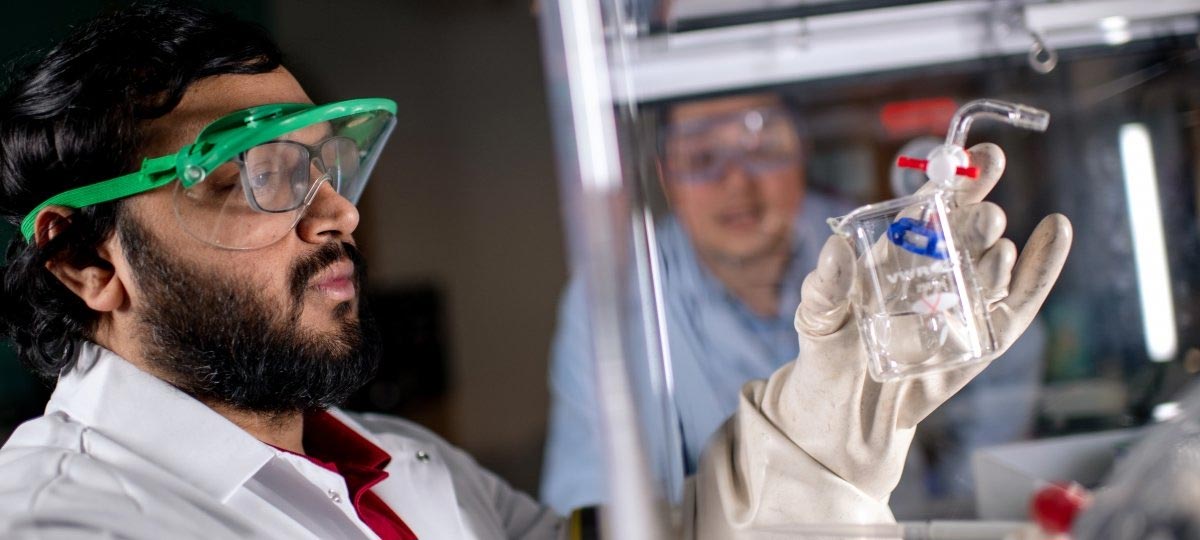
    Biomedical engineers Bruce Lee and Saleh Akram Bhuiyan test catechol-containing adhesives to make underwater smart glue. Credit: Sarah Bird/Michigan Tech

    With a small zap of electricity, biomedical engineers at Michigan Technological University take an underwater smart glue prototype from sticky to not in seven seconds.

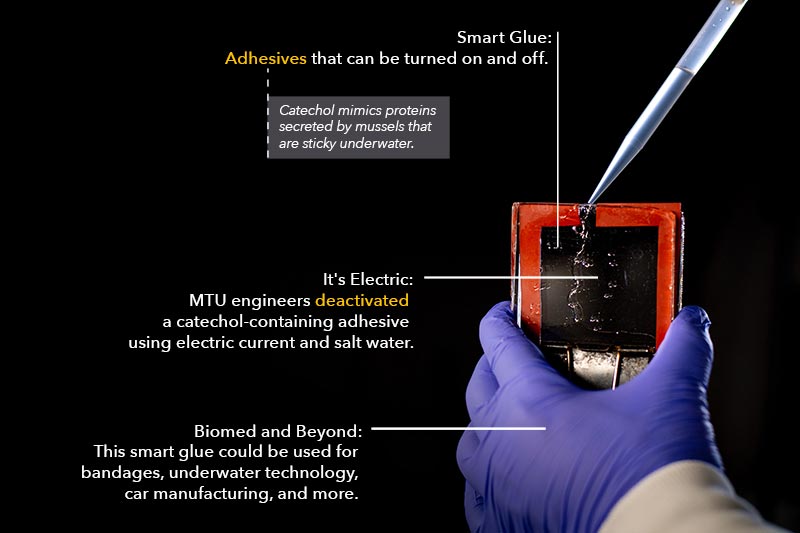
    Turning adhesion on and off is what makes a glue smart. It’s one thing to do this in the open air and quite another under water. Inspired by nature, catechols are synthetic compounds that mimic the wet-but-still-sticky proteins secreted by mussels and offer promise for smart adhesives that work in water. The technology could help with underwater glue, wound dressings, prosthetic attachments or even making car parts and in other manufacturing.
    Catechol Containing Smart Glue
    Turning adhesion on and off is what makes a glue smart. It’s one thing to do this in the open air and quite another under water. Inspired by nature, catechols are synthetic compounds that mimic the wet-but-still-sticky proteins secreted by mussels and offer promise for smart adhesives that work in water. The technology could help with underwater glue, wound dressings, prosthetic attachments or even making car parts and in other manufacturing. Credit: Nicole Kelly, Sarah Bird/Michigan Tech

    Bruce Lee, associate professor of biomedical engineering at Michigan Tech, is a part of the Office of Naval Research’s (ONR) Young Investigator Program (YIP) and showed how to use pH to make smart underwater adhesives. Along with doctoral researcher Saleh Akram Bhuiyan, Lee developed a new method using an electrical current to turn off the adhesion of a catechol-containing material.

    The team’s findings came out in the Journal of the American Chemical Society and detailed the stickiest part of the process — creating a repeatable contact mechanics test that can measure adhesion before and after a jolt of electricity.

    “A lot of people have been using catechol to mimic mussels and their adhesive proteins, but applying electricity to deactivate it is new,” Lee said. “It’s more convenient than using pH like what we were using before and it should be easier to integrate with electronic devices, which means detaching could be automated and could be as simple as pushing a button.”

    Catechols for Smart Glue

    One day catechol adhesives may help attach equipment to the hulls of submarines but testing prototypes in scuba gear isn’t how new tech gets created. Instead, Lee and Bhuiyan need to control a suite of variables in a small lab space. Simple as it sounds, running a current through a material and checking its stickiness is actually quite difficult to do over and over again.

    Bhuiyan developed a setup that uses a titanium sphere and a platinum wire electrode to apply electrical stimulation to the adhesive that is in contact with the sphere in the presence of salty water. This method makes it easy to control the voltage applied through the wire, glue and sphere as well as how salty the water is around them. The amount of time the current runs is also important. With more time, voltage and salt, the more the catechol adhesives gets oxidized and the less adhesive it becomes. With strong enough voltage, the glue detaches in only seven seconds.
    Catechol Containing Adhesives
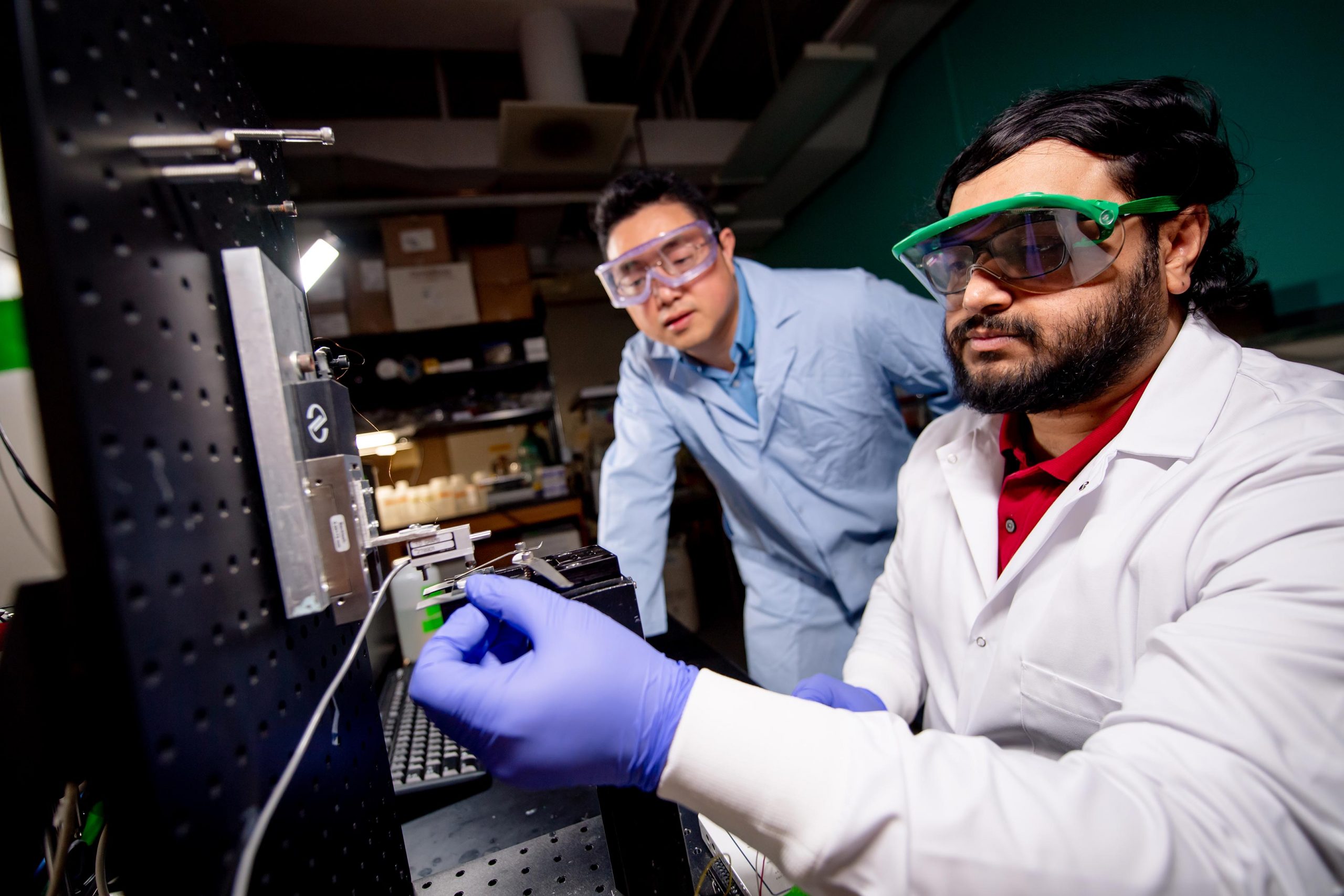
    A titanium sphere and a thin platinum wire act as electrodes to deliver a jolt of electricity to a catechol-containing adhesive. A Michigan Tech team has used electricity for the first time to deactivate a catechol-containing adhesive in salt water. Credit: Sarah Bird/Michigan Tech

    “The novelty is application of the electricity and the short amount of time it takes to detach,” Bhuiyan said. “What I find most unusual about the experiment is the color change. It starts white and when I apply the electricity and the material is deactivated, it oxidizes and turns a red color — and we really like to see that red color.”

    The next step in the research will be taking that red and trying to turn it back into white. The hallmark of a smart glue is not only deactivating adhesion, but turning it back on. Lee and doctoral graduate Ameya Narkar were able to accomplish this feat by playing with pH, which earned them the Bhakta Rath Research Award, and Bhuiyan hopes to apply the lessons from that research to using electrical current.

    From painless bandages to underwater glue, from automotive gear to prosthetic limbs, catechol-containing adhesives are versatile and promising materials.

    Reference: “In Situ Deactivation of Catechol-Containing Adhesive Using Electrochemistry” by Md. Saleh Akram Bhuiyan, James D. Roland, Bo Liu, Max Reaume, Zhongtian Zhang, Jonathan D. Kelley and Bruce P. Lee, 11 February 2020, Journal of the American Chemical Society.
    DOI: 10.1021/jacs.9b11266

    Never miss a breakthrough: Join the SciTechDaily newsletter.
    Follow us on Google and Google News.

    Biochemistry Electrical Engineering Materials Science Michigan Technological University
    Share. Facebook Twitter Pinterest LinkedIn Email Reddit

    Related Articles

    Breakthrough: Catalyzing a Zero-Carbon World by Harvesting Energy From Living Cells

    Scientists Design New Lightweight Magnets With Outstanding Properties

    Synthetic Melanin Dyes Developed for Natural-Looking Hair Colors

    Researchers Develop a Flexible Color-Changing Film Inspired by Chameleon Skin

    What Happens Between the Sheets? Extremely-Promising Superconductor Surprises Everyone

    Sulfur-Scavenging Bacteria Could Be Key to Biomanufacturing Common Component of Plastic

    Revolutionary ‘Green’ Bricks Made From Recycled Plastic and Organic Waste

    ‘Eco’ Super-Glue Made From Plant-Based Particles and Water – Single Drop Can Hold 200 Pounds

    New Technique Could Improve Electronics’ Energy Efficiency

    Leave A Reply Cancel Reply

    • Facebook
    • Twitter
    • Pinterest
    • YouTube

    Don't Miss a Discovery

    Subscribe for the Latest in Science & Tech!

    Trending News

    Just a Few Breathless Minutes a Day Could Slash Your Risk of 8 Major Diseases

    This Simple Habit Could Cut Your Risk of Dementia by 30%

    Scientists Debunk Rattlesnake Myth That Fooled Hikers and Doctors for Decades

    Scientists Discover Plants Can “Count” – and May Be Smarter Than We Thought

    New Research Reveals Ancient Mars May Have Been Warm, Wet – and Possibly Alive

    This Surprising Daily Habit Could Cut Dementia Risk by 35%

    Just 10 Minutes a Day: Scientists Say This Ancient Chinese Practice Shows Powerful Blood Pressure Benefits

    Scientists Say This Popular Food Could Help Your Body Get Rid of Microplastics

    Follow SciTechDaily
    • Facebook
    • Twitter
    • YouTube
    • Pinterest
    • Newsletter
    • RSS
    SciTech News
    • Biology News
    • Chemistry News
    • Earth News
    • Health News
    • Physics News
    • Science News
    • Space News
    • Technology News
    Recent Posts
    • Even Occasional Binge Drinking May Triple Liver Damage Risk
    • Quantum Circuits Have a Hidden Weakness and It Changes Everything
    • Liftoff! NASA’s Artemis II Launch Sends Astronauts Around the Moon for First Time in 50 Years
    • Giant Invasive Mantises Are Taking Over Europe
    • Ancient Farmers Accidentally Bred Aggressive “Warrior” Plants
    Copyright © 1998 - 2026 SciTechDaily. All Rights Reserved.
    • Science News
    • About
    • Contact
    • Editorial Board
    • Privacy Policy
    • Terms of Use

    Type above and press Enter to search. Press Esc to cancel.