
Close Menu
    Facebook X (Twitter) Instagram
    SciTechDaily
    • Biology
    • Chemistry
    • Earth
    • Health
    • Physics
    • Science
    • Space
    • Technology
    Facebook X (Twitter) Pinterest YouTube RSS
    SciTechDaily
    Home»Space»Closest Flyover of Asteroid Sample Site Nightingale Completed by OSIRIS-REx
    Space

    Closest Flyover of Asteroid Sample Site Nightingale Completed by OSIRIS-REx

    By NASA's Goddard Space Flight CenterJanuary 23, 2020No Comments2 Mins Read
    Facebook Twitter Pinterest Telegram LinkedIn WhatsApp Email Reddit
    Share
    Facebook Twitter LinkedIn Pinterest Telegram Email Reddit
    OSIRIS-REx Nightingale Flyover
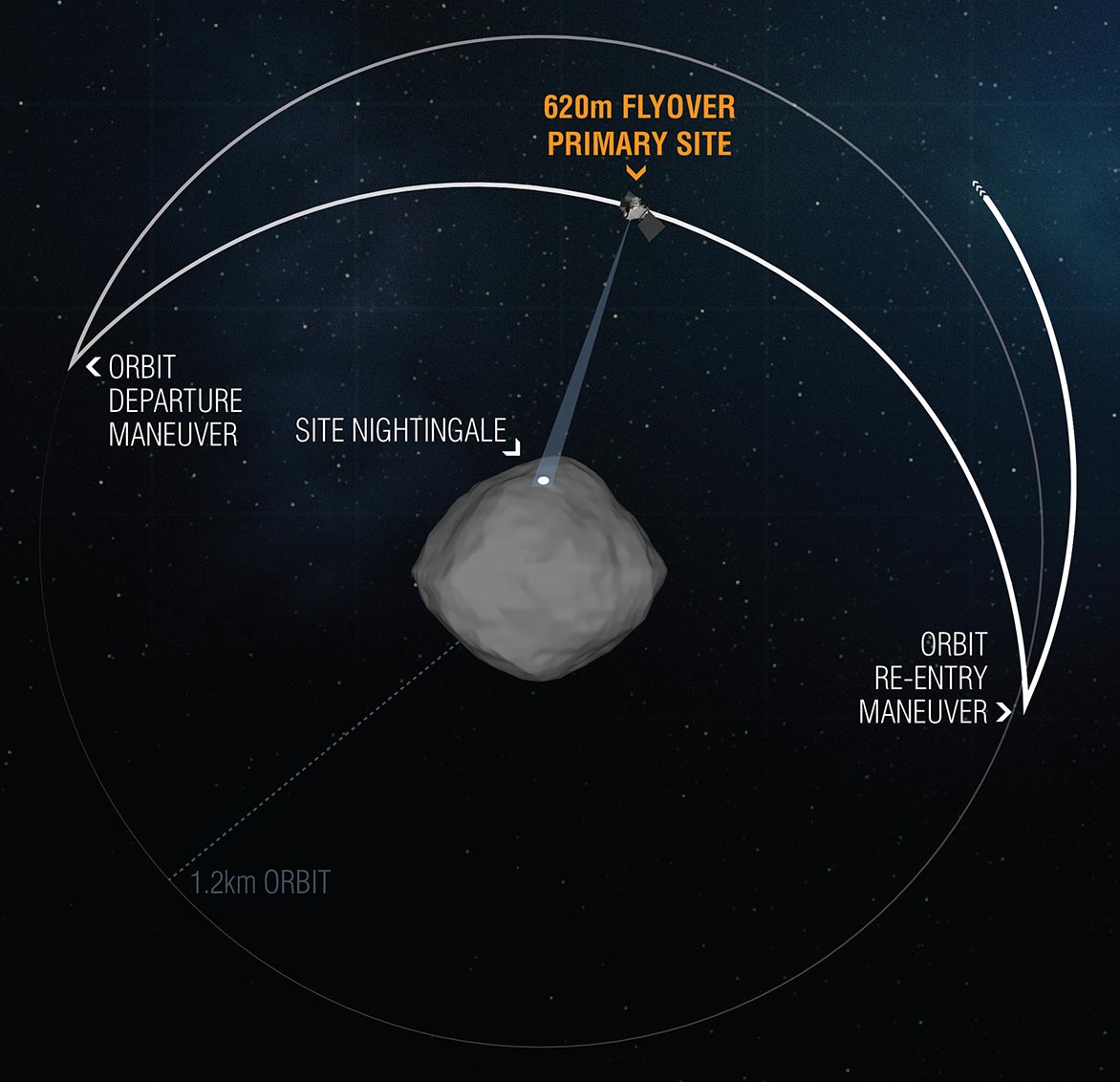
    During the OSIRIS-REx Reconnaissance B flyover of primary sample collection site Nightingale, the spacecraft left its safe-home orbit to pass over the sample site at an altitude of 0.4 miles (620 m). The pass, which took 11 hours, gave the spacecraft’s onboard instruments the opportunity to take the closest-ever science observations of the sample site. Credit: NASA/Goddard/University of Arizona

    Preliminary results indicate that NASA’s OSIRIS-REx spacecraft successfully executed a 0.4-mile (620-m) flyover of site Nightingale yesterday as part of the mission’s Reconnaissance B phase activities. Nightingale, OSIRIS-REx’s primary sample collection site, is located within a crater high in asteroid Bennu’s northern hemisphere.

    To perform the pass, the spacecraft left its 0.75-mile (1.2-km) safe home orbit and flew an almost 11-hour transit over the asteroid, aiming its science instruments toward the 52-ft (16-m) wide sample site before returning to orbit. Science observations from this flyover are the closest taken of a sample site to date.

    The primary goal of the Nightingale flyover was to collect the high-resolution imagery required to complete the spacecraft’s Natural Feature Tracking image catalog, which will document the sample collection site’s surface features – such as boulders and craters. During the sampling event, which is scheduled for late August, the spacecraft will use this catalog to navigate with respect to Bennu’s surface features, allowing it to autonomously predict where on the sample site it will make contact. Several of the spacecraft’s other instruments also took observations of the Nightingale site during the flyover event, including the OSIRIS-REx Thermal Emissions Spectrometer (OTES), the OSIRIS-REx Visual and InfraRed Spectrometer (OVIRS), the OSIRIS-REx Laser Altimeter (OLA), and the MapCam color imager.

    A similar flyover of the backup sample collection site, Osprey, is scheduled for February 11, 2020. Even lower flybys will be performed later this spring – Mar. 3 for Nightingale and May 26 for Osprey – as part of the mission’s Reconnaissance C phase activities. The spacecraft will perform these two flyovers at an altitude of 820 feet (250 m), which will be the closest it has ever flown over asteroid Bennu’s surface.

    Never miss a breakthrough: Join the SciTechDaily newsletter.
    Follow us on Google and Google News.

    Asteroid NASA NASA Goddard Space Flight Center OSIRIS-REx
    Share. Facebook Twitter Pinterest LinkedIn Email Reddit

    Related Articles

    NASA Uncovers Life’s Building Blocks in Asteroid Bennu’s Pristine Sample

    NASA’s Asteroid Sampling Spacecraft to Pursue Its First Practice Run

    Features on Asteroid Bennu Now Have Official Names – Based on Mythological Creatures

    OSIRIS-REx Swoops Over Sample Site Nightingale on Asteroid Bennu

    NASA’s OSIRIS-REx Spacecraft Completes Osprey Flyover – But There Was a Problem

    NASA Selects Nightingale Crater on Bennu for Asteroid Sample Collection

    Daring Rescue of Monumental Asteroid Mission – Here’s How Engineers Pulled It Off

    Asteroid Bennu’s Mysterious Particle Events Explained by NASA’s OSIRIS-REx [Video]

    NASA’s OSIRIS-REx Mission to Collect Asteroid Sample Moves Into Development Phase

    Leave A Reply Cancel Reply

    • Facebook
    • Twitter
    • Pinterest
    • YouTube

    Don't Miss a Discovery

    Subscribe for the Latest in Science & Tech!

    Trending News

    Scientists Call for a Complete Rethink of Alzheimer’s Treatment

    Scientists Identify Molecular Switch That Lets Exercise Reverse Muscle Aging

    Why Your Most Vivid Dreams Might Be the Key to Deep, Restful Sleep

    A Bright Star Hid a Massive Secret for 50 Years: Mystery of Gamma Cassiopeiae Finally Solved

    Scientists Identify Protein That Slows Key Effects of Aging

    Revolutionary Submarine Mysteriously Disappears Without a Trace – Scientists Are Now Preparing for a Bold Return

    Why Drinking More Water Isn’t Enough To Stop Kidney Stones

    New Study Reveals Surprising Effect of Drinking Coffee at Night

    Follow SciTechDaily
    • Facebook
    • Twitter
    • YouTube
    • Pinterest
    • Newsletter
    • RSS
    SciTech News
    • Biology News
    • Chemistry News
    • Earth News
    • Health News
    • Physics News
    • Science News
    • Space News
    • Technology News
    Recent Posts
    • Mystery Deepens: Astrophysicists Say Dark Matter May Not Be One Thing
    • Life Without a Sun? Scientists Say It May Thrive on Rogue Planet Moons
    • Your BMI Might Be Wrong: Study Finds Millions Are Misclassified
    • More Than Half of U.S. College Students Are Lonely, Major Study Reveals
    • Scientists Reveal Biological Signal Behind Mysterious Alzheimer’s Drug Side Effect
    Copyright © 1998 - 2026 SciTechDaily. All Rights Reserved.
    • Science News
    • About
    • Contact
    • Editorial Board
    • Privacy Policy
    • Terms of Use

    Type above and press Enter to search. Press Esc to cancel.