
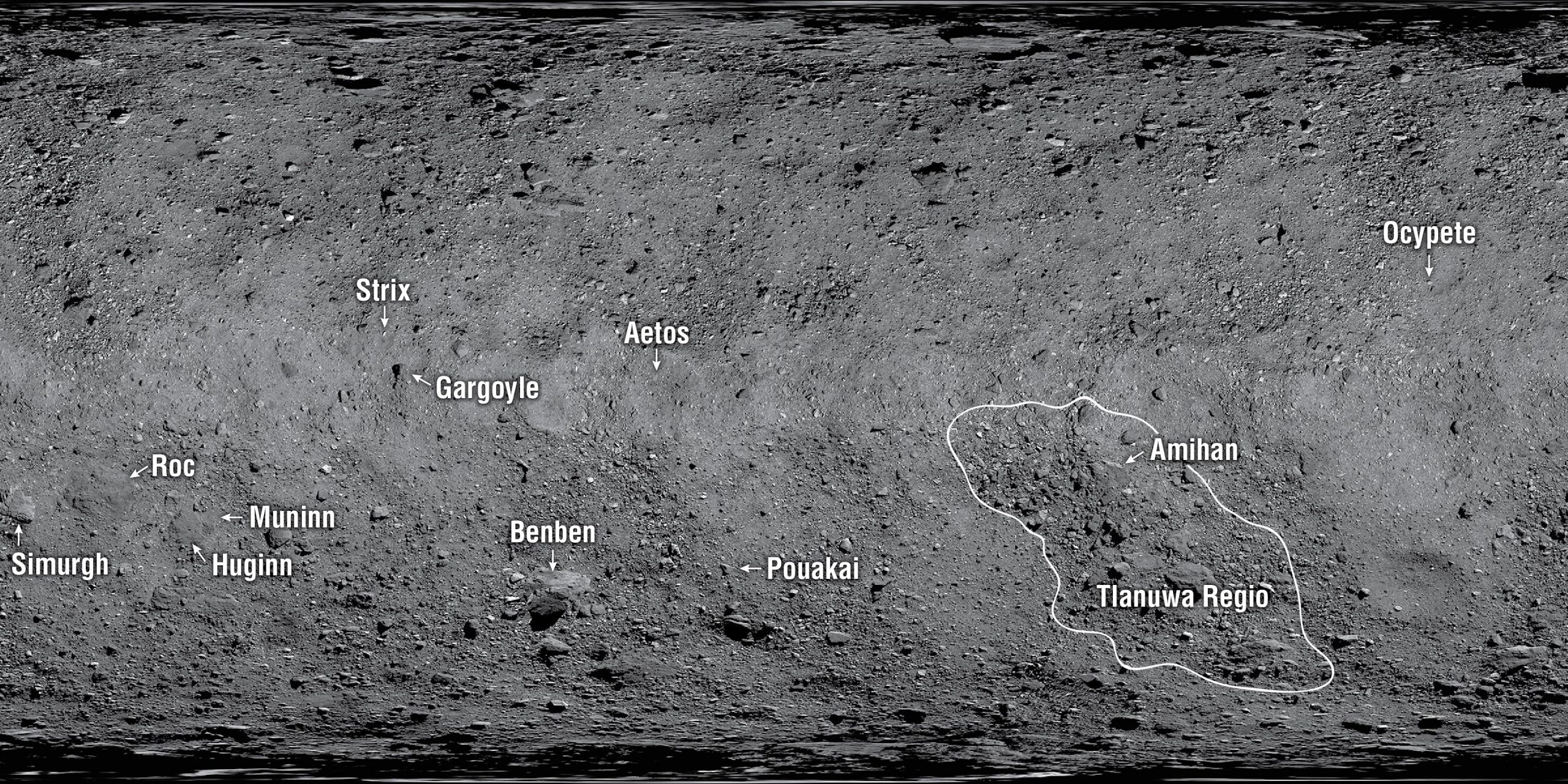
Asteroid Bennu’s most prominent boulder, a rock chunk jutting out 71 ft (21.7 m) from the asteroid’s southern hemisphere, finally has a name. The boulder – which is so large that it was initially detected from Earth – is officially designated Benben Saxum after the primordial hill that first arose from the dark waters in an ancient Egyptian creation myth.
Benben Saxum and 11 other features on the asteroid are the first to receive official Bennu feature names approved by the International Astronomical Union (IAU), the internationally recognized authority for naming celestial bodies and their surface features. The accepted names were proposed by NASA’s OSIRIS-REx team members, who have been mapping the asteroid in detail over the last year. The OSIRIS-REx spacecraft, NASA’s first asteroid sample return mission, is currently visiting the asteroid and is scheduled to collect a sample from Bennu’s surface this summer.
“Since arriving at the asteroid, the OSIRIS-REx team has become incredibly familiar with all of the geological features on Bennu,” said Dante Lauretta, OSIRIS-REx principal investigator at the University of Arizona, Tucson. “These features are providing us with insight into Bennu’s history, and their new names symbolize the essence of the mission – studying the past to both discover our origins and understand our future,” said Dante Lauretta, OSIRIS-REx principal investigator at the University of Arizona, Tucson.
The approved Bennu surface feature names are listed below. Bennu’s diverse terrain types – including regiones (broad geographic regions), craters, dorsa (ridges), fossae (grooves or trenches) and saxa (rocks and boulders) – will be named after birds and bird-like creatures in mythology, and the places associated with them.
Tlanuwa Regio is named for the giant birds who scattered the Earth with pieces of a serpent that turned into standing pillars of rocks in Cherokee mythology. Tlanuwa Regio is an area covered by large boulders in Bennu’s southern hemisphere.
Benben Saxum is named for an ancient Egyptian mound that arose from the primordial waters Nu. In Egyptian mythology, the god Atum settled upon Benben to create the world after his flight over the waters in the form of the Bennu bird. Benben Saxum is the tallest boulder on Bennu.
Roc Saxum is named for the Roc, an enormous bird of prey in the Arabian mythology of the Middle East. Roc Saxum is the largest boulder feature on Bennu.
Simurgh Saxum is named for the benevolent, mythological bird in Persian mythology. The Simurgh was said to possess all knowledge, and Simurgh Saxum defines the prime meridian on Bennu and is the basis for the asteroid’s coordinate system.
Huginn Saxum and Muninn Saxum are adjacent boulders named for the two ravens, Huginn and Muninn, who accompany the god Odin in Norse mythology.
Ocypete Saxum is named for one of the Greek harpies, the half-maiden and half-bird personification of storm winds that would snatch and carry things away from Earth. Ocypete Saxum is located near the origin of the Jan. 19, 2019, particle ejection event on Bennu.
Strix Saxum is named for the Strix bird of ill-omen from Roman mythology. Strix Saxum is a large boulder flanking the OSIRIS-REx mission’s backup sample collection site.
Amihan Saxum is named for the Tagalog (Philippines) mythological deity, who is depicted as a bird and was the first creature to inhabit the universe. This large, flat boulder appears to be partially buried and is located in Tlanuwa Regio, which has an unusually high concentration of large boulders.
Pouakai Saxum is named for the monstrous bird who kills and eats humans in Māori (Polynesia) mythology. Pouakai Saxum is a 55 ft (10.6 m)-wide boulder located in Bennu’s southern hemisphere, slightly north of Benben Saxum.
Aetos Saxum is named for the childhood playmate of the supreme god Zeus, who was turned into an eagle by Hera in Greek mythology. Aetos Saxum is a conspicuously flat boulder, with a general wing-like shape located near Bennu’s equator.
Gargoyle Saxum is named for the French dragon-like monster with wings, a bird-like neck, and the ability to breathe fire. Gargoyle Saxum is a large prominent boulder near the mission’s backup sample site that is one of the darkest objects on the surface.
NASA’s Goddard Space Flight Center in Greenbelt, Maryland provides overall mission management, systems engineering, and the safety and mission assurance for OSIRIS-REx. Dante Lauretta of the University of Arizona, Tucson, is the principal investigator, and the University of Arizona also leads the science team and the mission’s science observation planning and data processing. Lockheed Martin Space in Denver built the spacecraft and is providing flight operations. Goddard and KinetX Aerospace are responsible for navigating the OSIRIS-REx spacecraft. OSIRIS-REx is the third mission in NASA’s New Frontiers Program, which is managed by NASA’s Marshall Space Flight Center in Huntsville, Alabama, for the agency’s Science Mission Directorate in Washington.
Never miss a breakthrough: Join the SciTechDaily newsletter.
Follow us on Google and Google News.