
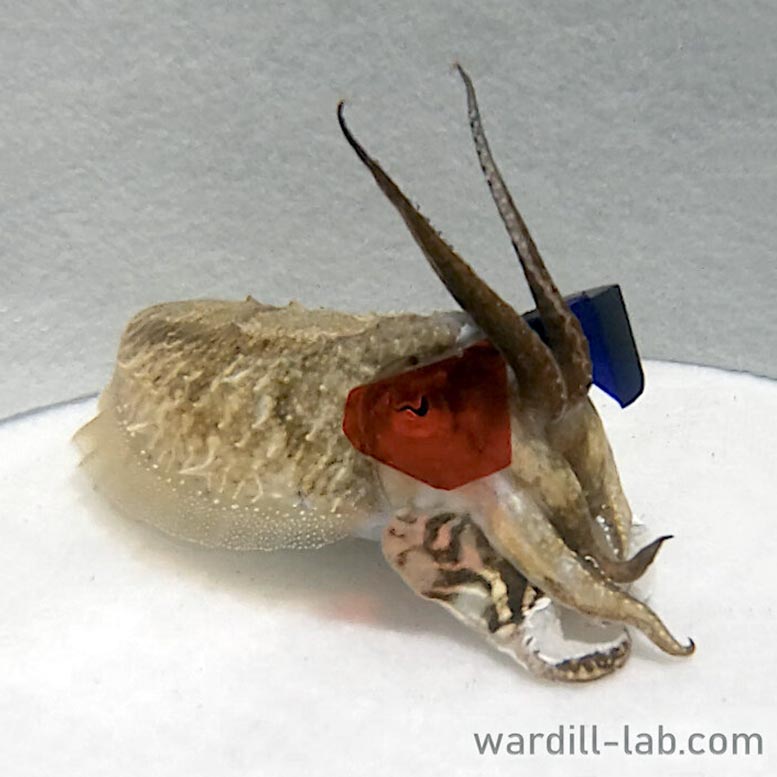
3D movies reveal how cuttlefish determine distance when striking at prey.
While cuttlefish wearing glasses is an unexpected sight, a University of Minnesota-led research team built an underwater theater and equipped the cephalopods with specialized 3D glasses to investigate how cuttlefish determine the best distance to strike moving prey. Their research revealed cuttlefish use stereopsis to perceive depth when hunting a moving target.
The findings are published in the journal Science Advances.
Cuttlefish catch a meal by deploying their tentacles and, to be successful in their strike, cuttlefish must compute depth to position themselves at the correct distance from the prey. If they are too close, the prey may be spooked and escape; too far, and the tentacles will not reach.
To test how the cuttlefish brain computes the distance to an object, the team trained cuttlefish to wear 3D glasses and strike at images of two walking shrimp, each a different color displayed on a computer screen at the Marine Biological Laboratory in Woods Hole, Mass.
The images were offset, allowing for the researchers to determine if the cuttlefish were comparing images between the left and the right eyes to gather information about the distance to their prey. The process of comparing the images is called stereopsis, and is the same way humans determine depth. Depending on the image offset, the cuttlefish would perceive the shrimp to be either in front of or behind the screen. The cuttlefish predictably struck too close to or too far from the screen, according to the offset.
“How the cuttlefish reacted to the disparities clearly establishes that cuttlefish use stereopsis when hunting,” said Trevor Wardill, assistant professor at the Department of Ecology, Evolution and Behavior in the College of Biological Sciences. “When only one eye could see the shrimp, meaning stereopsis was not possible, the animals took longer to position themselves correctly. When both eyes could see the shrimp, meaning they utilized stereopsis, it allowed cuttlefish to make faster decisions when attacking. This can make all the difference in catching a meal.”
Through this process, the investigators also found the mechanism that underpins cuttlefish stereopsis is likely different from humans due to the cuttlefish successfully determining the distance from the anti-correlated stimulus (i.e., the left and the right eye images have the same pattern, but are reversed in luminance). Humans cannot do this reliably.
“While cuttlefish have similar eyes to humans, their brains are significantly different,” said Paloma Gonzalez-Bellido, assistant professor at the Department of Ecology, Evolution and Behavior in the College of Biological Sciences. “We know that cuttlefish brains aren’t segmented like humans. They do not seem to have a single part of the brain — like our occipital lobe — dedicated to processing vision. Our research shows there must be an area in their brain that compares the images from a cuttlefish’s left and right eye and computes their differences.”
Moreover, cuttlefish have the ability to rotate their eyes to a forward-facing position, a unique trait that sets them apart from their cephalopod relatives (e.g., squid and octopus). It is possible that cuttlefish are the only cephalopods with the ability to compute and use stereopsis. Mantids are the only other invertebrate species known to use stereopsis.
If it was once thought that complex brain computations, such as stereopsis, were exclusive to higher-order vertebrates, studies such as this are leading scientists to reconsider the capabilities of invertebrate brains.
“This study takes us a step further toward understanding how different nervous systems have evolved to tackle the same problem,” said Rachael Feord, Ph.D., the research paper’s first author. “The next step is to dissect the brain circuits required for the computation of stereopsis in cuttlefish with the aim of understanding how this might be different to what happens in our brains.”
Reference: “Cuttlefish use stereopsis to strike at prey” by R. C. Feord, M. E. Sumner, S. Pusdekar, L. Kalra, P. T. Gonzalez-Bellido and Trevor J. Wardill, 8 January 2020, Science Advances.
DOI: 10.1126/sciadv.aay6036
This study was supported with funding from a Marine Biological Laboratory Whitman Center Fellowship, the University of Minnesota’s College of Biological Sciences and the Biotechnology and Biological Sciences Research Council Doctoral Training Program scholarship.
Never miss a breakthrough: Join the SciTechDaily newsletter.
Follow us on Google and Google News.