
Close Menu
    Facebook X (Twitter) Instagram
    SciTechDaily
    • Biology
    • Chemistry
    • Earth
    • Health
    • Physics
    • Science
    • Space
    • Technology
    Facebook X (Twitter) Pinterest YouTube RSS
    SciTechDaily
    Home»Biology»Relationships of Male Dolphins from Shark Bay Determined by Slow Swimming
    Biology

    Relationships of Male Dolphins from Shark Bay Determined by Slow Swimming

    By SciTechDailyApril 2, 2012No Comments3 Mins Read
    Facebook Twitter Pinterest Telegram LinkedIn WhatsApp Email Reddit
    Share
    Facebook Twitter LinkedIn Pinterest Telegram Email Reddit
    shark-bay-slow-swimming-dolphins
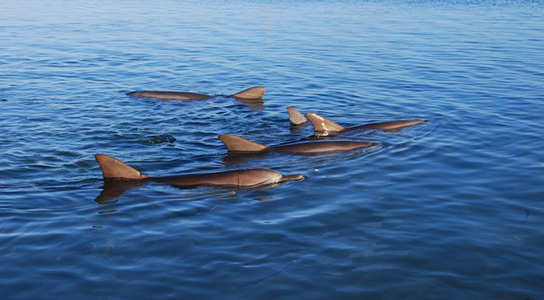
    Shark Bay Dolphins

    In Shark Bay, Australia, the male dolphins are well known to marine biologists for their messy social entanglements. These relationships are so unique, that they’re more like intricate webs of the way that the Cosa Nostra and the Mafia work than the typically vertical hierarchies of chimpanzees. A team of scientists argues in a recent article, published in the journal Proceedings of the Royal Society B, that this social system is unique among mammals.

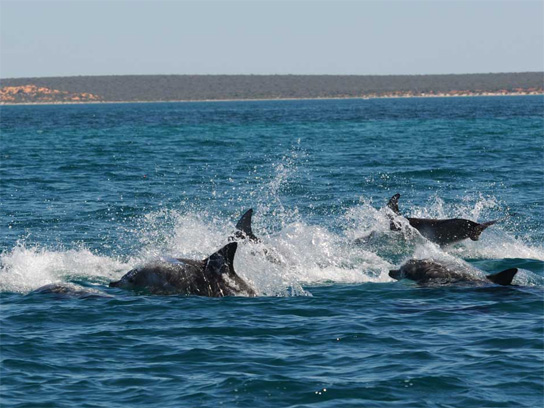
    These complex, and sometimes cooperative, relationships might stem from one simple and somewhat unexpected factor. These dolphins tend to swim at low speeds. Two or three adult males will form a tight alliance and cooperate to herd a female for mating purposes. Female dolphins don’t form strong alliances. The males in the first-level alliance form partnerships with other first-level alliances, creating a larger second-level alliance to protect the females, especially if they are in estrus.
    shark-bay-dolphins-at-war

    The larger, second-level alliances, can have as many as 14 dolphins and can last more than 15 years. They can even marshal troops from other groups, leading to huge battles and skirmishes over the right to keep or steal a single female.

    Researchers wanted to discover if these dolphin battles were similar to chimpanzee battles, where the males are fighting over territory. The team, led by Richard Connor, a cetacean biologist at the University of Massachusetts, Dartmouth, tracked 12 of the second-level alliances in Shark Bay, a 13,000-square-kilometer (5,000-square-mile) bay in western Australia.

    The team tracked the dolphins over six years during the peak mating periods. It was discovered that, unlike chimps, dolphins weren’t interested in territory. They lived within a mosaic of overlapping ranges, that were patrolled by males and females. The dolphins live in an open society, with groups teaming up and splitting apart, while continually measuring who stays on top and deciding whether to stay friends or foes.

    None of the other mammals with complex relationships are able to go outside their immediate community to form alliances. Only elephant society comes close, but they live in matrilineal groups and they aren’t as changeable as dolphin alliances.

    Female dolphins give birth to single calves every few years, which means that the males cannot form alliances with close kin. This pushes male dolphins to learn how to make and maintain friendships, demanding social skills that might have contributed to the dolphins’ larger brains.

    Connor thinks that their high level of social cognition, which is a convergence for not only dolphins, but humans and elephants as well, may be due to the minimal amount of energy these species expend when moving at slow speeds. The slow speeds force these dolphins to forge new alliances whenever they meet other groups.

    Reference: “Physical competition increases testosterone among Amazonian forager-horticulturalists: a test of the ‘challenge hypothesis’” by Benjamin C. Trumble, Daniel Cummings, Christopher von Rueden, Kathleen A. O’Connor, Eric A. Smith, Michael Gurven and Hillard Kaplan, 28 March 2012, Proceedings of the Royal Society B.
    DOI: 10.1098/rspb.2012.0455

    Never miss a breakthrough: Join the SciTechDaily newsletter.
    Follow us on Google and Google News.

    Australia Cetacean Dolphins Evolution Mammal Marine Biology Popular Relationships Sharks Slow Swimming Social
    Share. Facebook Twitter Pinterest LinkedIn Email Reddit

    Related Articles

    Why Great White Sharks’ DNA Doesn’t Add Up

    Answers to a Fundamental Puzzle: Why Are Some Fish Warm-Blooded When Most Are Not?

    Massive Predator: School Lesson Gone Wrong Leads to New, Bigger Megalodon Size Estimate

    Prehistoric Shark Hid Its Largest, Sharpest Teeth

    Unexpected Discovery of a 410-Million-Year-Old Fossil Forces Rethink of Shark Evolution

    Discovery of Giant 15′ Extinct Dolphin Shows Surprising Parallel Evolution With Whales

    Scientists Cracked the Case of Why Octopuses of the Same Species Can Look Totally Different

    Great White Shark Have a More Varied Diet Than Previously Thought

    Black Band Disease Puts Great Barrier Reef at Risk

    Leave A Reply Cancel Reply

    • Facebook
    • Twitter
    • Pinterest
    • YouTube

    Don't Miss a Discovery

    Subscribe for the Latest in Science & Tech!

    Trending News

    New Pill Lowers Stubborn Blood Pressure and Protects the Kidneys

    Humans May Have Hidden Regenerative Powers, New Study Suggests

    Scientists Just Solved the Mystery of Why Crabs Walk Sideways

    Doctors Are Surprised by What This Vaccine Is Doing to the Heart

    This Popular Supplement May Boost Your Brain, Not Just Your Muscles

    Scientists Say This Simple Supplement May Actually Reverse Heart Disease

    Warming Oceans Could Trigger a Dangerous Methane Surge

    This Simple Movement Could Be Secretly Cleaning Your Brain

    Follow SciTechDaily
    • Facebook
    • Twitter
    • YouTube
    • Pinterest
    • Newsletter
    • RSS
    SciTech News
    • Biology News
    • Chemistry News
    • Earth News
    • Health News
    • Physics News
    • Science News
    • Space News
    • Technology News
    Recent Posts
    • Scientists Say This Daily Walking Habit May Be the Secret to Keeping Weight Off After Dieting
    • New Therapy Rewires the Brain To Restore Joy in Depression Patients
    • Researchers Discover Efficient New Way To Split Hydrogen From Water for Energy
    • This Korean Skincare Ingredient Could Help Fight Deadly Superbugs
    • Giant Squid Detected off Western Australia in Stunning Deep-Sea Discovery
    Copyright © 1998 - 2026 SciTechDaily. All Rights Reserved.
    • Science News
    • About
    • Contact
    • Editorial Board
    • Privacy Policy
    • Terms of Use

    Type above and press Enter to search. Press Esc to cancel.