
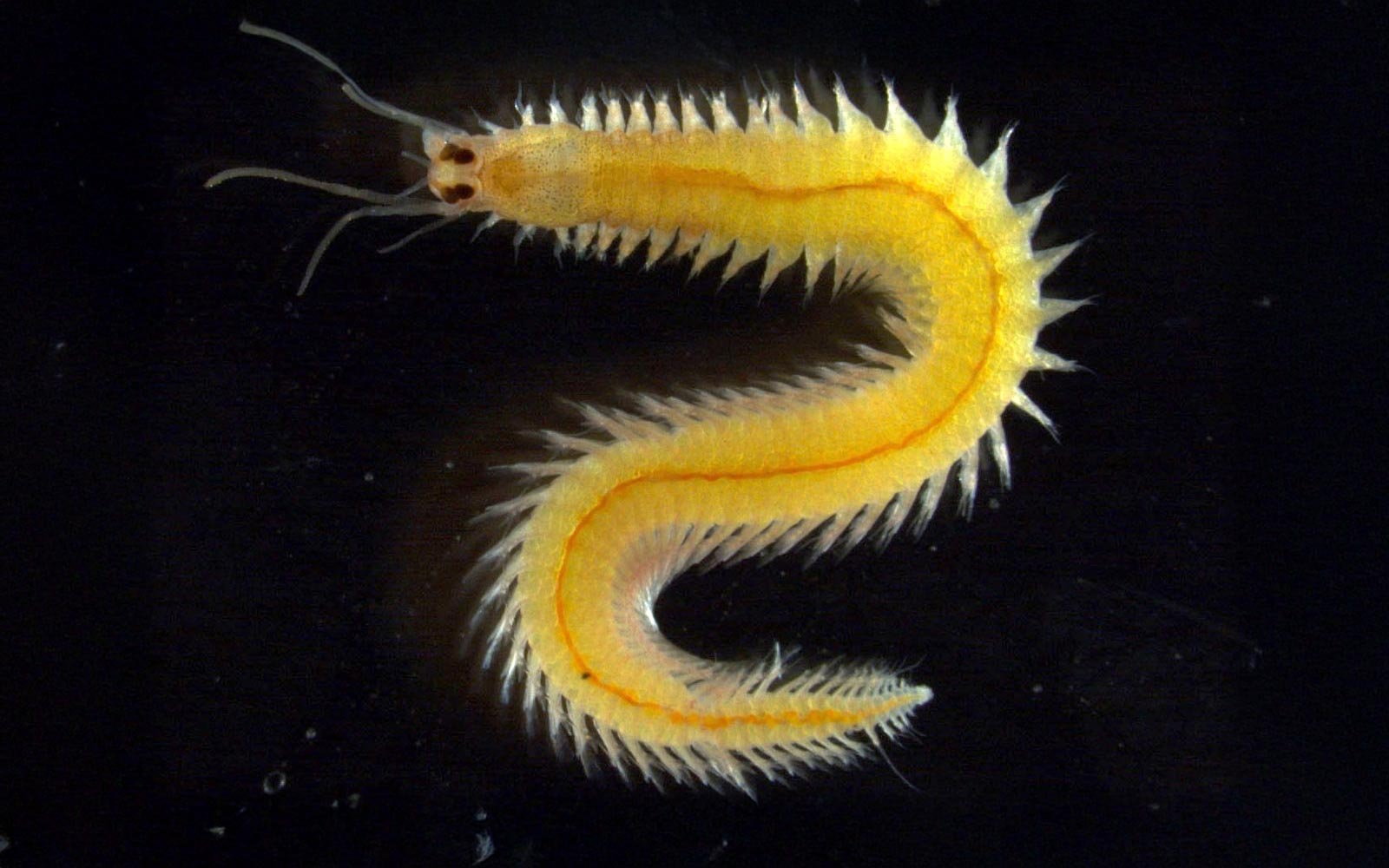
A ring of light-responsive stem cells helps bristleworms continually expand their eyes, offering an unexpected parallel to vertebrate eye growth.
The findings reveal shared evolutionary solutions for building vision and hint at deeper connections between light and neural development.
Sea Worms With Surprisingly Advanced Eyes
When people picture animals with sophisticated eyes, they usually think of mammals, birds, or octopuses. However, some marine annelid worms, including the bristleworm Platynereis dumerilii, also possess eyes built in a camera-like style similar to those found in vertebrates and cephalopods. These worms can even achieve unexpectedly sharp vision.
One major question has remained open: how do these invertebrate eyes keep growing after the worm reaches adulthood? An international research team from the University of Vienna, the Alfred Wegener Institute in Bremerhaven, and the University of Oldenburg set out to investigate this and uncovered compelling new findings.
Parallel Evolution and Continuous Eye Development
Camera-type eyes in worms and vertebrates are classic examples of parallel evolution. They appear to have arisen independently as comparable solutions to similar biological challenges. To understand how these eyes continue developing after maturity, the researchers examined the adult eyes of Platynereis, a longtime model for studying photoreceptors and early brain evolution.
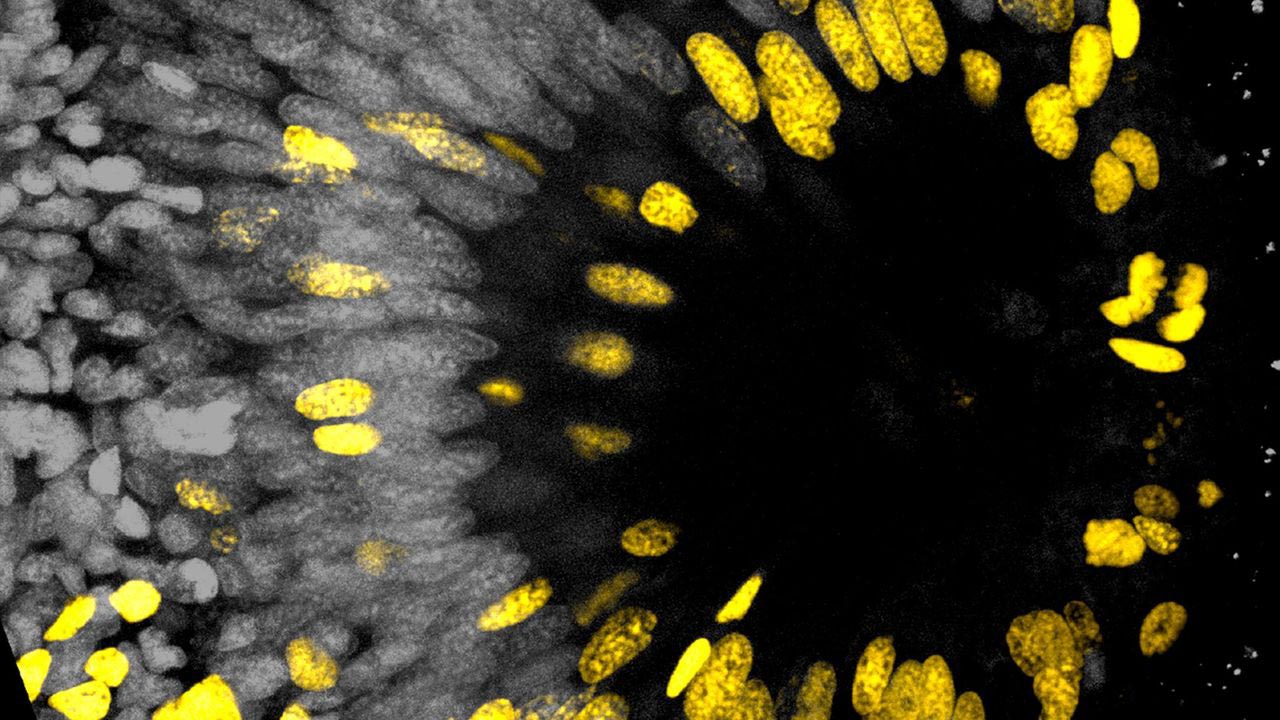
Using single-cell RNA sequencing, first author Nadja Milivojev from the Department of Neurosciences and Developmental Biology, University of Vienna, identified molecular signatures of stem cells and mapped their position and activity within the worm retina. Her work revealed a clearly defined region at the outer edge of the retina where neural stem cells cluster tightly and divide during phases of eye growth.
“It was remarkable to find dividing cells at the edge of the worm’s retina – the same place where some groups of vertebrates maintain their retinal stem cells for life-long eye growth,” Milivojev says.
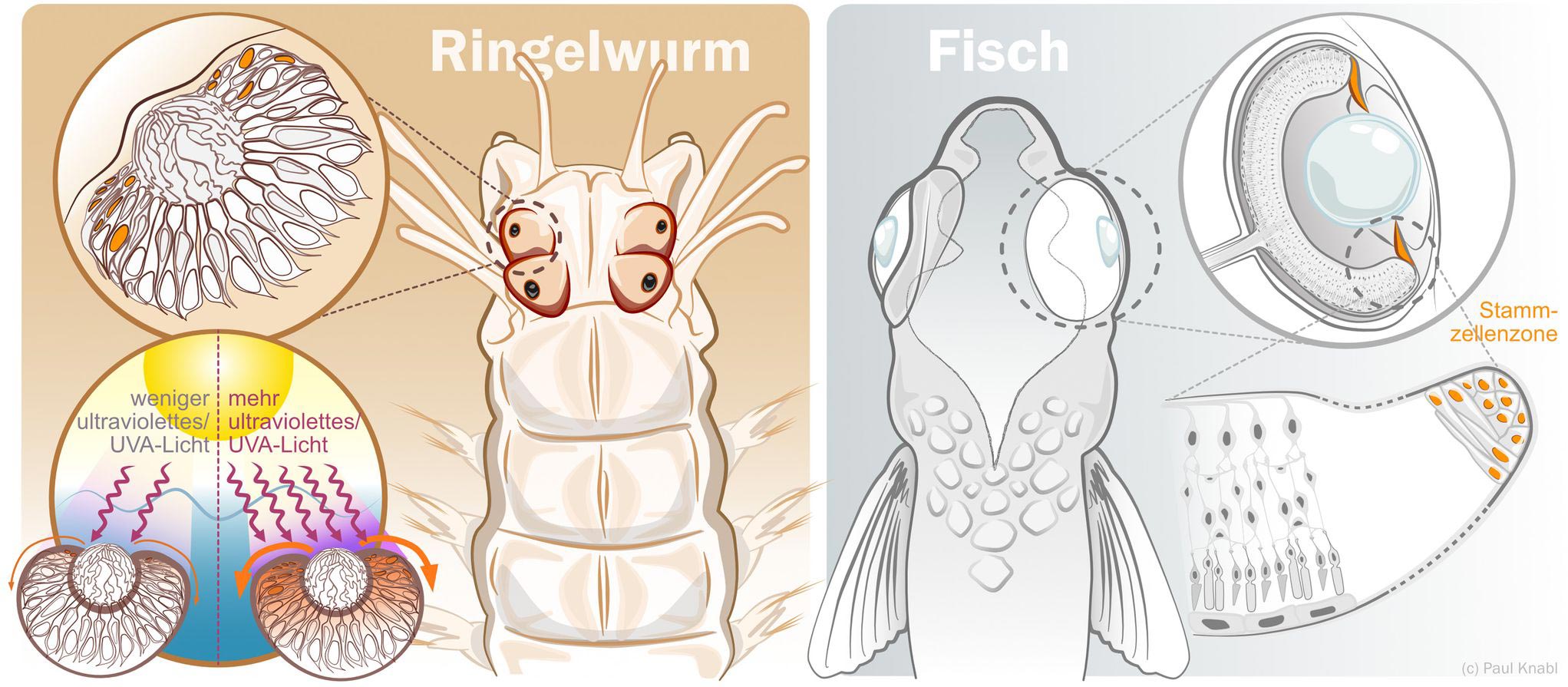
This region, known as the “ciliary marginal zone,” is believed to support steady eye enlargement. Senior author Florian Raible, University of Vienna, explains that in vertebrates such as fishes and amphibians, this area produces fresh retinal neurons as the animal develops.
He notes, “Remarkably, Nadja’s work showed that bristleworm eyes can also add new photoreceptor cells and expand their size – a trait that has not been well studied outside the vertebrate lineage.”
Light-Responsive Stem Cells in Adult Worm Eyes
The study revealed another surprising layer to eye growth in these worms. The researchers discovered that environmental light influences the activity of the adult eye. Their genetic and molecular analyses showed that this effect is mediated by a c-opsin, a light-sensitive molecule also found in vertebrate rod and cone cells.
Previous work had suggested that worm eyes relied on a separate family of opsins, so finding a vertebrate-type c-opsin was unexpected. Milivojev and colleagues identified this molecule in early precursors of the worm’s photoreceptor cells, indicating that it functions as a molecular switch connecting light in the environment to stem cell activity. The results emphasize that visual systems do more than detect light; their development can be shaped by it.
Evolutionary Insights and New Questions
These discoveries help close a long-standing gap in the understanding of how eyes in both invertebrates and vertebrates grow and sustain themselves. Showing that Platynereis eyes depend on a ring of neural stem cells brings researchers closer to identifying universal rules that guide the evolution of sensory organs. The findings also raise several new questions. Could other neural stem cell populations in the body respond to environmental light as well? And how might artificial lighting interfere with natural biological processes? The team hopes that future investigations into the worm’s stem cell systems will shed light on how nervous tissue adapts and regenerates.
Senior author Kristin Tessmar-Raible (University of Vienna, Alfred Wegener Institute, University of Oldenburg) concludes, “Clearly, basic research to uncover the unexpected is essential to understand the biological complexity of life and the possible consequences of anthropogenic impacts.”
Summary
- A research team from the University of Vienna and the Alfred-Wegener Institute studied adult marine bristleworms, an increasingly valuable model for uncovering how eyes and brains develop and how light influences biology beyond vision.
- The scientists found that the eyes of Platynereis dumerilii keep growing for the worm’s entire life. This lifelong growth is powered by a ring of neural stem cells that resembles a similar growth zone found in certain vertebrates that continue expanding their eyes as adults.
- Their findings help resolve a long-standing question about how camera-type eyes in both invertebrates and vertebrates increase in size and stay functional. The work suggests that even across very different evolutionary lineages, many animals rely on shared cellular strategies for growth and adaptability.
- By showing that Platynereis eyes depend on this stem cell ring, the study brings scientists closer to identifying universal principles that guide the evolution of sensory organs.
Reference: “Light-modulated stem cells in the camera-type eye of an annelid model for adult brain plasticity” by Nadja Milivojev, Federico Scaramuzza, Pedro Ozório Brum, Camila L. Velastegui Gamboa, Gabriele Andreatta, Florian Raible and Kristin Tessmar-Raible, 31 November 2025, Nature Communications.
DOI: 10.1038/s41467-025-65631-0
Never miss a breakthrough: Join the SciTechDaily newsletter.
Follow us on Google and Google News.