
Scientists discovered that Antarctica’s ice sheet became dramatically more climate-sensitive after crossing a critical threshold one million years ago.
A new study published in Nature Geoscience suggests that Antarctica’s massive ice sheet underwent a major change about one million years ago, becoming far more responsive to shifts in Earth’s climate.
The research, led by scientists at the IBS Center for Climate Physics (ICCP) at Pusan National University in South Korea, offers fresh insight into how large ice sheets react to long-term climate changes and may help improve projections of future sea level rise.
Today, Antarctica contains the largest reservoir of ice on the planet and plays a crucial role in regulating global sea levels. Around one million years ago, however, Earth’s climate experienced a dramatic transformation. During this period, known as the Mid-Pleistocene Transition, ice ages became longer, colder, and more intense than before.
Although scientists have long recognized this shift, understanding exactly how the Antarctic ice sheet responded has been difficult because realistic records of ancient temperature and precipitation conditions have been limited.
Reconstructing Three Million Years of Climate History
To address that challenge, the research team relied on an advanced paleoclimate simulation recently developed at the ICCP. The model successfully recreates global climate conditions spanning the past 3 million years.
The scientists then used temperature and precipitation data from that simulation to drive the Penn State University ice-sheet–ice-shelf model. This sophisticated model tracks changes in ice sheet thickness, flow, and temperature across Antarctica and the Northern Hemisphere. It also simulates the behavior of floating ice shelves, including those in the Ross and Weddell Seas.
Running on one of South Korea’s fastest supercomputers dedicated to basic science research, the model produced a physically consistent picture of how the world’s major ice sheets evolved as climate conditions changed through time.
A Critical CO2 Threshold Emerges
The simulations revealed that after the Mid-Pleistocene Transition, the Antarctic ice sheet began operating under a fundamentally different set of dynamics.
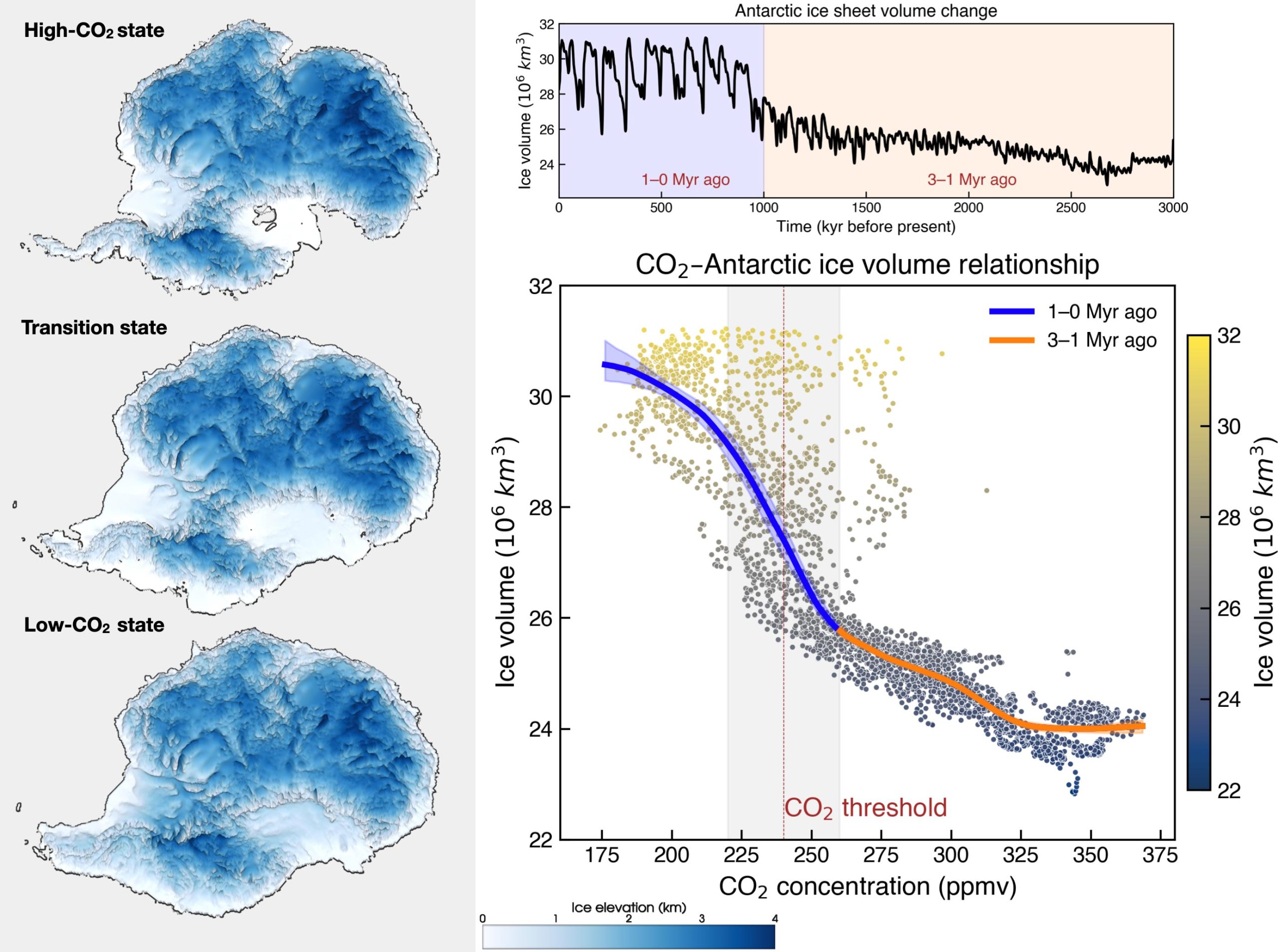
Researchers identified a key atmospheric carbon dioxide threshold of roughly 240 parts per million. When CO2 levels dropped below that value, Antarctic ice volume became much more sensitive to changes in both ocean and atmospheric temperatures. As a result, the size of the ice sheet fluctuated far more dramatically than before.
“After this transition, the Antarctic ice sheet reacts much more strongly to changes in climate forcing. This indicates that the system does not evolve gradually but instead becomes more responsive after crossing a particular threshold in the climate system,” said Dr. Kyung-Sook Yun, researcher at the IBS Center for Climate Physics and lead author of the study.
Why Antarctic Ice Grew More Rapidly
According to the simulations, several factors worked together to promote larger Antarctic ice sheets after the transition roughly one million years ago.
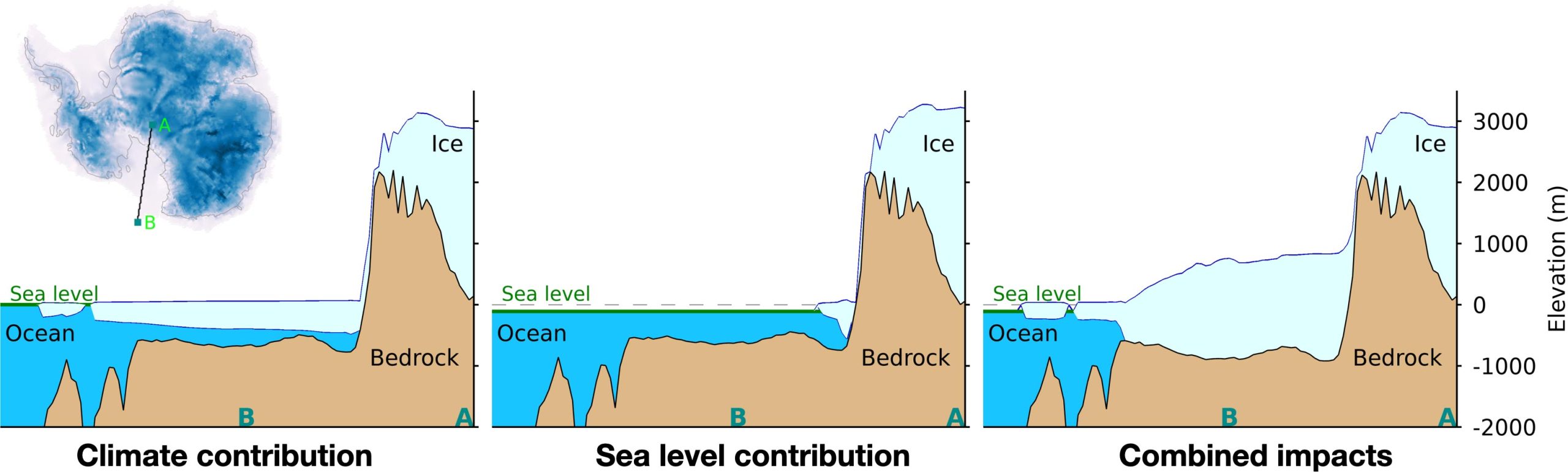
One factor was colder ocean temperatures during glacial periods, which reduced melting beneath portions of the Antarctic ice sheet that rest below sea level.
At the same time, global sea levels were approximately 50-100 m lower than they are today. The lower sea level reduced pressure on the bedrock beneath Antarctic ice shelves. Over time, this allowed the bedrock to slowly rise, a process that encouraged additional ice thickening along coastal regions.
Together, these mechanisms helped establish the larger and more persistent Antarctic ice sheets that characterized later ice age cycles.
Implications for Future Climate Change
The findings suggest that Antarctica may respond to climate change in a less predictable way than previously thought.
“Our findings suggest that the Antarctic ice sheet was more sensitive to external forcings than previously assumed. This also raises important questions about its future response to global warming,” said Prof. Axel Timmermann, Director of the IBS Center for Climate Physics and co-author of the study.
The researchers emphasize that ice sheets do not always respond gradually to environmental changes. Instead, they can cross thresholds that trigger abrupt shifts in behavior and dramatically alter their sensitivity to outside influences.
Understanding when and why those transitions occur is important for scientists trying to improve forecasts of future sea level rise in a warming world.
References:
“Increased sensitivity of the Antarctic Ice Sheet to decreasing CO2 across the Mid-Pleistocene Transition” by Kyung-Sook Yun, and Axel Timmermann, 28 May 2026, Nature Geoscience.
DOI: 10.1038/s41561-026-01979-2
“A transient coupled general circulation model (CGCM) simulation of the past 3 million years” by Kyung-Sook Yun, Axel Timmermann, Sun-Seon Lee, Matteo Willeit, Andrey Ganopolski and Jyoti Jadhav, 13 October 2023, Climate of the Past.
DOI: 10.5194/cp-19-1951-2023
Never miss a breakthrough: Join the SciTechDaily newsletter.
Follow us on Google and Google News.
4 Comments
Occam’s Razor basically says, “Entities must not be multiplied beyond necessity.” That is, the simplest answer is probably the correct one. The alternative, an edifice of infinite elements and infinite possibilities, is of no practical utility.
For the sake of illustration, let’s assume that Tyndall had never done his experiments with CO2. Would anyone today really be surprised that the Earth has been warming for about 20,000-years? Would they have any motivation to look for an explanation for interglacials beyond the Milankovitch Cycles? I think not.
Yet, the news media (and to be fair, probably most climatologists) bombard us with hypotheses about how it is anthropogenic CO2 that is responsible for the warming since about the start of the Industrial Revolution, as if astronomical effects or natural variation magically disappeared when civilization started using coal and then petroleum. However, the citation of Tyndall’s discovery as being the driving force for warming ignores the fact that we know that there are numerous feedback loops that are interrelated, notably evapotranspiration cooling the surface, clouds increasing the albedo, and precipitation again cooling the surface. The thermodynamics of clouds are not only the least understood feedback, but there isn’t a supercomputer made that is fast enough to solve the partial differential equations to give researchers a model that can be run at the same spatial resolution for the energy exchanges in clouds as are routine for all the other parameters. Thus, modelers resort to what is called ‘parameterization,’ which means that some experts guess at what the think happens on average over a large volume. The claim that the models are just physics is not true.
There is probably not any single answer to how the climate works. Instead, there are many answers and it is the net result of all those answers that determines the various Köppen-Geiger climate classifications.
Note that the various climate classifications are defined by the temperatures, precipitation, AND types of vegetation. The CO2 in the atmosphere is not as well-mixed as is usually claimed. [See here: https://www.researchgate.net/profile/Martin-Manning/publication/48602774/figure/fig2/AS:669455969419264@1536622149012/Global-average-distribution-of-atmospheric-carbon-dioxide-in-the-marine-background-by.png ] It is evident that vegetation controls the seasonal CO2 variation. An argument can be made that vegetation plays a significant role not just in the annual variation, but also the increase in the CO2 as the Earth ‘greens.’ [See here: https://www.nasa.gov/centers-and-facilities/goddard/carbon-dioxide-fertilization-greening-earth-study-finds/ ] This is not the place to defend and expound on that hypothesis, but I would encourage readers to think outside their media-defined box and consider other possibilities.
One simple question. Has or has not the amount of CO2 in our atmosphere increased from approx. 270 ppm at the onset of the industrial revolution to approx. 420ppm now.
Second question; is or is not CO2 greenhouse?
If “yes” is the answer to both questions, then modelling what could happen is justifiable. If assorted models indicate potentially serious results globally, then appropriate global reactions are required. Given the human factor of utter inertia to changes in our assorted social systems, then pre-emptive action for the worst-case scenario is required. It’s the logic as to why nations build nuclear weapons in order to deter other nations from hypothetically obtaining them or in fact hypothetically using them.
It becomes rather unscientific in a number of ways; but that is being human.
rob, the first question is true. The second question may be true, BUT it is the wrong question. The question should be, “Is CO2 causing warming, and if so, how much? The problem with your question is the unstated assumption that if something is considered to be a ‘greenhouse’ gas, then it is automatically responsible for the current warming. The real world is far more complex than what a simple yes or no answer can allow to be understood. It is well established that CO2 absorbs IR, and were it the only thing to consider, it would slow down radiative cooling. However, what is often deflected is the established fact (by Tyndall even!) that water vapor is a potentially more powerful ‘greenhouse gas.’ But what makes things really difficult to understand is the quantitative, net relationship between several feedback loops, such as warming causing the potential for increased water vapor, which however, is supply limited in the interior of continents. When and where evaporation increases, it can increase clouds downwind, increase albedo, and inhibit warming. Vegetation almost certainly modulates the concentration of CO2, with a ‘greening’ Earth providing more organic detritus that bacteria and fungi can decompose, releasing more CO2 each year. To the best of my knowledge, no model has attempted to explicitly take the NASA substantiated ‘greening’ into account.
The whole point of models is to try to objectively quantify the net interaction between all the feedback loops. One often hears the claim that the models are just physics. Unfortunately, there are no models that are sufficiently fast to solve the critical partial differential equations that deal with the energy exchanges in clouds, at the same spatial scale as the rest of the meteorological parameters. Therefore, the modelers rely on what is called “parameterization,” which means guessing how clouds work on average, without having the full force of the computations behind the guesses. Computer models can be quite sensitive to unexamined assumptions. Therefore, if the modelers have a subjective bias, what comes out of the models can be what they expect to come out.
What I consider to be reasonable arguments can be made that it is biology that is augmenting the Milankovitch Cycles, and not the almost constant anthropogenic emissions. Remember, we are still considered to be in the midst of an interglacial. Would you reasonable expect it to be cooling before the peak of the interglacial?
thanks for this