
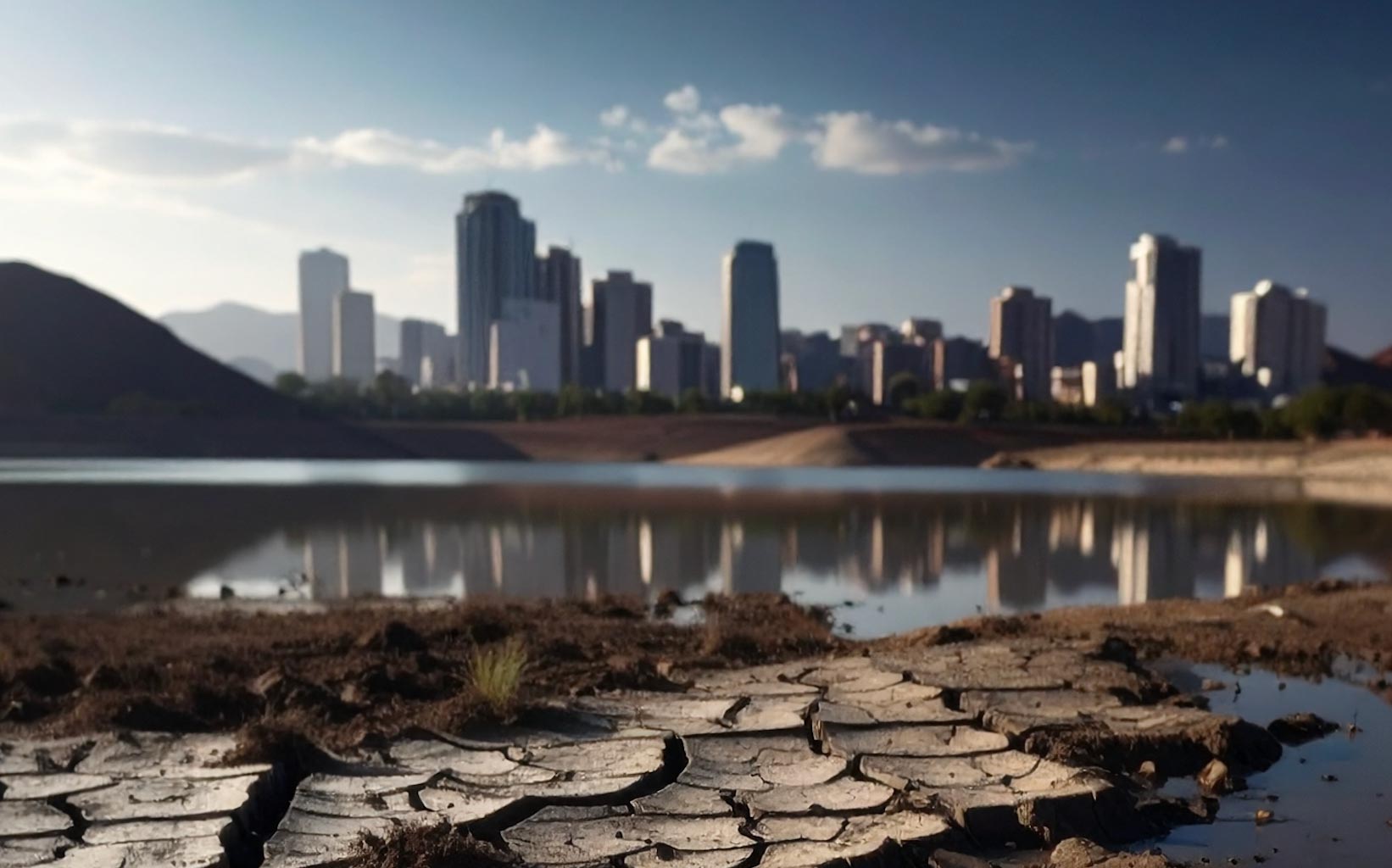
Climate simulations reveal that Day Zero Drought conditions are approaching rapidly worldwide, putting vast populations at risk of severe water scarcity.
A new study in Nature Communications from researchers at the IBS Center for Climate Physics (ICCP) at Pusan National University in the Republic of Korea finds that global warming is speeding up the likelihood of multi-year droughts. These prolonged dry periods can push regions toward severe water shortages, putting pressure on drinking water supplies, agriculture, and communities around the world within the next few decades.
To investigate this risk, the team used state-of-the-art climate model simulations to estimate when local water demand will surpass the available supply from rainfall, rivers, and reservoirs. This tipping point is known as the Day Zero Drought (DZD). Recent close calls in Cape Town (South Africa) in 2018 and Chennai (India) in 2019 have already demonstrated how vulnerable cities are to running out of water.
Identifying when and where these thresholds will occur is essential for planning effective water management for both urban and rural regions. According to the study, DZD events are projected to rise rapidly in the coming years, happening far earlier than once expected.
Climate model projections reveal accelerating Day Zero Drought events
The team relied on climate simulations based on the SSP3-7.0 and SSP2-4.5 greenhouse gas scenarios. By examining prolonged rainfall shortages, declines in river flow, and growing water use, the researchers identified clear DZD hotspots across the Mediterranean, southern Africa, and sections of North America. The analysis shows that cities in these regions are especially at risk.
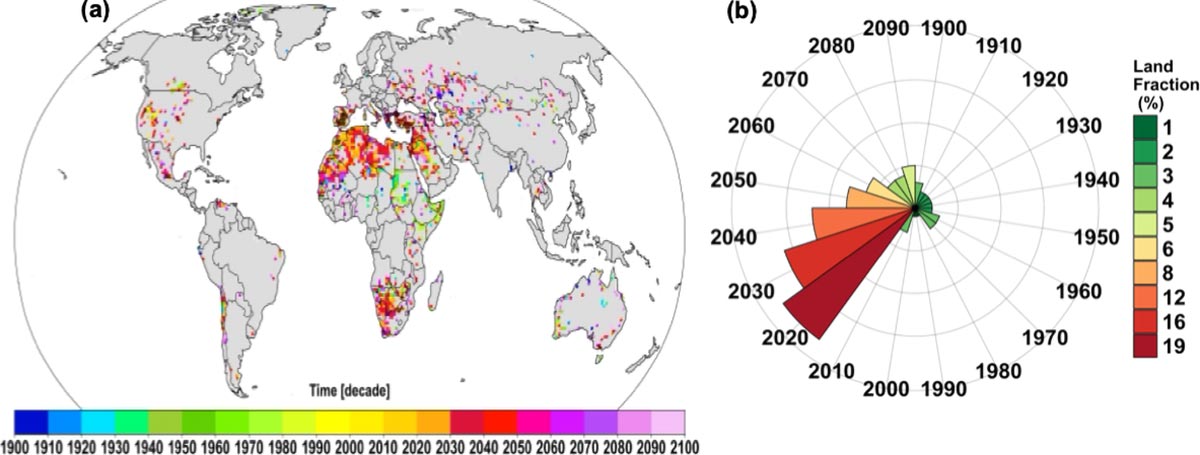
According to the simulations, DZDs are likely to emerge in 35% of the vulnerable regions already within the next 15 years (Figure 1). By the end of this century, DZD conditions could threaten about 750 million people globally, including 470 million city residents and 290 million people in rural areas. The Mediterranean region is projected to have the highest urban exposure, whereas Northern and Southern Africa and parts of Asia face the most severe rural impacts.
Projected impacts on reservoirs and global communities
“Our study shows that global warming causes and accelerates Day Zero Drought conditions worldwide. Even if we meet the 1.5°C target, hundreds of millions of people will still face unprecedented water shortages,” says PhD candidate Ms. Ravinandrasana, first author of the study.
“According to our calculations, and due to the increasing severity of hydrological stress, 14% of major water reservoirs could dry out already during their first DZD events, with severe impacts on people’s livelihoods,” says corresponding author Prof. Christian Frankze from the IBS Center for Climate Physics.
“Day Zero Droughts are no longer a distant scenario: they are already happening. Without immediate adaptation and sustainable water management, hundreds of millions of people are likely to face unprecedented future water shortages,” says Ms. Ravinandrasana.
Reference: “The first emergence of unprecedented global water scarcity in the Anthropocene” by Vecchia P. Ravinandrasana and Christian L. E. Franzke, 23 September 2025, Nature Communications.
DOI: 10.1038/s41467-025-63784-6
The study was supported by the Institute for Basic Science (IBS), Republic of Korea, under IBS-R028-D1. C.F. is also supported by the National Research Fund of Korea (NRF-2022M3K3A1097082 and RS−2024-00416848).
Never miss a breakthrough: Join the SciTechDaily newsletter.
Follow us on Google and Google News.
15 Comments
Water use needs to be controlled, but not by giving the first user on an aquifer absolute right to tge amount of water the first v owner of tge land was allowed to use. There are SO MANY things that need to be considered. Tge recharge rate of an aquifer has to be considered, and for some huge aquifer like the Ogalalla, the fact that they may have taken thousands of years to accumulate their water must be considered. There are a lot of acres of water being used to irrigate alfalfa that will be shipped overseas to feed racehorses in the Arab Emirates and,such places, while cities in Nebraska are suffering from water shortage because the irrigation has drawn down the aquifer to the point that hat all those towns need to drill another hundred feet down to continue to use the water, and the water may no longer be drinkable because of the fertilizer, herbicides, and pesticides being applied to make sure that alfalfa isn’t contaminated by any weeds or eaten by any insects. It’s one thing to grow vegetables using more water than really necessary, but do horses in Arabia also need premium American alfalfa?
ALL water supplies are POST FLOOD! THAT, is the “problem”, someone LOST their “planet” when the Flood occurred, now they HATE “humans”.
Yeah….NO!
Natural, FOREVER ABUNDANCE IS our sovereign, GOD given right!
THAT, is all. anyone FIGHTING and LEGISLATING AGAINST THAT is a demon that needs it’s skin removed from the skull.
Yeah, you thought Christians would just “roll over”….hehehehehehehehe.
That is because Revelation 11 is at work under the direction of Christ.
Almost three-fourths of this planet’s surface is water. There is no water shortage, but there is a problem with water distribution.
The problem isn’t water, it is potable water. Desalinization requires energy to build, maintain facilities, and distribute it. And besides the desired product of fresh water, there will be either concentrated brine that will poison the coastal waters where it is put back, or solid salt that will have to be disposed of. Problems are rarely as simple as they first appear — “The Devil is in the details.”
Got lots of ammo. I’ll always have water
“To investigate this risk, the team used state-of-the-art climate model simulations to estimate when local water demand will surpass the available supply from rainfall, rivers, and reservoirs.”
The important question is NOT whether the computer models are “state-of-the-art,” but whether they are accurate and reliable. Where is that addressed in the research? Historically, as bad as the models are at predicting future temperatures, they have been even worse at regional precipitation predictions, some models predicting flooding, other models predicting drought, for the SAME regions.
Can’t agree more about all-wise state-of-the art computing. The Bible used to be one of those, back in the day, although I guess that computer models might be a little more human; one no longer gets burnt at the stake for disagreeing with them.
rob, you are overlooking the fact that while nuclear may be less expensive long-term, compared to coal or gas, nuclear reactors have much larger financing problems because of the much larger up front costs, and there are also regulatory costs to maintain safety. Related to that, there is no simple solution for disposal of the long-lived fission products. Whatever choice is made, it will impact the economics of the nuclear power.
The source-energy costs, assuming that they can be addressed, don’t address the issue of disposing of the brine.
While nobody gets burned at the stake for disagreeing with the ‘wisdom of the age,’ people can and do get shunned for not toeing the line, and may not be able to get grants for research, which is as permanent as being burned, for an academic.
Basically, the article claims that THE problem is the availability of potable water and blames global warming. How did the authors miss the obvious, that the population is the reason for the demand and consequent potential future shortages?
The authors also ignore the fact that Tehran (Iran) may have to be evacuated as there is a serious drought going on there. But that’s only a ‘wog’ terrorist Sate, is it not? One might consider that nuclear-generated power could be used for desalination programmes.
Whatever might or might not constitute anthropogenic global heating, 8.6billion people are certainly drinking this world dry. Potable water is not a waste commodity nor a commodity to be wasted; it is of greater value than gold. I was once told that by the time the River Thames had got to London, it had been drunk 7 times. Recycling water is very simple technology , done primarily by filtration and bacteria.
The problem with “nuclear-generated power” that is uses a tremendous amount of water to condense steam, the same as other fuels (coal, gas, wood, waste…) feeding steam turbines.
Once the water is condensed and cooled, it can be used for other things. It is probably going to be sterile considering the temperatures that were achieved. In fact, that might be its greatest drawback. Distilled water lacks nutrients usually obtained from drinking water, and is more corrosive than typical groundwater. However, those are not insurmountable obstacles.