
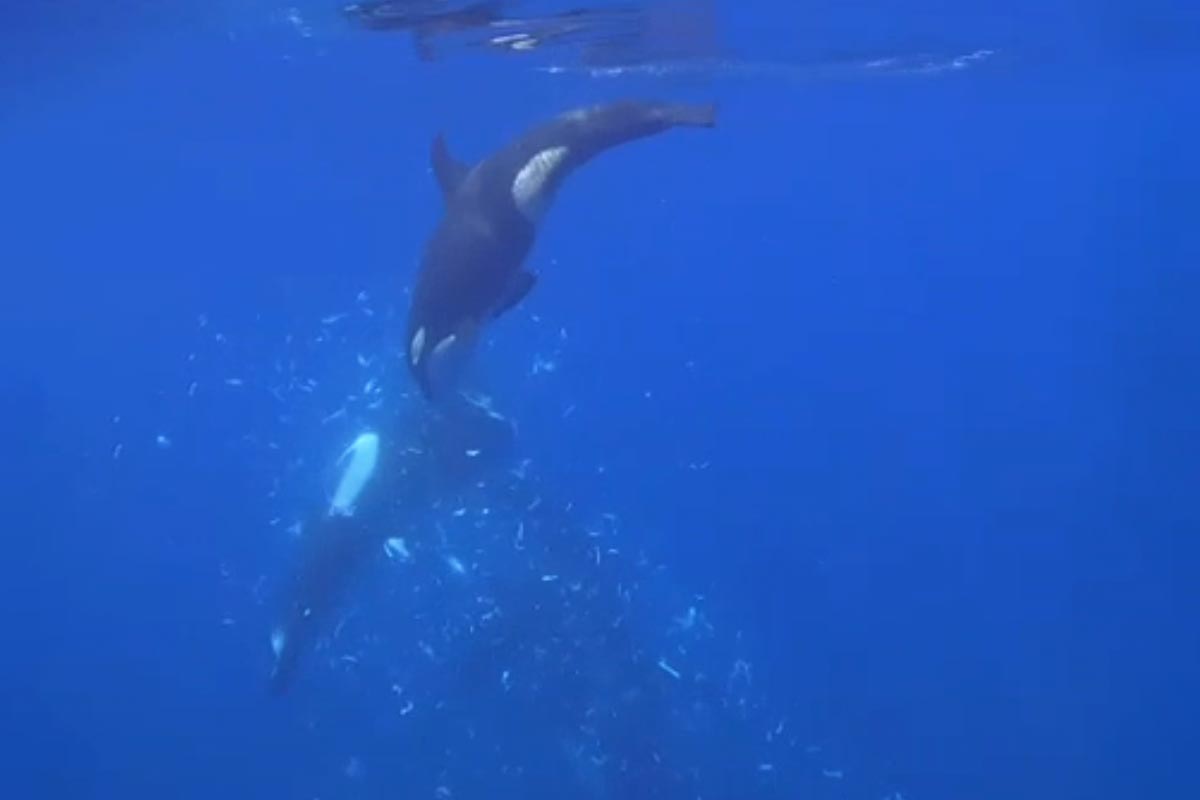
Orcas in the Gulf of California have revealed a startling new feeding technique: smashing dead sunfish into thousands of pieces.
One orca held the enormous sunfish in place. Another charged straight toward it. At the last moment, the first released its grip, and the collision tore the carcass into thousands of pieces.
Researchers say the coordinated maneuver, filmed twice in the Gulf of California, represents a previously undescribed form of prey processing. The behavior may help young orcas eat, allow adults to share food more efficiently, or simply provide entertainment for one of the ocean’s most intelligent predators.
“We document how one orca holds the sunfish and lets go just before another orca hits it at high speed, causing the tissue to break apart into thousands of pieces,” said Dr. Kathryn Ayres, first author of the Frontiers in Ethology study and a scientist at Beneath The Waves, a nonprofit organization promoting ocean health. “We think this may help younger orcas feed more easily, or it could also just be for fun. Orcas are known for playing with their food.”
A group of orcas in the Gulf of California has been observed applying a hold-to-ram strategy to process a sharp-tail sunfish. This is a previously undescribed behavior that could be a form of parental investment – or entertainment. Credit: Kathryn Ayres
Sunfish Become Vulnerable Prey
Orcas are highly adaptable hunters with a known diet spanning more than 200 animal species. Different groups develop their own prey preferences and hunting traditions, often coordinating their movements with remarkable precision. In the Gulf of California, they have been documented hunting animals ranging from rays and sharks to whales and sea turtles.
Sunfish are among their most frequently observed fish prey in the region. These unusual animals belong to the world’s largest family of bony fish and can exceed three meters (9.8 feet) in length and weigh up to 2,000 kg (4,409 pounds). They travel through a broad range of depths but often rise to the surface to rest, warm themselves, or have parasites removed, leaving them exposed to attack.
The new study describes two opportunistically recorded encounters involving sharp-tail sunfish. Although the events occurred more than a year apart, both followed a strikingly similar sequence.
A Carefully Coordinated Collision
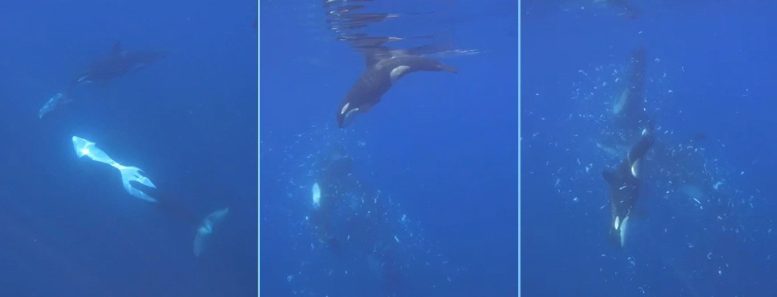
The first was observed near San José del Cabo in July 2024. A group of three adult females, one adult male, and a juvenile had already hunted a ray before researchers saw them interacting with a dead sharp-tail sunfish.
An adult female gripped the carcass by its pronounced tail structure, providing a stable target. Its internal organs had already been removed, indicating that the orcas had begun feeding before the unusual maneuver started.
The adult male then accelerated toward the sunfish while swimming with his underside facing upward. The female released the carcass moments before impact. A loud collision followed, and pieces of the fish scattered through the water.
The juvenile immediately began eating the suspended fragments. Meanwhile, the adults continued feeding on the larger remains and were not seen consuming the smallest pieces.
Why Orcas Shatter Their Food
A second encounter, filmed by Héctor Franz in September 2025, unfolded in much the same way. One adult held another dead sharp-tailed sunfish steady while a second struck it at high speed. A calf later pulled tissue from the remaining carcass. Earlier that day, the same group had been seen feeding on a shortfin mako shark.
The researchers call the behavior “ram-to-fragment.” Orcas have previously been observed using body strikes during hunts, including coordinated attacks on whale sharks. However, no earlier report described them hitting a sunfish with enough force to cause this degree of tissue disintegration.
Because both sunfish were already dead, the impacts were not killing blows. Instead, the orcas appeared to be processing food after the hunt.
Feeding Young or Simply Playing?
Holding the carcass in place would allow the striking animal to hit it more accurately, suggesting that the maneuver required coordination between the adults. The young animals feeding afterward raises the possibility that the adults were deliberately making the meat easier to access.
“Orcas often tear apart prey and share it with other members of the group, including calves and juveniles,” said Ayres.
Such food sharing can serve as parental care, but it may also help young orcas observe and practice behaviors used by their group. Many orca hunting methods are socially learned and passed between generations rather than being purely instinctive.
Play remains another plausible explanation. Orcas sometimes manipulate, strike, or carry prey without immediately eating it. The two possibilities are not mutually exclusive, since an activity can provide food, practice, and social stimulation at the same time.
Sunfish Anatomy May Hold the Key
The sunfish’s unusual anatomy may explain why the collisions were so destructive. Beneath its skin is a thick, gelatinous collagen layer called the capsule that is nearly 90% water. A powerful impact against this tissue could cause the body to rupture in a way that would not occur in firmer prey.
So far, researchers have documented extreme fragmentation only in sharp-tail sunfish. Their especially prominent tail structure may give orcas a convenient place to grip the body before impact, while their tissue may be unusually vulnerable to sudden force. More observations are needed to determine whether the technique works on other sunfish species.
The study also raises a more speculative possibility. Sunfish skin and capsule tissue support distinctive communities of microorganisms. Shattering the carcass releases those microbes and nutrients into the surrounding water, potentially exposing the orcas to material from the prey’s microbiome, mycobiome, and virome. Whether that provides any nutritional or immune benefit remains unknown.
Is the Behavior Socially Learned?
Scientists cannot yet tell whether the same orcas participated in both encounters. Clear photographs of dorsal fins, scars, and eye patches are needed because these features allow researchers to identify individual animals and track their behavior over time.
Better documentation could reveal whether young orcas eventually perform the maneuver themselves, which would strengthen the case that it is socially learned.
“Collecting good identification photographs whenever possible is key: we are still seeing new techniques of how orcas hunt and process their prey,” concluded Ayres. “They’re one of the most iconic marine predators in the world, yet they continue to surprise us.”
Reference: “Fragmentation of sharp-tail sunfish (Masturus lanceolatus) caused by high-impact ramming behavior in orcas (Orcinus orca)” by Kathryn A. Anne Ayres, Austin J. Gallagher, Christine V. Avena, Carlos M. Duarte and Jesús Erick Erick Higuera Rivas, 28 May 2026, Frontiers in Ethology.
DOI: 10.3389/fetho.2026.1835536
Never miss a breakthrough: Join the SciTechDaily newsletter.
Follow us on Google and Google News.
4 Comments
Orcas almost certainly understand the concept of playing with their food. Of course, they have also found an extremely efficient way to divide a large piece of meat between the members of the pod.
Killer whales are also killing Blue whales – so maybe they’re becoming problematic.
The orcas don’t seem to be eating the pieces of shattered sunfish. It’s more like they’re looking at the pieces and watching them. Maybe it is like a dissection. Maybe they are expecting something to be inside the sunfish or are trying to figure out what they are made of, or something along those lines. Or maybe it looks pretty to them, or fascinating, watching the bits float around and swimming through them. Like humans are with confetti or fireworks.
I wonder if the orcas do this with other things, or is it just sunfish.
OR….or…. orcas are all just going crazy. They’re sinking yachts, ramming sharks and now they’re blowing up sunfish. Anyone else scared?
Almost forgot about the salmon hats. Orcas are carrying around dead salmon on their heads. Yeah, that’s just nuts. Crazy, I say. They are all going crazy.