
A study finds that during the PETM, Earth’s landscapes became widely browner amid elevated atmospheric CO2, global warming, and reduced rainfall caused by volcanically driven carbon release, with trees playing a central role in these dramatic changes.
Fifty-six million years ago, a massive pulse of carbon entered the atmosphere during the Paleocene Eocene Thermal Maximum (PETM), producing one of the best ancient comparisons for understanding how forests respond to rapid warming.
In research published in Science, scientists reconstructed the forest canopy from that period using fossilized leaf cells for the first time, providing a detailed record of how vegetation changed during Earth’s most recent episode of comparable global warming.
“We are putting CO2 into the atmosphere faster than any known natural process,” says lead author and paleobotanist Dr. Regan Dunn, Assistant Deputy Director and Associate Curator of the Samuel Oschin Global Center for Ice Age Research at La Brea Tar Pits and the Natural History Museum of Los Angeles County. “The Earth has never experienced a carbon release at the pace we’re creating today. The PETM gives us our best window into how Earth’s climate and ecosystems respond to a massive carbon injection before humans began reshaping the planet.”
Ancient warming turned landscapes browner
The reconstruction indicates that large areas of Earth became browner during the PETM. Volcanically driven carbon emissions increased atmospheric CO2, raised global temperatures, and reduced rainfall.
As conditions changed, plant species shifted northward, forest canopy cover decreased, erosion intensified, and the terrestrial water cycle was disrupted. Today, human activity is adding CO2 to the atmosphere at roughly an order of magnitude faster than during the PETM, and changes to trees appear central to many of these effects.
“There are significant tree mortality events everywhere on Earth right now,” says Dunn. “Forests are in decline because of warming temperatures, drought stress, pathogen and insect infestations, and wildfires—when you start losing the trees, our canaries in the coal mine, you’re in trouble. It’s almost universally true in all of Earth’s five major extinction events.”
Fossil cells reveal vanished forest canopies
Reconstructing forests that disappeared more than 50 million years ago required the researchers to examine microscopic pieces of fossilized leaves known as leaf cuticle fragments.
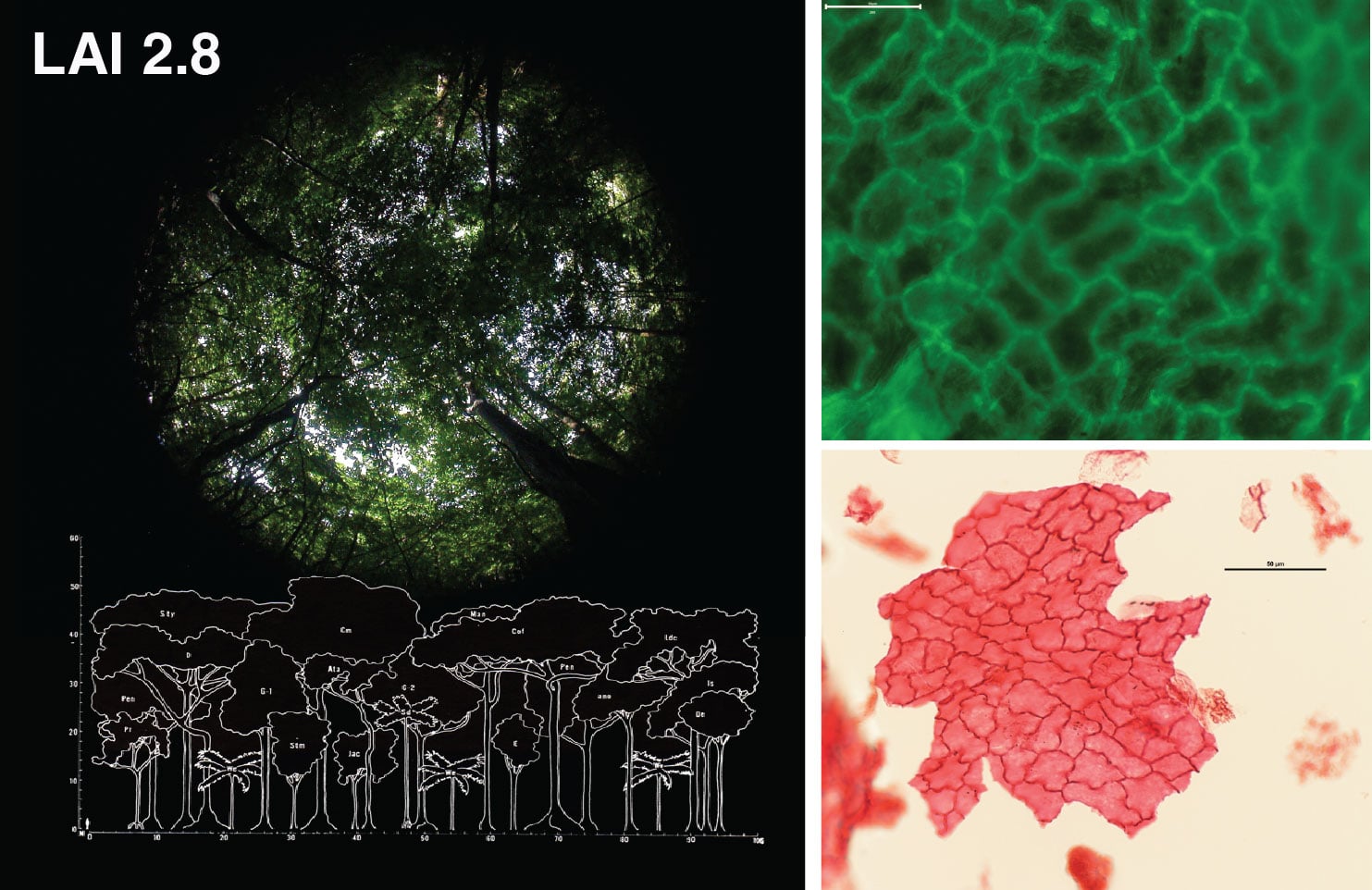
The researchers developed a new way to use these fragments to calculate leaf area index (LAI), a measurement of how much of the sky is covered by leaves and therefore how dense a forest canopy is. Dunn and her colleagues first measured LAI in several modern forests across South and Central America. They pointed a camera fitted with a fisheye lens upward from a tripod while simultaneously collecting leaf cuticles from soil directly below the canopy.
“What excites me about LAI is that it lets us move beyond somewhat subjective descriptions of vegetation, like ‘open forest’ or ‘woodland.’ Instead, the leaves themselves provide a quantitative estimate of canopy structure, allowing us to compare ecosystems using an objective, reproducible metric,” says Dunn. Assigning a numerical measurement makes it possible to compare changes in canopy structure more precisely through time.
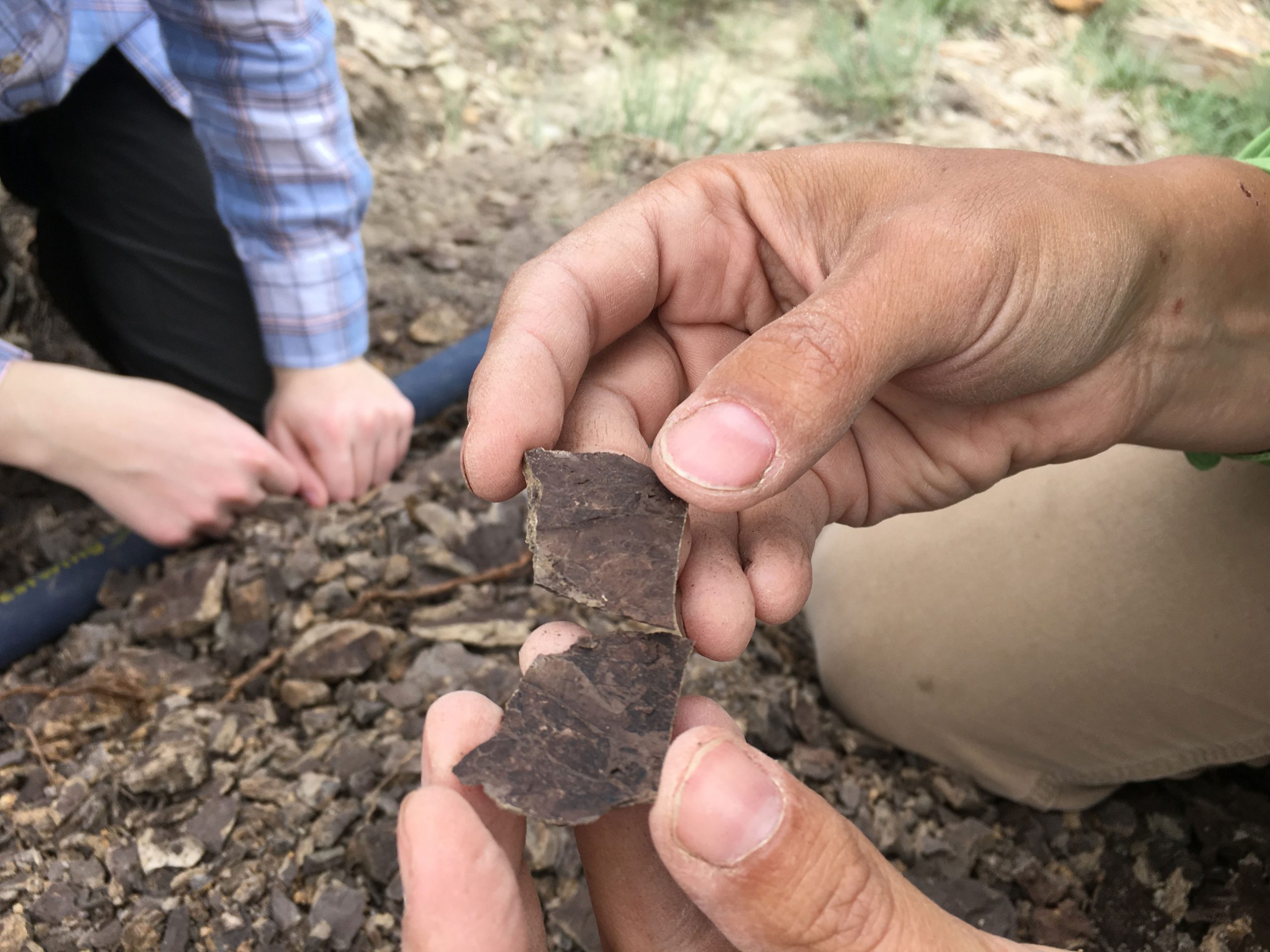
Dunn previously estimated LAI using phytoliths, microscopic plant cells filled with silica. Because leaf cuticle fragments are preserved differently, however, the researchers needed a separate calculation to account for those differences. To reconstruct how forests responded to the enormous rise in CO2 during the PETM, Dunn examined cuticle fragments preserved within organic-rich sedimentary rocks from Wyoming.
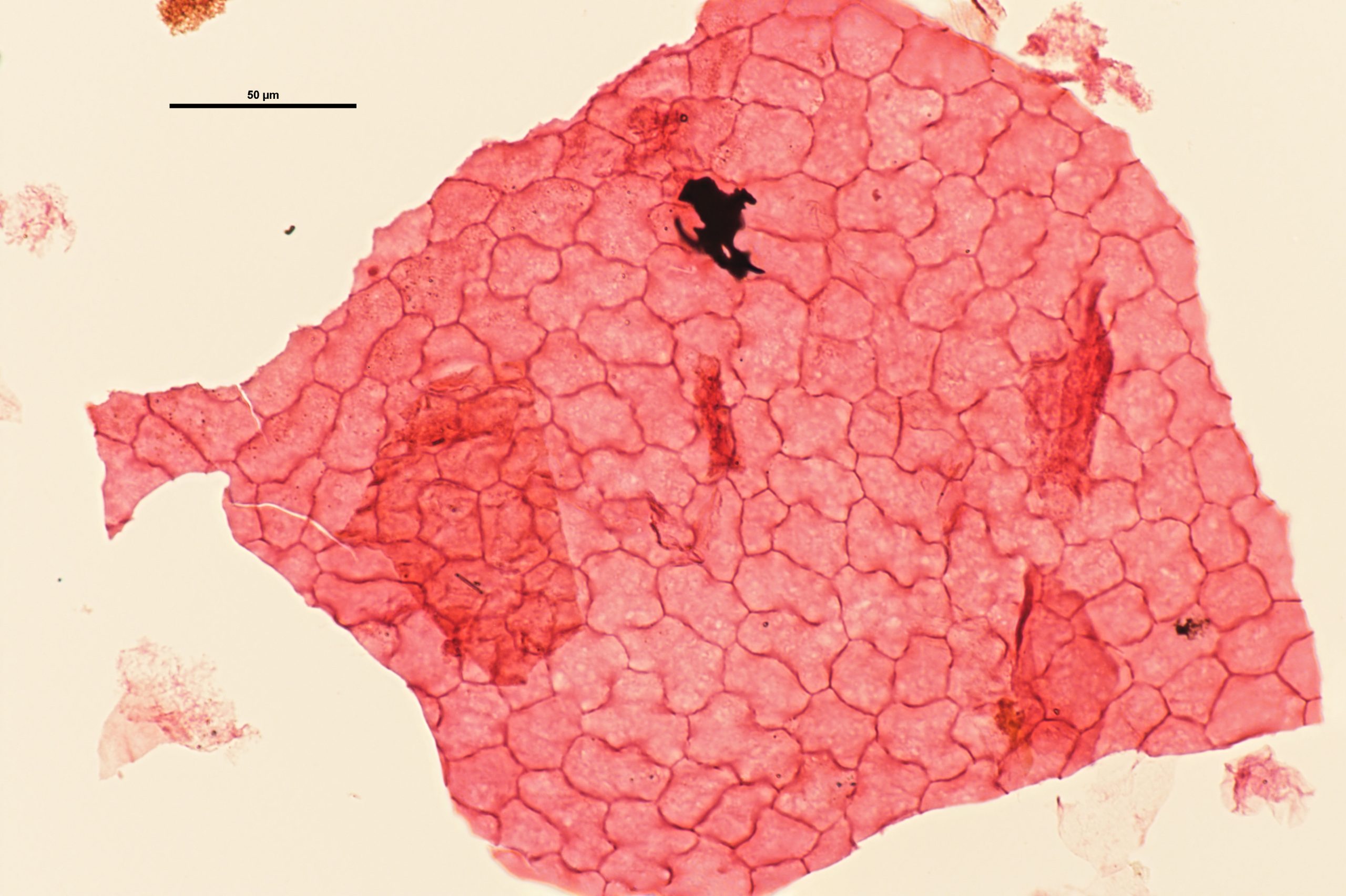
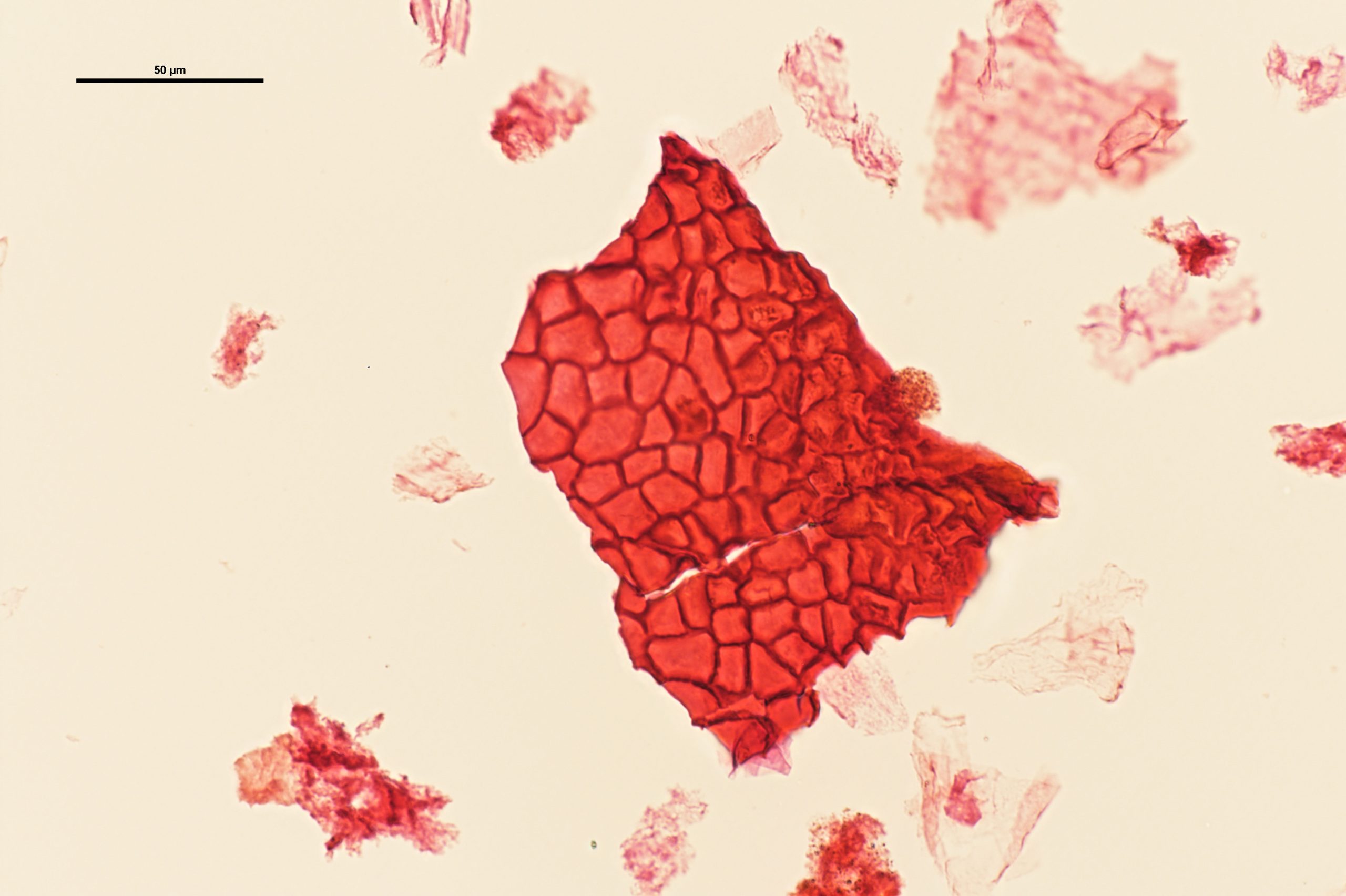
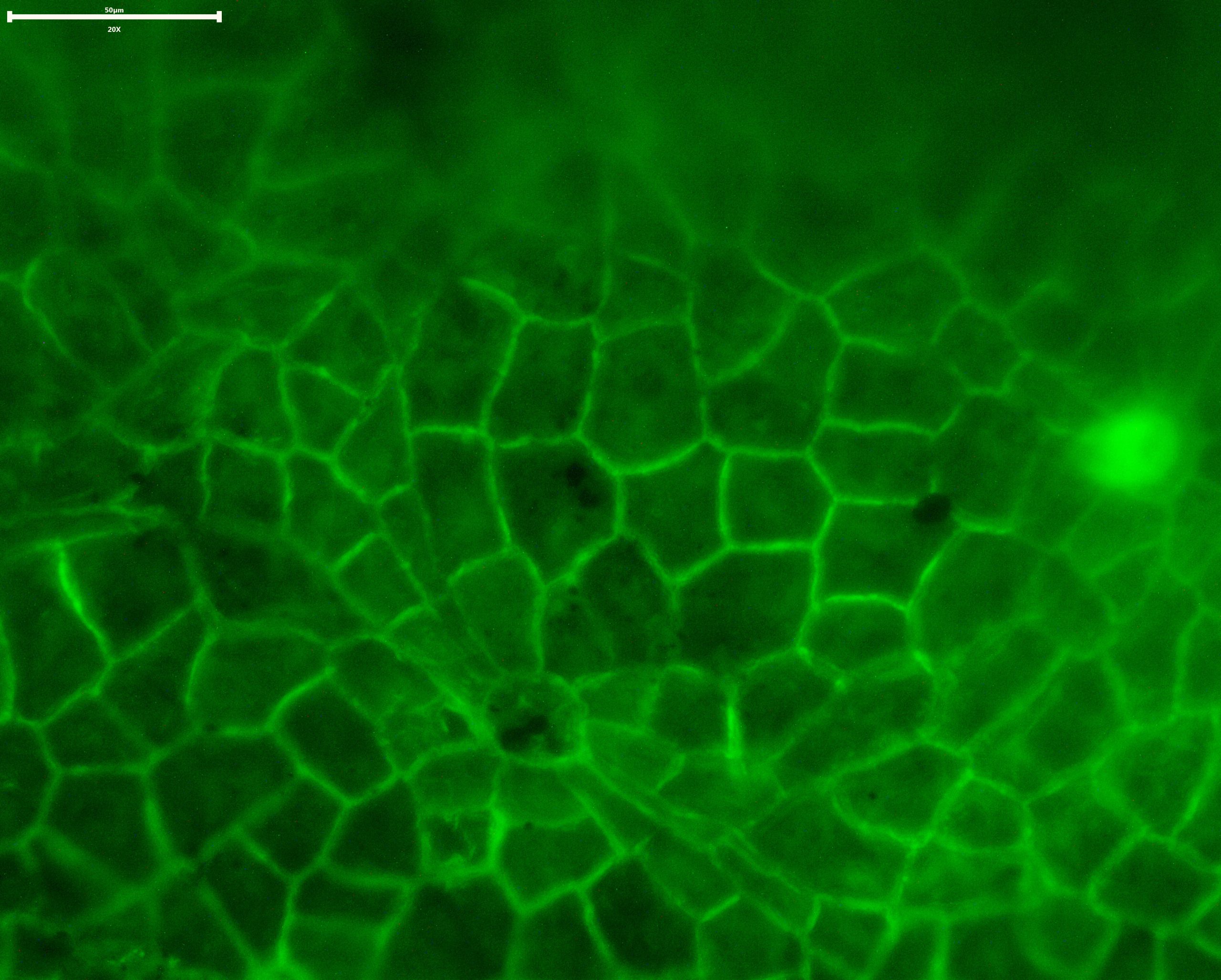
A leaf’s epidermal cell shape records how much sunlight it received during growth. Leaves growing lower in a tree under heavy shade develop differently from leaves near the top of the canopy that receive direct sunlight. Dunn found that these cell shapes are closely related to vegetation density (LAI). “Leaves that grow in denser forests—in shadier habitats–have cells with higher aspect ratios, or more elongate and skinny cells than leaves receiving more sunlight,” says Dunn.
“This is the shade response of plants; they lengthen the leaf by lengthening each cell,” Dunn says. Picture each cell stretching itself to get sunlight, compared to a fat and happy cell bathed in full sunlight. “Once the leaves fall from the tree, and begin to break down in the soil, the cell shapes preserved in the fragments can tell us how dense the canopy was where the leaf originally grew.”
The researchers calculated LAI from photographs of modern forests, then measured thousands of epidermal cells preserved in leaf fragments collected from the soil and compared those measurements with the corresponding LAI values. “This is the process of setting up a proxy to reconstruct an environmental variable from fossil deposits. You go into modern environments, establish the relationship, and create a model from which you can reconstruct that variable, in this case LAI, from rocks 56 million years old,” says Dunn.
“I love telling my undergraduate classes that Wyoming has the best fossil record in the world,” says co-author Dr. Ellen D. Currano, paleoecologist, paleobotanist, and professor at the University of Wyoming. “This work is another demonstration of that.”
“What’s unique about the Hanna Basin is that it’s a coal-forming basin. So you have all these organic-rich rocks, like lignites and coals, that are lacking in other places where the PETM interval is well-known, such as the Bighorn Basin in Northwestern Wyoming,” adds Dunn. “Contained within these organic-rich rocks are the leaf fragments we need to reconstruct the ancient forest canopy.”
Wyoming fossils record thinning forests
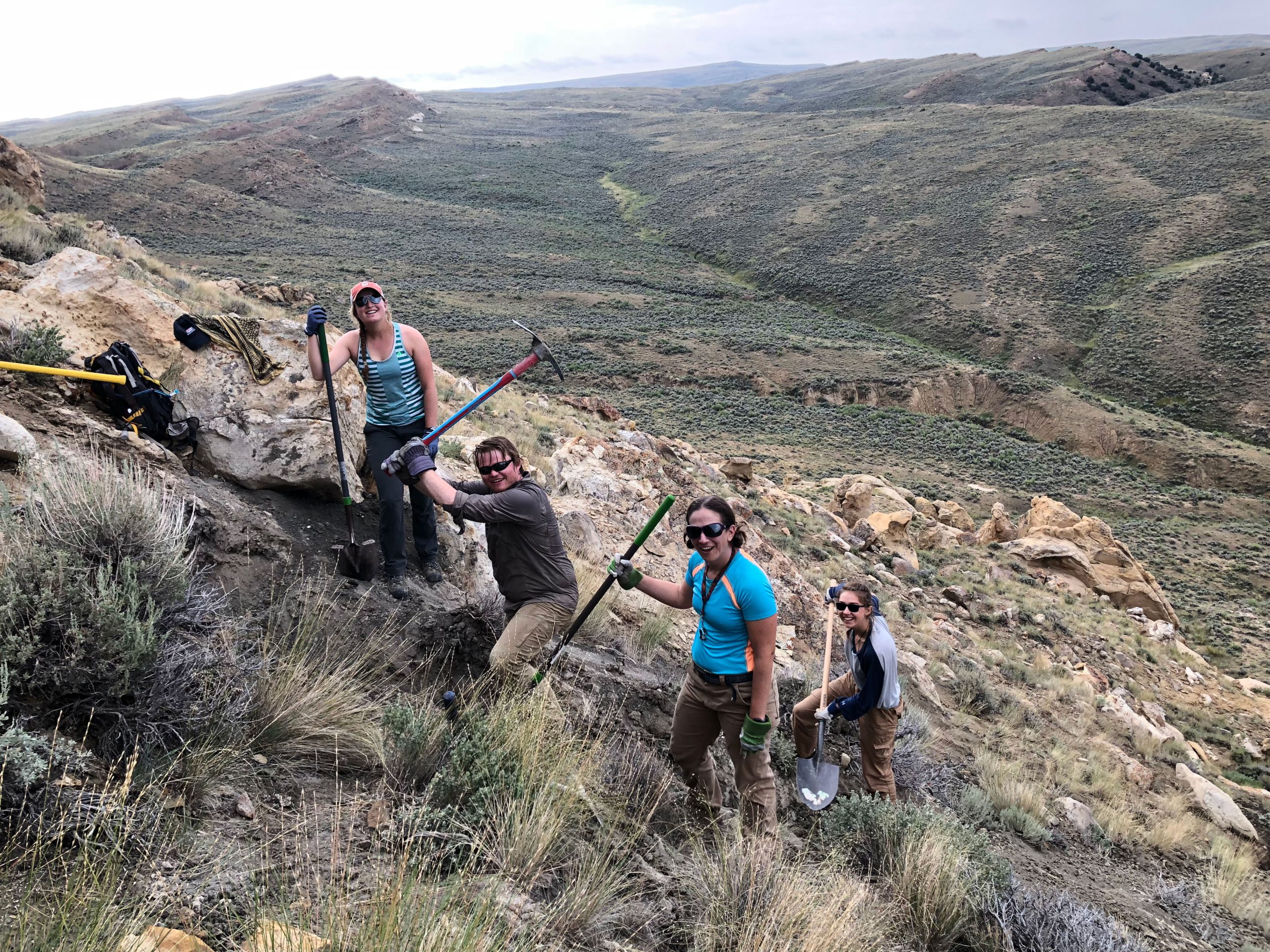
Ancient Wyoming supported forests dramatically different from the sagebrush landscape found there today. Giant dawn redwoods (Metasequoia) rose above sycamores, alders, palms, and other subtropical and tropical plants. Over more than a decade, Currano, Dunn, and their colleagues collected hundreds of samples from the Hanna Basin, searching systematically for fossil evidence of forests that existed before and after the PETM. Those samples allowed the researchers to reconstruct how the forests changed as the climate shifted.
“Understanding how forest structure changed during the PETM is really important because it tells us about how plant growth, biomass, and productivity are affected by adding a lot of carbon dioxide to the atmosphere. It turns out that too much carbon dioxide is a bad thing for forests because the accompanying warming and drying stresses the trees and kills many of them,” says Currano. “Our work shows that during the PETM, forest canopies became more open, with fewer big trees, and this change affected climate, nutrient cycling, weathering, and, of course, the animals that inhabited the forests. We are starting to see similar changes to forests occurring today, particularly in the Amazon, and the Wyoming plant fossil record gives us insight into where Earth might be headed.”
Modern forests show a similar warning
Satellite measurements of modern global LAI, available since the 1980s, show a pattern that the researchers compare with their PETM reconstruction.
“Earth has been on a greening trajectory because of anthropogenic carbon dioxide emissions that have fertilized plants,” says Dunn. “But as Earth has heated up because of those emissions, this greening trend is reversing, and many parts of Earth are now browning. This suggests that we’ve passed a critical threshold where heightened temperatures are now adversely affecting forests.”
The findings suggest that continued warming could move modern forests toward the widespread browning recorded during the PETM. Today’s forests, however, face several human-driven pressures at the same time. Along with rapidly increasing atmospheric CO2 and rising temperatures, deforestation, increasingly frequent and severe wildfires, habitat fragmentation, invasive species, and land use change are weakening forest resilience and reducing opportunities for recovery.
Together, these pressures could intensify carbon release and ecosystem degradation beyond what occurred during the PETM. Protecting and restoring forests is therefore important both for preserving biodiversity and for maintaining one of Earth’s major natural defenses against accelerating climate change.
“Trees are awesome. All those forests are taking up hundreds of millions of tons of carbon for us every day,” Dunn adds. “But when you start losing the forests, then you’re losing those critical carbon sinks. The PETM reminds us that when forests decline, the consequences ripple through the climate system. We would be wise to protect and restore them while they can still help buffer the unprecedented pace of human-caused climate change.”
Reference: “Forest canopy decline under elevated CO2 during the Paleocene-Eocene Thermal Maximum” by Regan E. Dunn, Marieke Dechesne, Brady Z. Foreman, Keifer Nace, Jenna M. West and Ellen D. Currano, 13 August 2026, Science.
DOI: 10.1126/science.aec4776
Never miss a breakthrough: Join the SciTechDaily newsletter.
Follow us on Google and Google News.
6 Comments
“The Earth has never experienced a carbon release at the pace we’re creating today.”
It is difficult to support that claim because time tends to act like a low-pass filter, suppressing apparent temperature peaks and broadening them. Thus, past increases might have been much larger than what we are experiencing today. If carbon dioxide is responsible for warming, then temperature should be a proxy for changes in CO2. We don’t have actual CO2 measurements because there are no Eocene ice cores. The Oligocene is much better known for vulcanism than is the Eocene. However, the Oligocene is know for cooling, not warming. Their research doesn’t actually speak to the source of the CO2, that is just an assumption. Their research just suggests that when it eventually got too hot, plants couldn’t tolerate the heat and started to die off. The pre-Cretaceous rivers in California were abundant and large, suggesting that the drying may have been confined to the interiors of continents, not unlike today. However, there were large lakes in the headwaters of what is now the Green River in Wyoming.
“We don’t have actual CO2 measurements because there are no Eocene ice cores.” -Clyde Spencer
The typical reader might erroneously conclude that there’s no way to estimate CO2 levels from that period, but that’s far from the truth. There are CO2 proxies from both land (stomatal density, paleosol carbon isotope ratios), marine locations (boron isotopes in marine plankton, alkenones) and in-between (nahcolite in evaporites). They tell a cohesive story of extremely high CO2.
Yes, there are proxies, which notoriously have confounding variables. How does one conclusively prove that the proxy has 100% correlation with the thing that can’t actually be measured directly? In the case of carbon-dating trees, the initial estimate for the age of the wood, is corrected for variations in 14C production by cosmic rays by counting rings and developing a long-range correction table. It is difficult, if not impossible, to be certain of the correlation between apparent CO2 levels in the past and estimates coming from the various proxies, when available. For example, were all the environmental variables that might affect stomatal size or density the same 60 million years ago? One has to assume that they were, without being able to actually make measurements. Do things like oxygen concentration, average altitude (atmospheric pressure), or windiness affect stomata? Isotopic fractionation is not well studied, and it is again difficult to determine what the exact situation was when direct measurements can’t be taken of living organisms tens of millions of years ago.
I don’t have an argument with the claim of “extremely high CO2” in the past. What I do challenge is its accuracy when dependent on proxies that can’t actually be measured and calibrated, and there are unexamined assumptions. And all I was basically saying in my remark was that proxies from the distant past should not be expected, for many reasons, to have the same accuracy as modern instrumental measurements.
“Oligocene is much better known for vulcanism than is the Eocene.” -Clyde Spencer
Yes, it is especially known for a massive number of silicic ignimbrite eruptions in western North America. Calcium and magnesium silicates in the ignimbrite deposits (often extremely porous or loose) rapidly weathers when exposed to carbonic acid in rainwater, resulting in dissolved bicarbonate washing toward the ocean. Iron in ash also caused a fertilizer effect in the oceans, pulling CO2 out of the atmosphere and dumping its carbon as organic matter on the ocean floor. Were you assuming the small amount of CO2 released during the eruption would somehow be larger than the silicic weather and oceanic fertilization drawdowns of CO2? Not so.
You asked, “Were you assuming the small amount of CO2 released during the eruption would somehow be larger than the silicic weather and oceanic fertilization drawdowns of CO2?”
It is the authors of this study who implicated eruptions with their remark “and reduced rainfall caused by volcanically driven carbon release.” I was following their lead. As you correctly point out, the net changes in CO2 are complex and require measurements of many variables. For example, long-term chemical weathering proceeds more rapidly with ultramafic and mafic rocks, particularly for dunites and with calcium-rich feldspars in pyroxenites and gabbros/basalts; the rate also varies with average temperatures, precipitation, and ambient CO2. Can you provide measurements of the ratios of surface exposures of (ultra)mafic rocks during the PETM compared to the Oligocene? Hutton was fond of saying, “The present is the key to the past.” However, if we don’t have actual measurements from 60 million years ago of all the critical variables, then we shouldn’t expect better than semi-quantitative estimates, and should assign very large uncertainties to the numeric estimates.
Incidentally, while recent ignimbrite flows are often porous, welded ignimbrites are less so and particularly if they have been buried deeply before being exhumed. So, once again, hand waving, which geologists have a reputation for being skilled at, have many caveats. One needs to treat each situation as unique and them average them before coming to conclusions.