
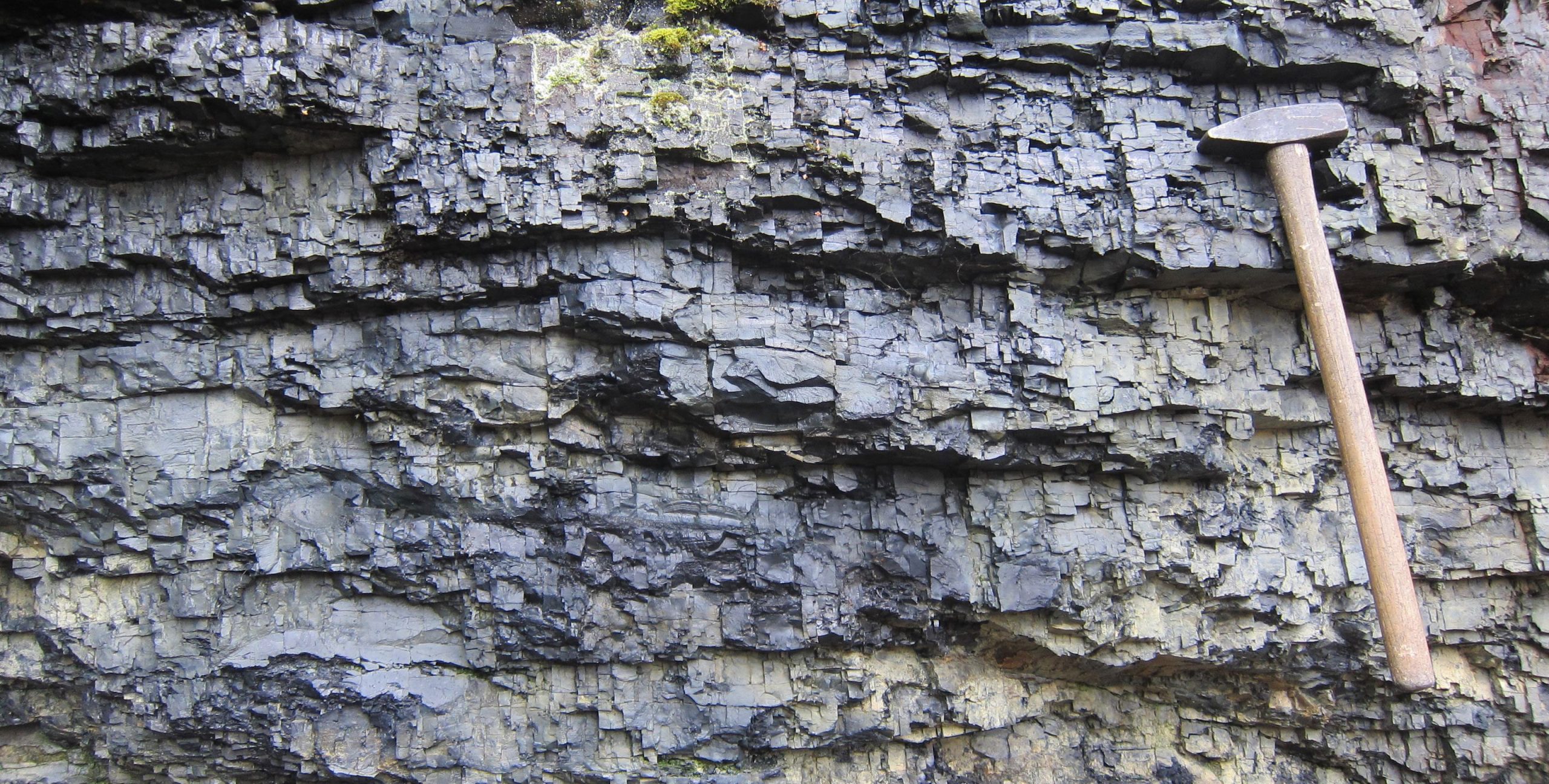
A key geological clue to a global disruption in Earth’s ancient carbon cycle may have a more local origin.
Between roughly 2.5 and 2 billion years ago, Earth underwent the greatest chemical transformation known from its surface history as oxygen accumulated in the atmosphere. That shift ultimately helped create conditions for complex organisms such as plants and animals, which appeared about half a billion years ago.
During this early oxygen rise, enormous amounts of microbial material were buried beneath the seafloor, trapping carbon in rocks with an unusual isotopic signature. That signal has often been interpreted as evidence that Earth’s carbon cycle was disrupted on a global scale.
Much of the evidence for such a worldwide event comes from drill cores, long cylinders of rock extracted from below the surface, taken from ancient seafloor deposits in Karelia, Russia, and the Francevillian Basin of Gabon. Research led by Caltech scientists now challenges part of that interpretation by showing that the Russian record may instead reflect processes operating within one sedimentary basin.
“One major debate centers on an unusual carbon-isotope signal that has often been interpreted as evidence of a worldwide environmental change,” says Nivedita Thiagarajan (PhD ’12), a senior scientific researcher at Caltech who works in the lab of John Eiler, the Robert P. Sharp Professor of Geology and Geochemistry and Ted and Ginger Jenkins Leadership Chair of the Division of Geological and Planetary Sciences. “We studied gases trapped in microscopic pockets within rocks from the Zaonega Formation in Karelia, Russia, one of the world’s oldest known fossil oil fields, and found that the carbon-isotope signal at this key site can be explained by local phenomena that occurred in a several-hundred-square-kilometer sedimentary basin rather than across the entire globe.”
Thiagarajan led the study, published in Geology, which reconstructs the processes recorded in Karelia after oxygen first became abundant in Earth’s atmosphere.
A global signal comes into question
Carbon exists in heavier and lighter isotopic forms, and the proportions preserved in ancient biomass can provide clues about where that carbon came from. Ratios between these isotopes (or carbon-isotope signals) in drill cores therefore provide a record of environmental change through deep time, somewhat like the information preserved in tree rings. An unusual carbon signature identified in the Zaonega Formation and in rocks from Gabon is called the Shunga–Francevillian event. Researchers have used it as evidence that Earth’s carbon cycle underwent a global disturbance about 2 billion years ago.
“Earth, in a way, went crazy during that time interval when oxygen appeared in the atmosphere. What we are trying to assess are the causes and consequences of Earth oxygenation,” explains Aivo Lepland, a researcher at the Geological Survey of Norway (NGU) in Trondheim and a co-author on the study. “This information is archived in the rocks, so, in order to study what happened, you have to study rocks.”
The researchers approached the Shunga–Francevillian anomaly by examining a different kind of evidence. Using drill cores stored at NGU, they analyzed the molecular and isotopic composition of gases preserved in tiny fluid inclusions within samples rich in pyrobitumen from the Zaonega Formation, an ancient marine sedimentary basin. Pyrobitumen is insoluble organic carbon produced when crude oil or kerogen (a source material for natural gas) trapped underground is exposed to intense heat.
The collaboration took shape during Lepland’s sabbatical at Caltech. He arrived with a new set of isotope measurements from gases trapped in Zaonega rocks that still needed an explanation. At the same time, Thiagarajan and Eiler had recently studied isotope ratios in natural gases and developed a broader framework for understanding how those gases form.
Magma heating could explain the anomaly
When the researchers combined those observations, a different explanation for the unusual isotope signatures emerged. They propose that a sheet of magma pushed into layers of marine sediment at the Zaonega Formation while the sediments were buried beneath a prehistoric ocean. Heat from the magma altered organic-rich sediments and generated hydrocarbons including methane and propane.
Those compounds then moved upward toward the seafloor, where methane-consuming microbes used them and produced biomass carrying a light carbon isotope signature. Measurements also revealed a large temperature gradient, from about 350 degrees Celsius beside the magma intrusion to about 72 degrees Celsius at an ancient asphalt spill on the seafloor approximately 300 meters higher.
“This chain of geological and biological processes can account for the unusual carbon-isotope signal recorded at the Zaonega Formation,” Thiagarajan says. “It was interesting to see that some of the same signatures that we observe in modern oil and gas basins are also there and preserved in 2-billion-year-old samples.”
Evidence favors a local cause
The researchers cannot completely rule out contributions from other processes. However, their measurements indicate that the Zaonega carbon isotope anomaly was driven predominantly by events within the local basin rather than by a change affecting the entire planet.
“Because Zaonega is a reference site for the Shunga–Francevillian event, our findings raise important questions about whether it should be considered a worldwide event,” says Thiagarajan.
Gabon will provide a crucial test
The next test will come from Gabon, where rocks record a similar isotopic anomaly. The researchers plan to analyze samples collected through the GOE-DEEP project, which is co-funded by the International Continental Scientific Drilling Program, to determine whether comparable local processes can account for the signal there as well. Lepland spent four months in Gabon during the summer of 2025 coordinating the drilling effort.
The resulting cores reached NGU in February and are scheduled to be sampled later this year by an international research group representing 18 countries.
“Now we can really put things together by doing a similar type of study on the Gabonese rocks to compare the two sites,” Lepland says. “This is how science moves forward.”
Reference: “Paleoproterozoic thermogenic hydrocarbon generation, Zaonega Formation, Russia” by Nivedita Thiagarajan, Aivo Lepland, Florian Eichinger, Anthony Prave and John Eiler, 13 July 2026, Geology.
DOI: 10.1130/G54338.1
Never miss a breakthrough: Join the SciTechDaily newsletter.
Follow us on Google and Google News.
3 Comments
“That signal has often been interpreted as evidence that Earth’s carbon cycle was disrupted on a global scale.”
I think that it would be more accurate to say that the heating event disrupted the Carbon Cycle as it was then. Without land plants, and only very simple marine organism before the Great Oxygenation Event, the Carbon Cycle was very different then, compared to today.
Readers might find the following to be of interest: https://en.wikipedia.org/wiki/Shungite
Please tell which carbon-isotopes are in play! It is not tha 12-C- isotope since it is long gone.
We still have plenty of 12C and 13C, which are stable isotopes. 14C produced by nuclear explosions is radioactive and the anthropogenic 14C is pretty much gone from the atmosphere. However, 14C is also produced by cosmic rays and while it is decaying, it is also being replenished and taken in by photosynthetic organisms; when the organism dies, it no longer replaces the decayed 14C and after about 60,000 years there is so little 14C left that it becomes impossible determine (with current technology) the time when it died.
Why do you make claims about things which you obviously know little about, especially when it is now so easy to use your computer to educate yourself?