
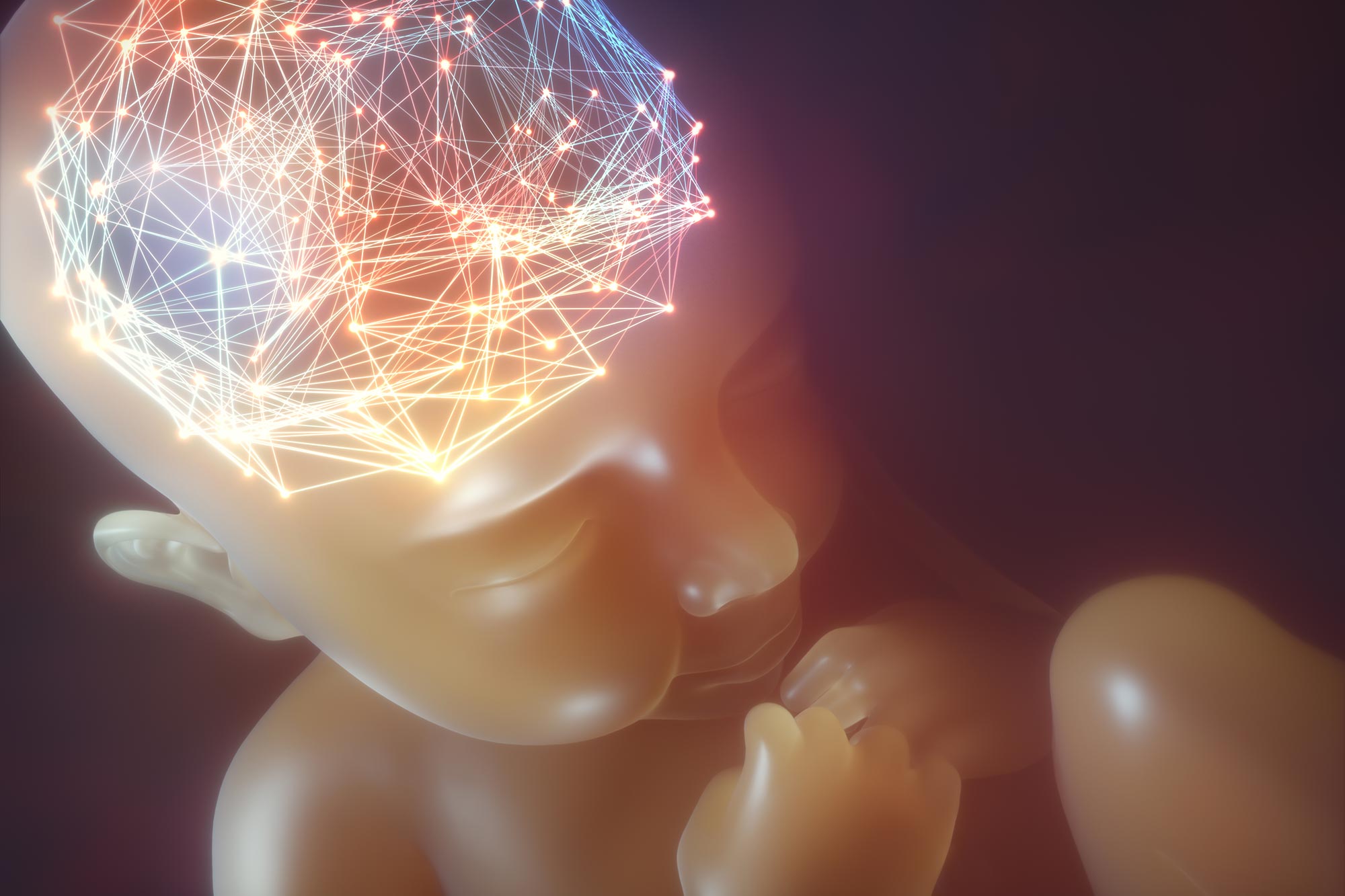
Scientists have uncovered two surprising forces that help guide how the human brain forms before birth.
Before birth, the human brain is shaped in large part by an unusual class of stem cells known as radial glia. These cells help determine which brain cells are produced, when they appear, and how the cerebral cortex, the region involved in thought, memory, and language, develops.
Radial glia give rise to many of the neurons and supporting cells found in the cortex. Scientists believe they also played a major role in the dramatic expansion of the human cortex compared with that of other species. Most radial glia disappear before birth, although cells with similar characteristics can later appear in brain cancers for reasons that are still not fully understood.
“Radial glia are the coolest cells that have ever existed,” said Aparna Bhaduri, an assistant professor of biological chemistry at the David Geffen School of Medicine at UCLA. “They’re really key to making us human. But they’re also at the center of many neurodevelopmental and neuropsychiatric disorders, as well as cancer — so understanding how they make their decisions is one way to start understanding how those conditions arise.”
Two new studies, published in Cell and Science, now provide fresh insight into how these cells decide what to become. Bhaduri and her colleagues found that radial glia respond to two very different kinds of information: the way they process nutrients and direct physical signals coming from another part of the developing brain.
Together, the findings offer a clearer picture of how the human cortex produces such an enormous variety of cells.
Metabolism Helps Direct Brain Stem Cells
In the Cell study, researchers created a detailed map of metabolic activity in the developing human cortex. The project brought together Bhaduri’s lab and Heather Christofk’s lab and was led by co-first authors Jessenya Mil and Jose Soto.
Using donated human tissue along with brain organoids grown from stem cells, the researchers found that metabolism does more than simply supply energy and raw materials. It can actively influence what developing brain stem cells become.
Radial glia were found to depend heavily on the pentose phosphate pathway, a metabolic process that uses glucose to make molecular building blocks needed by rapidly dividing cells.
When the researchers lowered glucose levels or interfered with that pathway, the radial glia changed their behavior. Instead of producing the same mix of cells, they shifted toward making more inhibitory neurons and other cell types that normally emerge later in development.
“What was surprising is that metabolism isn’t just a passive thing that happens in the background,” said Bhaduri, a member of both the UCLA Broad Stem Cell Research Center and the UCLA Health Jonsson Comprehensive Cancer Center. “It can really control how stem cells make decisions.”
The results may help scientists investigate how maternal nutrition, metabolic disorders and other environmental influences affect the developing brain. The metabolic atlas created by the team also provides one of the most detailed resources yet for studying metabolism during human brain development.
A Surprising Signal From the Thalamus
The second study, published in Science and led by first author Claudia Nguyen, examined a very different source of information reaching radial glia.
The researchers focused on the thalamus, a structure deep inside the brain that helps relay information throughout the nervous system.
Scientists have long known that neurons in the thalamus send out long fibers toward the cortex. These thalamic projections eventually connect with specific cortical neurons. But in humans, anatomical studies have shown that the fibers arrive well before those final connections are established.
That raised an important question: Why do the projections reach the cortex so early?
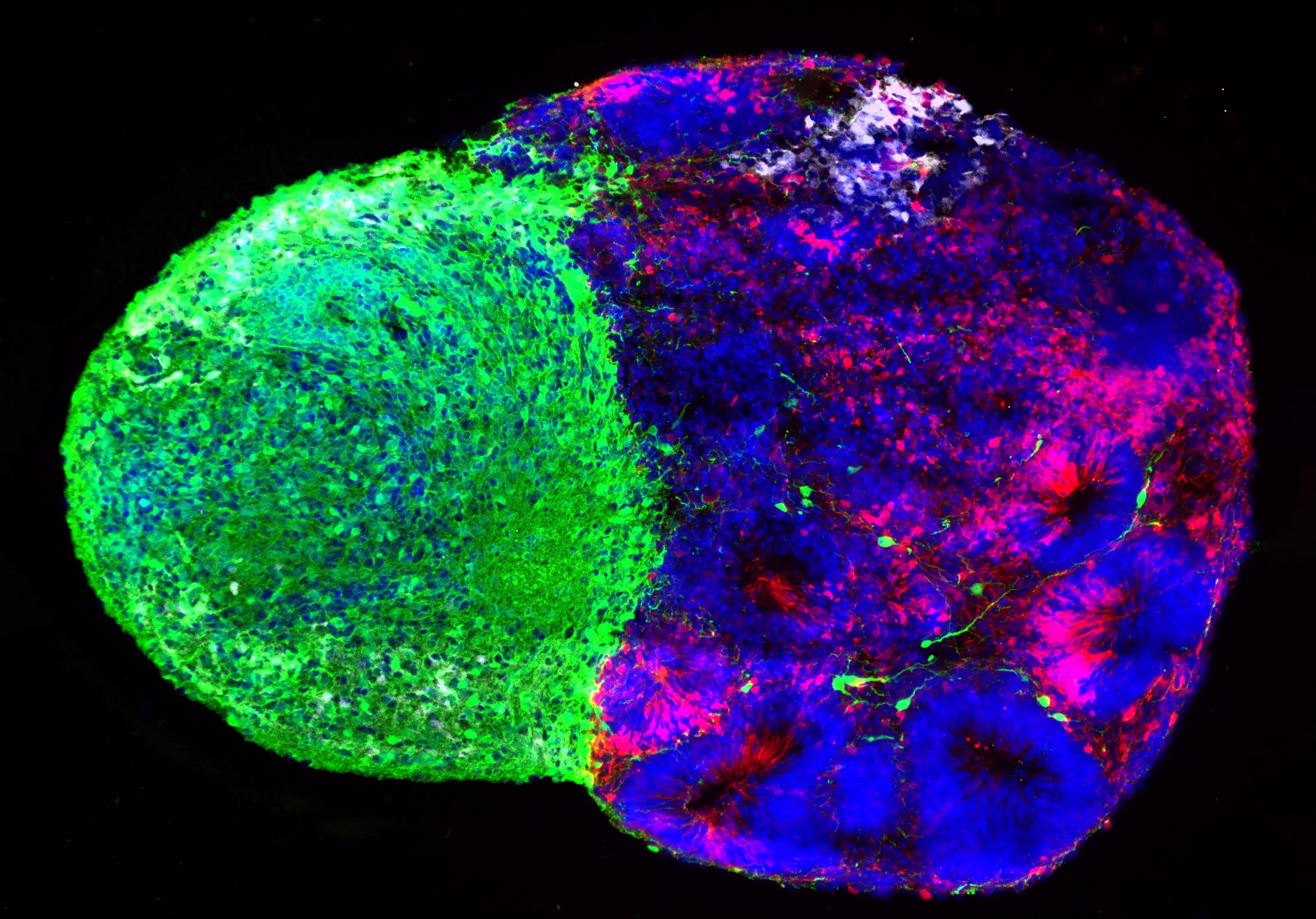
Using human stem cell-derived brain “assembloids,” the UCLA researchers found that the fibers have another role. During development, projections from the thalamus directly touch radial glia.
That physical contact changed what the stem cells produced. Radial glia exposed to the thalamic projections generated more excitatory neurons, which are the cortex’s primary signal-carrying cells. The effect was especially strong for upper-layer neurons, a population that has expanded substantially during human brain evolution.
“We already knew that these projections influence how the cortex develops,” Bhaduri said. “What we specifically found is that this influence comes through an actual physical connection between the projections and the radial glia — a point of contact that just hasn’t been identified before, and one that very likely does not exist in rodents.”
A Gene Linked to the Physical Connection
The researchers connected this newly identified contact point to NRXN1, a gene already known for helping neurons form connections with one another.
Mutations in NRXN1 have previously been associated with autism spectrum disorder. To explore its role, the team created assembloids using patient-derived cells carrying an NRXN1 mutation.
The altered thalamic signals behaved differently from those produced by unaffected cells. This changed the balance between radial glia and the neurons they generated.
The result gives researchers a new way to study how very early changes in brain development might influence the formation of the cortex and potentially contribute to neurological conditions.
The Developing Brain Is in Constant Communication
Although the two studies examined very different mechanisms, they point toward the same broader idea.
One focused on metabolism, while the other examined direct physical contact between developing brain regions. In both cases, radial glia were shown to respond continuously to information from their surroundings.
The findings also demonstrate how brain organoid technology is changing the study of human development. A decade ago, scientists had few practical ways to directly investigate how uniquely human neural stem cells behave. Organoids now make it possible to recreate certain features of human brain development in the laboratory and test questions that cannot easily be addressed using animal models alone.
Bhaduri hopes the findings will help establish a broader principle in developmental neuroscience: metabolism and physical connections are not simply supporting processes. They can actively determine how stem cells behave and what kinds of cells they produce.
“Ultimately, these studies give us a glimpse under the hood of how these cells make decisions,” she said. “Understanding those decisions is a first step toward understanding normal brain development, disease vulnerability and, potentially, how similar stem-cell programs operate in brain cancer.”
References:
“Metabolic atlas of early human cortex reveals glycolytic remodeling and pentose phosphate pathway control of cell fate transitions” by Jessenya Mil, Jose A. Soto, Abigail S. Krall, Julia Peloggia, Sara Frigui, Olivia S. Fong, Laila Sathe, Nedas Matulionis, Francesca Day, Linsey Stiles, Katrina P. Montales, Daria J. Azizad, Carlos E. Gonzalez, Elisa Fazzari, Matthew X. Li, Patricia R. Nano, Antoni A. Martija, Cesar A. Perez-Ramirez, Claudia V. Nguyen, Brittney Wick, Weihong Ge, Ryan L. Kan, Madeline G. Andrews, Maximilian Haeussler, Michael F. Wells, Heather R. Christofk and Aparna Bhaduri, 4 August 2026, Cell.
DOI: 10.1016/j.cell.2026.07.023
“Thalamic NRXN1-mediated input to human cortical progenitors drives excitatory neurogenesis” by Claudia V. Nguyen, Antoni Martija, Daniel C. Jaklic, Rista White, Marty G. Yang, Patricia R. Nano, Jose A. Soto, Jessenya Mil, Dakshesh Rana, Jacqueline M. Martin, Hunter E. Schweiger, Sebastian Hernandez, Elisa Fazzari, Yu Liu, Jack M. Parent, Mohammed A. Mostajo-Radji, Daniel H. Geschwind and Aparna Bhaduri, 3 September 2026, Science.
DOI: 10.1126/science.ady5180
This research was supported by the National Institutes of Health, the National Science Foundation, the Brain & Behavior Research Foundation, the Alfred P. Sloan Foundation, the Rose Hills Foundation, the Esther A. & Joseph Klingenstein Fund, the Simons Foundation, the Chan Zuckerberg Initiative, the NIH BRAIN Initiative Cell Atlas Network, the International Foundation for Ethical Research, the UCLA Broad Stem Cell Research Center’s Stem Cell Research Training Program, and the UCLA Health Jonsson Comprehensive Cancer Center and UCLA Broad Stem Cell Research Center Ablon Scholars Program.
Never miss a breakthrough: Join the SciTechDaily newsletter.
Follow us on Google and Google News.