
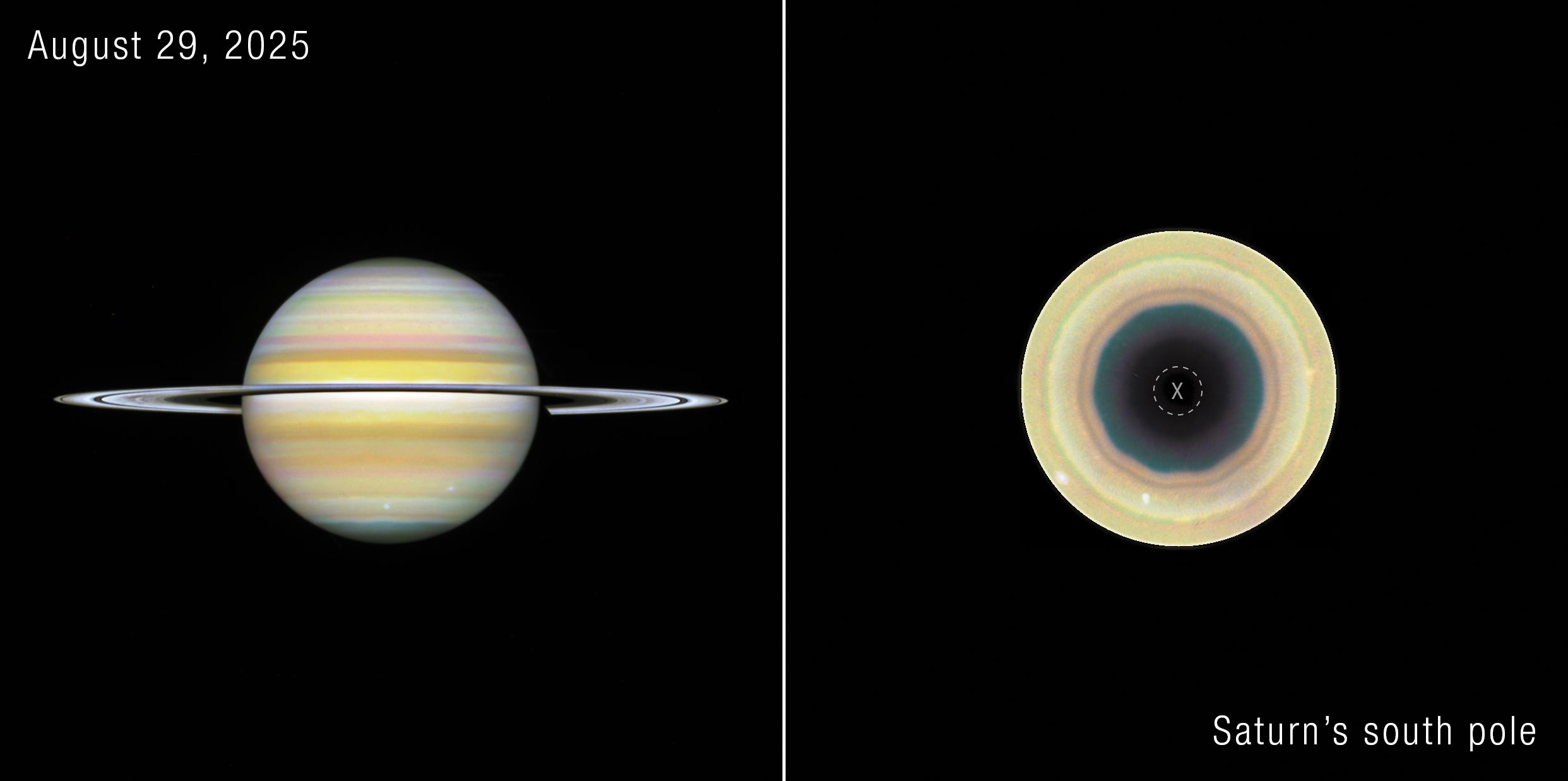
A giant 10-sided wave is emerging around Saturn’s south pole, giving scientists a rare chance to watch a planetary weather pattern take shape.
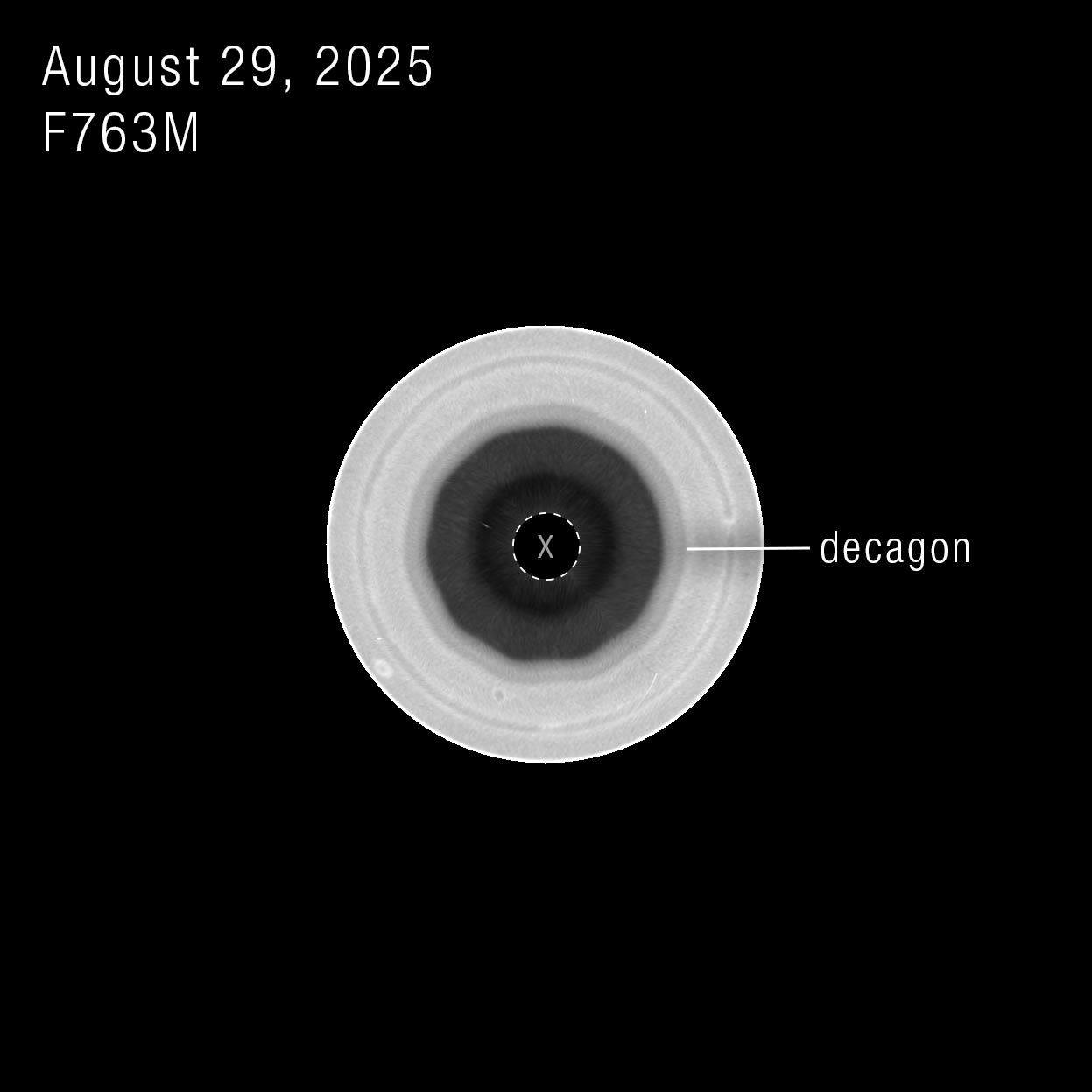
NASA’s Hubble Space Telescope has detected a huge, evolving atmospheric wave with 10 sides wrapped around Saturn’s south pole. It is the first time scientists have seen a large, regular-sided jet pattern in the planet’s southern hemisphere.
The newly identified feature bears a striking resemblance to Saturn’s famous hexagon at its northern pole, yet the two are not identical. That difference raises the possibility that researchers are watching a distinct atmospheric phenomenon develop on the gas giant.
The results were published in the journal Science Advances.
A Giant Pattern Emerges Over Time
Researchers reconstructed the feature’s development using several years of Hubble observations going back to 2023. The earlier images contained faint signs of the structure before it became more clearly defined.
Those observations came from Hubble’s Outer Planet Atmospheres Legacy (OPAL) program, which has imaged the outer planets every year for more than a decade.
“We’ve never seen anything quite like this in Saturn’s southern hemisphere,” said Amy Simon, study co-author and OPAL principal investigator, at NASA’s Goddard Space Flight Center in Greenbelt, Maryland. “The northern hexagon has been there every time we’ve looked for more than 40 years. This feature is different — it appears to be strengthening, giving us the rare opportunity to watch a giant atmospheric pattern develop.”
Saturn’s changing seasons helped make the discovery possible. As the planet moved through its seasonal cycle, the south pole gradually became easier to observe from Earth.
Ground Observers Helped Spot the Decagon
The first strong clues came from astronomers examining ground-based images of Saturn.
Agustín Sánchez-Lavega, lead author of the new study, is a researcher at the University of the Basque Country in Spain. The university operates the Planetary Virtual Observatory Laboratory, a website that collects images of solar system planets submitted by observers around the world.
In 2024, Sánchez-Lavega and amateur astronomers Trevor Barry and Jean-Paul Oger noticed a faint, wavy band near Saturn’s south pole in those images. Ground-based observations from 2025 made the emerging decagon look even more convincing.
Hubble then provided a much clearer view. Because it observes from space, the telescope can capture Saturn with high spatial resolution over full planetary rotations without the blurring effects of Earth’s atmosphere.
“Given Saturn’s symmetry in its north-south jet stream system, we have been searching for a counterpart to Saturn’s northern hexagon on the south pole in Hubble images since 1990,” Sánchez-Lavega said. “Images from NASA’s Cassini spacecraft, which orbited Saturn between 2004 and 2017, showed no inkling of a long-lived formation, either. The Hubble data confirmed the feature’s presence back to 2023.”
More Than a Cloud-Level Feature
The 10-sided wave is embedded within one of Saturn’s powerful jet streams. It also appears to extend through several layers of the atmosphere, which suggests it is not simply a pattern confined to the cloud tops.
Its apparent position shifts slightly depending on the wavelength used by Hubble. That happens because different wavelengths reveal different heights within Saturn’s atmosphere.
“The most intriguing part to me is that this seems to have just formed recently,” said Simon. “The question is, why did it suddenly form now when we haven’t seen one before?”
Scientists still do not know what caused the decagon to appear or how long it will survive. The team says future observations from Hubble and NASA’s James Webb Space Telescope, combined with computer modeling, could help explain how the structure formed and how it compares with Saturn’s long-lasting northern hexagon.
Why Long-Term Hubble Observations Matter
Hubble’s long operational lifetime has given astronomers an unusual ability to watch gradual changes unfold across the solar system and in other astronomical objects as well.
Instead of relying on isolated snapshots, the OPAL program repeatedly observes the giant planets. That makes it possible to track seasonal shifts, follow temporary storms, and detect atmospheric features that change slowly over many years.
“When we started the OPAL program, we expected compelling surprises, but we didn’t know what to expect specifically,” said Mike Wong, study co-author, University of California, Berkeley. “A lot of the discoveries we see coming from OPAL are not just based on one observation, but on years and years of data. Regular observations over time are enabling a lot of new findings.”
Will Saturn’s Decagon Last?
The researchers plan to keep watching Saturn to see whether the decagon becomes a stable, long-lived structure like the northern hexagon or continues changing.
Future observations could also reveal what drives the wave, what it can teach scientists about the atmospheric behavior of giant planets across the solar system, and whether similar processes have parallels in weather systems closer to home on Earth.
Reference: “A decagon wave around Saturn’s south pole” by Agustín Sánchez-Lavega, Amy A. Simon, Michael H. Wong, Leigh N. Fletcher, Arrate Antuñano, Ricardo Hueso, Peio Iñurrigarro, Aida Flix-Bellmunt, Arnau Miró, Enrique García-Melendo, Trevor Barry, Jean-Paul Oger, Glenn S. Orton and Itziar Garate-Lopez, 2 September 2026, Science Advances.
DOI: 10.1126/sciadv.aee4251
Never miss a breakthrough: Join the SciTechDaily newsletter.
Follow us on Google and Google News.