

Scientists have filmed a crystal of tiny magnetic vortices melting and reshaping in real time, a breakthrough that could bring ultra-efficient computers closer to reality.
A crystal does not have to be made of atoms. In ultrathin magnetic materials, tiny whirlpools of magnetism known as skyrmions can arrange themselves into orderly, crystal-like patterns, and those patterns may hold clues to a new generation of computing.
Skyrmions are remarkably small and stable, yet they can also be moved and manipulated. Those properties have made them promising candidates for storing and processing information with far less space and energy than many conventional technologies require.
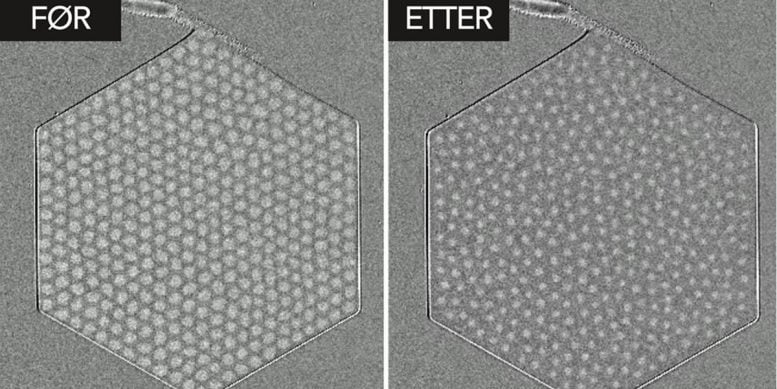
Now, researchers have watched a skyrmion crystal lose its order in real time. In a study published in Nature Nanotechnology, the team filmed an orderly skyrmion lattice as it became increasingly disorganized while simultaneously manipulating individual skyrmions, providing a rare window into how order breaks down in a two-dimensional magnetic system.
Most of the research was conducted at the Institute of Physics at Johannes Gutenberg University Mainz, with contributions from a professor at the Norwegian University of Science and Technology (NTNU).
Tiny Vortices With Computing Potential
“Skyrmions are small, magnetic vortices that can store information in a completely new way,” explained Asle Sudbø, head of NTNU’s Centre for Quantum Spintronics (QuSpin).
Their small size, stability, and ability to move through magnetic materials have made skyrmions promising candidates for storing and processing data. Information could potentially be encoded in their presence, position, or motion, reducing the physical space and energy required for some computing operations.
“Instead of the current technology, where we constantly need more space and energy to process data, skyrmions could make it possible to build much smaller and more energy-efficient data storage systems,” Sudbø explained.
The structures are also relevant to spintronics, a field that uses the magnetic properties of electrons as well as their electrical charge. This approach could support devices that perform certain tasks through magnetism while consuming far less electricity than conventional electronic components.
Building Computers That Behave More Like Brains
“These nanoscale vortices could help develop computers that resemble biological brains,” said Sudbø.
Such brain-inspired systems would not necessarily separate memory from computation as sharply as conventional computers do. Magnetic structures could instead respond collectively and process information through their changing patterns, an approach that may be useful for highly efficient computing.
Before that potential can be realized, researchers need to understand how large groups of skyrmions organize, move, and lose their structure. Skyrmions often settle into repeating arrangements that resemble crystals, forming what scientists call a lattice.
The team studied what happened as one of these ordered lattices “melted.” Here, “melting” describes the skyrmions moving from an orderly lattice into an increasingly disorganized arrangement.
Watching a Magnetic Lattice Melt
“For the first time, researchers have managed to film how a magnetic skyrmion lattice melts in real time while simultaneously being able to manipulate each individual skyrmion directly as they film it. For example, both their shape and size can be changed “on the fly,” said Sudbø.
Using magnetic fields, the researchers altered the skyrmions’ size and mobility. The lattice did not move directly from an ordered solid state to complete disorder. It passed through an intermediate phase in which the skyrmions lost their fixed positions while retaining some shared directional alignment.
The real-time images also revealed how defects emerged and spread through the lattice. These disruptions moved up to roughly 100 times faster than the skyrmions themselves, showing that small local rearrangements can rapidly destabilize the larger pattern.
Observing that process gives researchers a new way to test theories of two-dimensional melting while learning how skyrmion systems might be controlled more reliably.
From Fundamental Physics to Future Devices
“The findings give us new insight into how these types of particles behave. This could therefore become important for the development of more energy-efficient computer technology in the future,” said Sudbø.
The work remains fundamental research rather than a demonstration of a practical computer. Engineers would still need to develop dependable methods for creating, moving, reading, and preserving skyrmions inside working devices.
However, the ability to observe individual skyrmions and adjust their behavior in real time could help researchers design magnetic systems with predictable responses. Possible long-term applications include denser data storage, brain-inspired processors, and components for emerging quantum technologies.
“This could revolutionize the way we think about computers,” concluded Sudbø.
Reference: “Real-time observation of topological defect dynamics mediating two-dimensional skyrmion lattice melting” by Raphael Gruber, Jan Rothörl, Simon M. Fröhlich, Maarten A. Brems, Fabian Kammerbauer, Maria-Andromachi Syskaki, Elizabeth M. Jefremovas, Sachin Krishnia, Asle Sudbø, Peter Virnau and Mathias Kläui, 4 August 2025, Nature Nanotechnology.
DOI: 10.1038/s41565-025-01977-2
Never miss a breakthrough: Join the SciTechDaily newsletter.
Follow us on Google and Google News.
3 Comments
New Findings Could Help Build Computers That Think More Like Your Brain.
VERY GOOD.
If nature can create humans through topological spin, it is possible to create civilizations that are more advanced than humans. Your discovery will help humans construct nature through topological spin.
Grounded in the topological spin of spacetime vortices, the astonishing mathematical isomorphism between the quantum world and the fluid world gives the “local realism” upheld by Einstein a more natural physical foundation than standard quantum-mechanical interpretations. The human brain is not necessarily smarter than intelligent machines made by humans.
—— https://zhuanlan.zhihu.com/p/2085001571696431522.
“The motion at the cosmic scale compared to micro scale is wild—how similar those two things look. Whether you’re watching tiny magnetic vortices shift under a lab microscope or looking at massive spiral galaxies spinning out in deep space, it really makes you wonder if nature is just running the exact same playbook at every single scale.
We tend to put quantum physics and macro-astrophysics into completely separate boxes with entirely different rules. But when you step back and look at how both systems handle rotational stress, momentum, and energy transfer, the structural patterns are remarkably alike. Instead of rigid systems that just snap or break under pressure, they both rely on those flexible, sliding transition zones—acting almost like built-in friction clutches—that let them absorb force and keep moving without falling apart.
It just highlights how much more we could understand if we stop treating every scale of the universe as a completely isolated problem. Makes you appreciate how efficient a universal mechanical design can be when it isn’t forced to fit into our rigid, human-made categories. What do you think—are we looking at a fundamental physical blueprint, or just a really striking coincidence in how rotation plays out across the board?” The Link , https://docs.google.com/document/d/1RQdUm_EUcSBkvx37DqGIbKLH39clPyUZ5MYiWCehjxk/edit?usp=drive_link