
Close Menu
    Facebook X (Twitter) Instagram
    SciTechDaily
    • Biology
    • Chemistry
    • Earth
    • Health
    • Physics
    • Science
    • Space
    • Technology
    Facebook X (Twitter) Pinterest YouTube RSS
    SciTechDaily
    Home»Physics»Computing With Individual Molecules: A Big Step in Molecular Spintronics
    Physics

    Computing With Individual Molecules: A Big Step in Molecular Spintronics

    By Kiel UniversityDecember 23, 2019No Comments3 Mins Read
    Facebook Twitter Pinterest Telegram LinkedIn WhatsApp Email Reddit
    Share
    Facebook Twitter LinkedIn Pinterest Telegram Email Reddit
    Scanning Tunneling Microscope Illustration
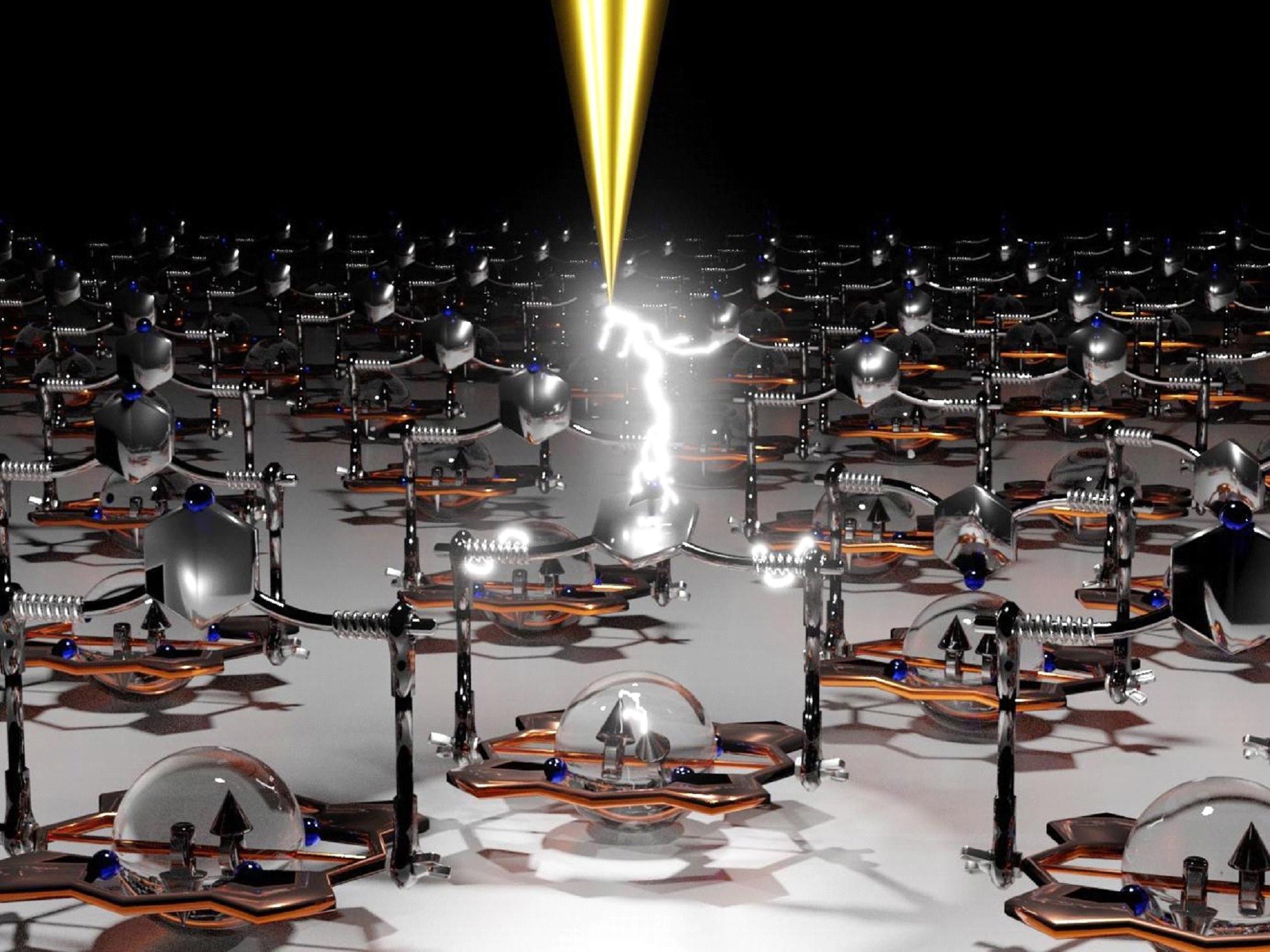
    Each molecule can be separately addressed with a scanning tunneling microscope and switched between the states by applying a positive or negative voltage. Credit: © Jan-Simon von Glasenapp and Rainer Herges

    International Research Team Lead by Kiel University Developed More Stable Spin States

    Spintronics or spin electronics in contrast to conventional electronics uses the spin of electrons for sensing, information storage, transport, and processing. Potential advantages are nonvolatility, increased data processing speed, decreased electric power consumption, and higher integration densities compared to conventional semiconductor devices. Molecular spintronics aims for the ultimate step towards miniaturization of spintronics by striving to actively control the spin states of individual molecules.

    Chemists and physicists at Kiel University joined forces with colleagues from France, and Switzerland to design, deposit and operate single molecular spin switches on surfaces. The newly developed molecules feature stable spin states and do not lose their functionality upon adsorption on surfaces. They present their results in the current issue of the renowned journal Nature Nanotechnology.
    Intermolecular Cooperativity Graphic
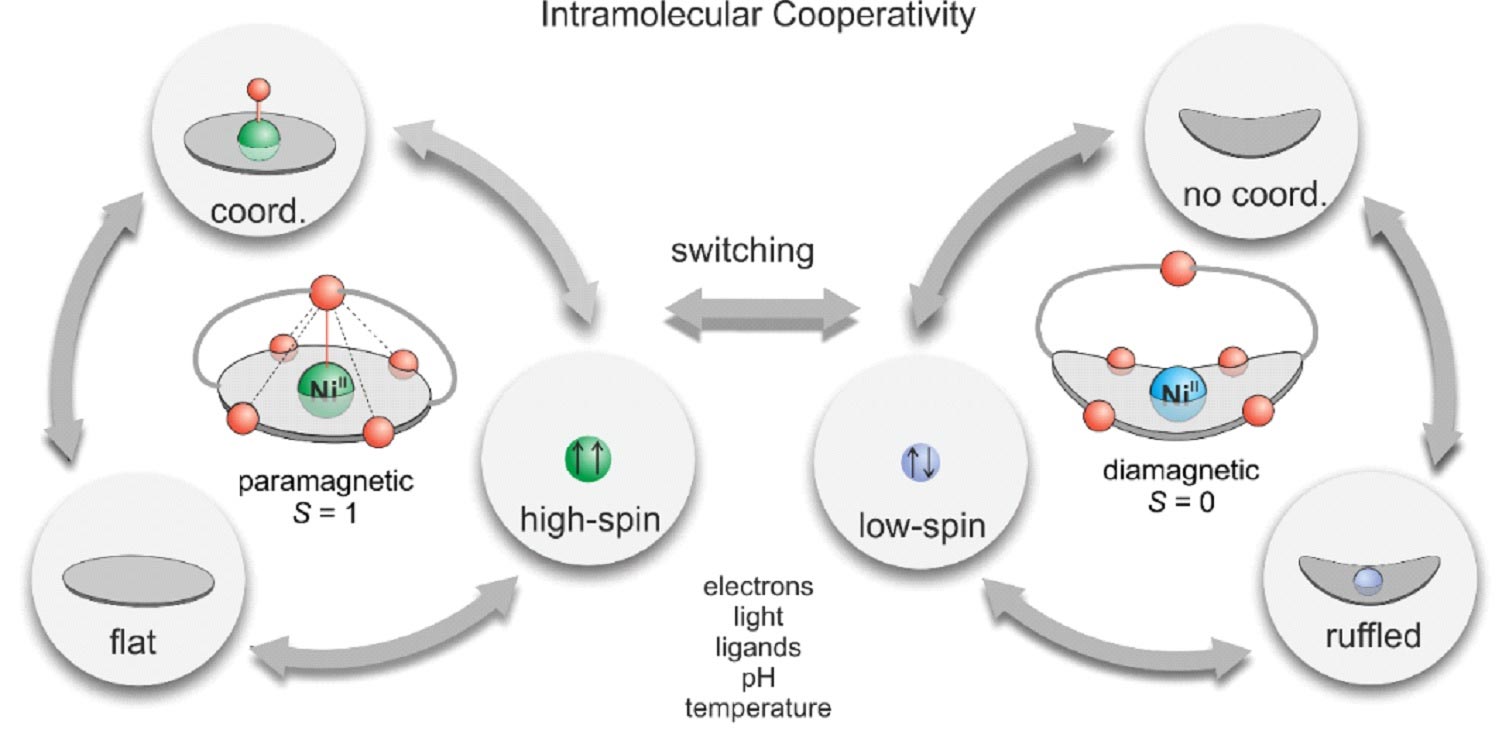
    The new molecule has three properties. Only two combinations of these properties are stable. Switched between the different states is achieved by applying tiny tunneling currents. Credit: © Rainer Herges

    The spin states of the new compounds are stable for at least several days. “This is achieved by a design trick that resembles the fundamental electronic circuits in computers, the so-called flip-flops. Bistability or switching (between 0 and 1) is realized by looping the output signal back to the input,” says experimental physicist Dr. Manuel Gruber from Kiel University.

    The new molecules have three properties that are coupled with each other in such a feedback loop: their shape (planar or flat), the proximity of two subunits, called coordination (yes or no), and the spin state (high-spin or low-spin). Thus, the molecules are locked either in one or the other state. Upon sublimation and deposition on a silver surface, the switches self-assemble into highly ordered arrays. Each molecule in such an array can be separately addressed with a scanning tunneling microscope and switched between the states by applying a positive or negative voltage. 

    “Our new spin switch enables us to realize in just one molecule what takes several components like transistors and resistors in conventional electronics. That means a big step towards a further miniaturization,” Dr. Manuel Gruber and organic chemist Prof. Dr. Rainer Herges explain. A next step will be to increase the complexity of the compounds to implement more sophisticated operations.

    Molecules are the smallest constructions that can be designed and built with atomic precision and predictable properties. Their response to electrical or optical stimuli and their custom-designed chemical and physical functionality make them unique candidates to develop new classes of devices such as controllable surface catalysts or optical devices.

    Reference: “Reversible coordination-induced spin-state switching in complexes on metal surfaces” by Alexander Köbke, Florian Gutzeit, Fynn Röhricht, Alexander Schlimm, Jan Grunwald, Felix Tuczek, Michał Studniarek, Danilo Longo, Fadi Choueikani, Edwige Otero, Philippe Ohresser, Sebastian Rohlf, Sven Johannsen, Florian Diekmann, Kai Rossnagel, Alexander Weismann, Torben Jasper-Toennies, Christian Näther, Rainer Herges, Richard Berndt and Manuel Gruber, 23 December 2019, Nature Nanotechnology.
    DOI: 10.1038/s41565-019-0594-8

    Never miss a breakthrough: Join the SciTechDaily newsletter.
    Follow us on Google and Google News.

    Kiel University Nanotechnology Particle Physics Spintronics
    Share. Facebook Twitter Pinterest LinkedIn Email Reddit

    Related Articles

    New Exotic Magnetic Quasiparticle: “Skyrmion Bundle” Joins Topological Zoo

    Quantum Light Sources: Devil in the Defect Detail of Quantum Emissions

    Machine Learning to Automatically Measure and Control Qubits

    Photonics Breakthrough: Half-Light Half-Matter Quasiparticle Based LED

    Kiel Physicists Store Data on a Single Molecule

    “Proximity Magnetism” Could Be a Building Block for Quantum Computers

    Superabsorption Can Be Achieved and Sustained in Simple Nanostructures

    New Quantum Dots Design for Solotronics

    Researchers Discover Electrical Switch for Magnetic Current

    Leave A Reply Cancel Reply

    • Facebook
    • Twitter
    • Pinterest
    • YouTube

    Don't Miss a Discovery

    Subscribe for the Latest in Science & Tech!

    Trending News

    Two Drinks a Day May Be Riskier Than Many Americans Think

    A Lost Human Lineage May Have Left a Genetic Legacy in People Today

    Study Reveals a Surprising Link Between Birth Control Pills and Binge Eating

    NASA’s HiRISE Captures Perseverance Rover Completing a Marathon on Mars

    Ancient DNA Reveals the Hidden Origins of China’s Mysterious Shimao Civilization

    Scientists Discover a Surprising Link Between Sleep, Genes, and Alzheimer’s

    Popular Childhood Drinks Linked to Higher Blood Pressure Later in Life

    Scientists Just Challenged a 70-Year-Old Myth About the Human Brain

    Follow SciTechDaily
    • Facebook
    • Twitter
    • YouTube
    • Pinterest
    • Newsletter
    • RSS
    SciTech News
    • Biology News
    • Chemistry News
    • Earth News
    • Health News
    • Physics News
    • Science News
    • Space News
    • Technology News
    Recent Posts
    • Why Ancient Mesopotamians Took Their Signatures So Seriously
    • Archaeologists Decapitated Tutankhamun and Glued His Body Back Together
    • The Propellantless Spacecraft Technologies That Could Help Us Reach the Stars
    • New Black Hole Theory Solves a 50-Year-Old Problem
    • China’s Tianwen-1 Captures Rare Close-Up Images of Interstellar Comet 3I/ATLAS
    Copyright © 1998 - 2026 SciTechDaily. All Rights Reserved.
    • Science News
    • About
    • Contact
    • Editorial Board
    • Privacy Policy
    • Terms of Use

    Type above and press Enter to search. Press Esc to cancel.