

Over the past few years, the building blocks of storage media have gotten even smaller. But further miniaturization of the current technology is hindered by the fundamental limits of quantum mechanics. A new approach consists in using so-called spin-crossover molecules as the smallest possible storage unit. Similar to normal hard drives, these special molecules can save information via their magnetic state. To do so, they have to be placed on surfaces, which is challenging without damaging their ability to save the information. A research team from Kiel University has now not only managed to successfully place a new class of spin-crossover molecules onto a surface, but they have also used interactions which were previously regarded as obstructive to improve the molecule’s storage capacity. The storage density of conventional hard drives could therefore theoretically be increased by more than one hundredfold, and data carriers could be made significantly smaller. The scientists have published their findings in the scientific journal Nano Letters.
Is a switch on or off? Is a statement true or false? Is an answer yes or no? The differentiation between the two possibilities is the smallest piece of information that a computer can save. Bits (a word comprised of ‘binary’ and ‘digit’), as the smallest electronic storage unit, are the basic building blocks for all information stored on our hard drives. They are presented as a sequence of two different symbols like 0 and 1, the so-called binary code. Over the past few years, storage media have become ever smaller while their capacity to store information has increased. One Bit on a hard drive now only requires a space of around 10 by 10 nanometers. This is still too big for miniaturizing components, however.
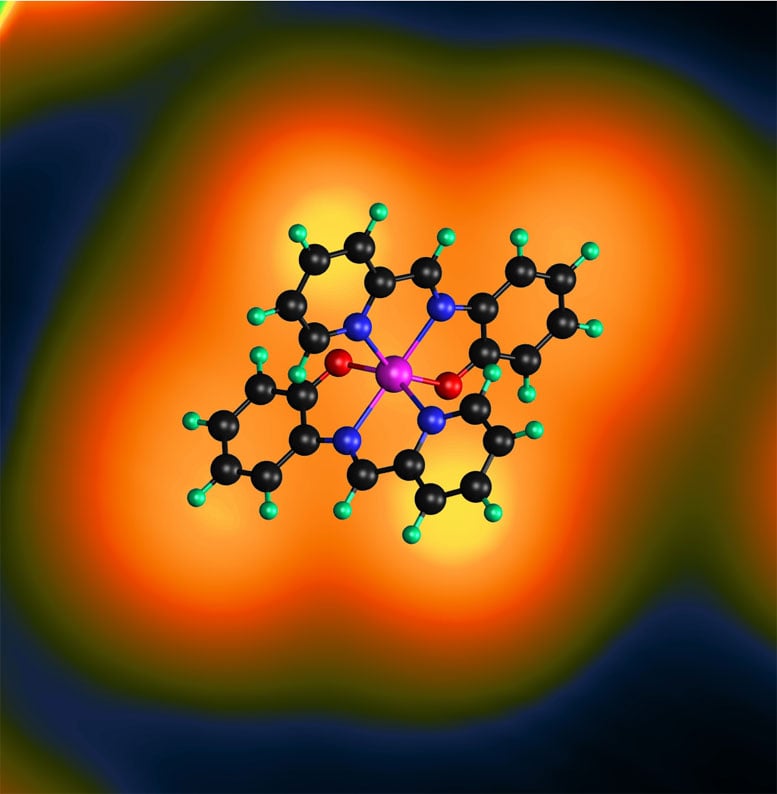
“The technology that is currently being used to store data on hard drives now reaches the fundamental limits of quantum mechanics due to the size of the Bit. It cannot get any smaller, from today’s perspective,” says Torben Jasper-Tönnies, doctoral researcher in Professor Richard Berndt’s working group at Kiel University’s Institute of Experimental and Applied Physics. He and his colleagues used a single molecule, which could be employed to encode a Bit, to demonstrate a principle which might just enable even smaller hard drives with more storage in the future. “Our molecule is just one square nanometer in size. Even with this alone, a bit could be encoded in an area hundred times smaller than what is nowadays required,” says his colleague, Dr. Manuel Gruber. This would be another step toward shifting the limits of quantum physics in storage technology.
When Bits become Trits
The molecule that the interdisciplinary research team from the Kiel Collaborative Research Center (CRC) 677 “Function by Switching” uses can not only assume two different magnetic states, but when attached to a special surface, it can also change its connection to the surface. It can then be switched between a high and low magnetic state, and turned by 45 degrees. “When transferred onto storage technology, we would be able to depict information on three states – those being 0, 1, and 2,” explained Jasper-Tönnies. “As a storage unit, we wouldn’t have a Bit, we would have a Trit. Binary code would become trinary code.”
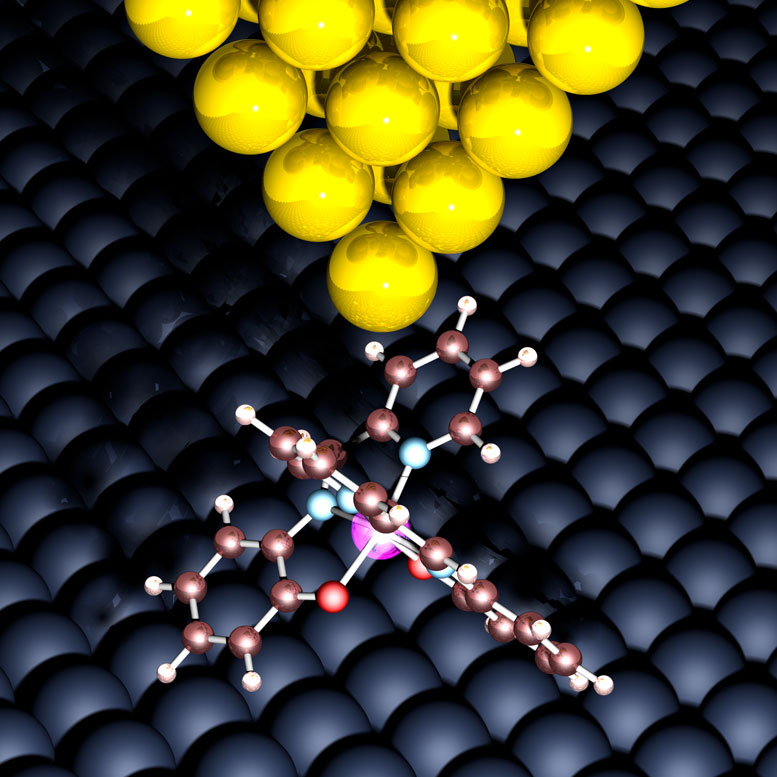
The challenge for the researchers from Chemistry and Physics was in finding a suitable molecule and a suitable surface, as well as using the correct method to connect the two together in a way that would still allow them to work. “Magnetic molecules, so-called spin-crossover molecules, are very sensitive and easily damaged. We needed to find a way to firmly attach the molecule to the surface without affecting its switching ability,” explained Gruber.
Perfect combination of molecule and surface
Their experiments finally paid off: Chemists from Professor Felix Tuczek’s working group at the Institute of Inorganic Chemistry synthesized a magnetic molecule of a special class (a so-called Fe(III) spin crossover molecule). Physicists Jasper-Tönnies, Gruber and Sujoy Karan were able to deposit this molecule on a copper nitride surface by means of evaporation. Using electricity, it can be switched between different spin states, and also between two different directions (in the so-called low-spin state). The fine tip of a scanning tunneling microscope (STM) acts as a hard drive’s reading and writing head in their experiments. This piece of equipment allows the molecule to not only be “written” as a storage medium, but also to be “read” using electricity.
Before these molecules can be used as a data storage on an industrial level further investigation must be carried on. Indeed, the proof of principle is demonstrated using a rather voluminous setup (STM) and further work is required to integrate such a molecular memory on a small chip.
References:
- “Robust and Selective Switching of an Fe III Spin-Crossover Compound on Cu2N/Cu(100) with Memristance Behavior” by Torben Jasper-Toennies, Manuel Gruber, Sujoy Karan, Hanne Jacob, Felix Tuczek and Richard Berndt, 12 October 2017, Nano Letters.
DOI: 10.1021/acs.nanolett.7b02481 - “Deposition of a Cationic FeIII Spin-Crossover Complex on Au(111): Impact of the Counter Ion” by Torben Jasper-Toennies, Manuel Gruber, Sujoy Karan, Hanne Jacob, Felix Tuczek and Richard Berndt, 20 March 2017, Journal Physical Chemistry Letter.
DOI: 10.1021/acs.jpclett.7b00457
Never miss a breakthrough: Join the SciTechDaily newsletter.
Follow us on Google and Google News.