

For the first time, scientists formed a charged rare earth molecule on a metal surface and rotated it using scanning tunneling microscopy.
Scientists from Ohio University, Argonne National Laboratory, and the University of Illinois at Chicago used scanning tunneling microscopy to form a charged rare earth molecule on a metal surface and rotate it clockwise and counterclockwise without affecting its charge.
Their findings open up new avenues for research into the atomic-scale manipulation of materials important to the future, ranging from quantum computing to consumer electronics.
“Rare earth elements are vital for high-technological applications including cell phones, HDTVs, and more. This is the first-time formation of rare-earth complexes with positive and negative charges on a metal surface and also the first-time demonstration of atomic-level control over their rotation,” said team lead Saw-Wai Hla, who has dual appointments as a scientist at Argonne and professor of physics and astronomy in the College of Arts and Sciences at Ohio University.
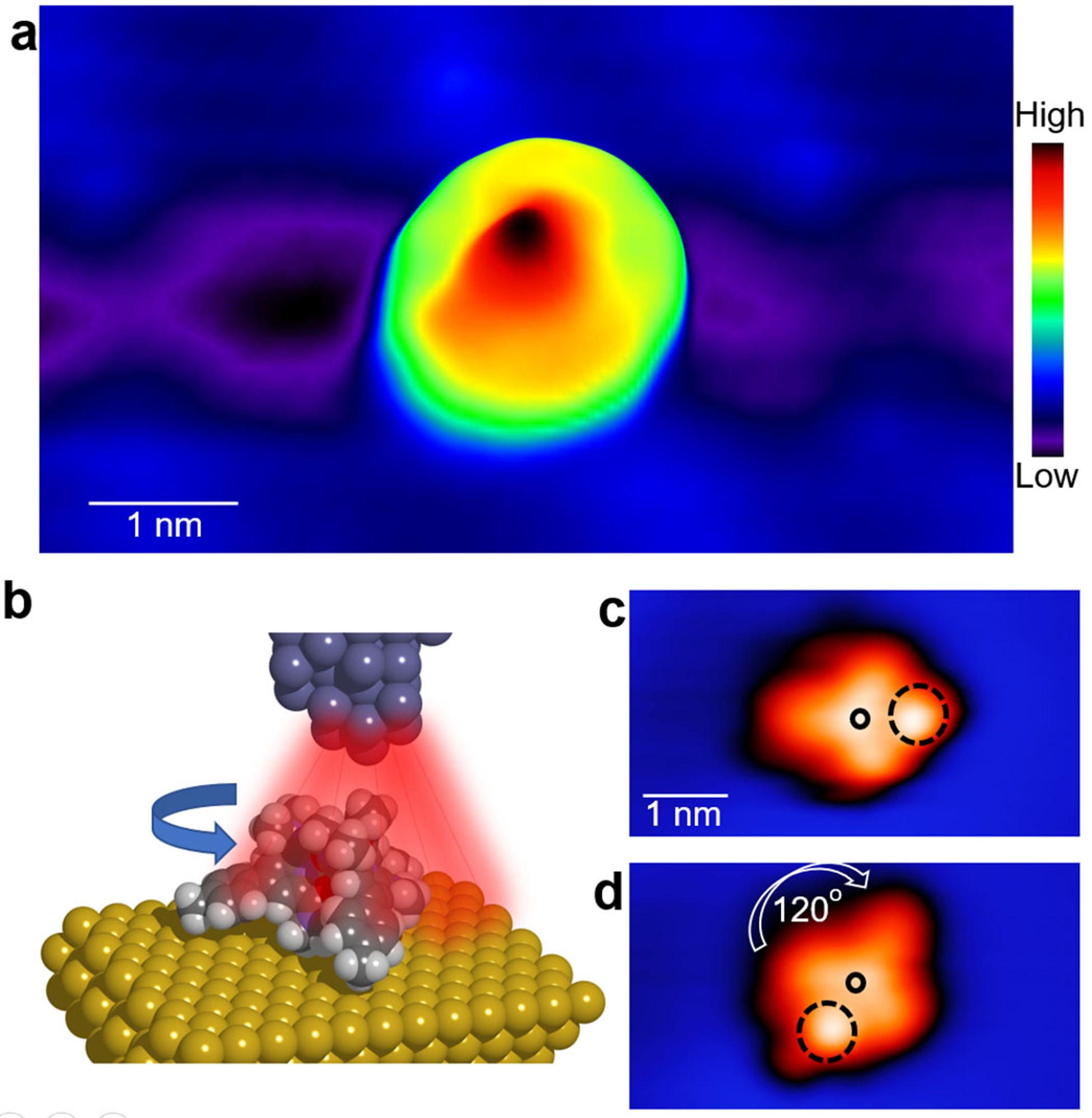
The experiment was carried out at both Argonne and Ohio University, utilizing two different low-temperature scanning tunneling microscopy (STM) systems. The environment for STM experiments requires a temperature of about 5 degrees K (-450 degrees Fahrenheit) in an ultrahigh vacuum. The size of the sample molecules was roughly 2 nanometers.
“The same results were achieved in both locations, which ensures reproducibility,” Hla said. The Ohio lab is operated by students of the Hla group associated with the Nanoscale & Quantum Phenomena Institute.
The scientists’ research was recently published in the journal Nature Communications.
The rare-earth complexes the researchers assembled were positively charged Europium base molecules with negatively charged counterions on a gold surface. Rotations of the complexes resulted from applying electric field emanating from the STM tip, using the counterion underneath as a pivot. The researchers demonstrated 100% directional control over the rotation of these rare-earth complexes.
This movie reveals different energetic positions and the shapes of unoccupied orbitals of [Eu(pcam)3X]2+ and [Eu(pcam)3]3+. It is created from 8000 dI/dV spectroscopic maps acquired over a pair of [Eu(pcam)3X]2+ – [Eu(pcam)3]3+ complexes at ±2000 mV range with 1 mV interval between the consecutive frames. This movie shows the controlled clockwise rotation of a [Eu(pcam)3X2]+ complex on Au(111) surface when a negative electric field is applied from the STM tip.
Eric Masson, professor and Roenigk Chair of Chemistry at Ohio University and one of the co-investigators of the project designed the rare-earth complexes, and his group at Ohio University synthesized them. Density functional theory calculations were performed by scientists at Argonne and the group of Anh Ngo, an associate professor of Chemical Engineering at the University of Illinois at Chicago, using Argonne’s BEBOP, the most powerful supercomputer in the United States to date. The calculations unveil only a negligible amount of charge transfer at the molecule-substrate interface, which means the complexes remained charged on the surface.
The chemical state of the Eu ion in the complexes adsorbed on the surface is determined by a nascent experimental method known as synchrotron X-rays scanning tunneling microscopy at the Advanced Photon Source in Argonne by Hla and co-workers, where they confirm that the molecules are positively charged on the gold surface. STM images show the structure as a distorted triangular shape with three arms. The incorporation of the counterion underneath is proved by an STM movie acquired with a record number of 8,000 spectroscopic frames. Then the Hla group used STM manipulation to further demonstrate the control rotation, which shows clockwise and counterclockwise rotations at will.
“These findings may be useful for the development of nanomechanical devices where the individual units in the complex are designed to control, promote, or restrict motion,” Hla said. “We have demonstrated the rotation of charged rare-earth complexes on a metal surface, which now enables investigations one-complex-at-a-time for their electronic and structural as well as mechanical properties.”
Reference: “Atomically precise control of rotational dynamics in charged rare-earth complexes on a metal surface” by Tolulope Michael Ajayi, Vijay Singh, Kyaw Zin Latt, Sanjoy Sarkar, Xinyue Cheng, Sineth Premarathna, Naveen K. Dandu, Shaoze Wang, Fahimeh Movahedifar, Sarah Wieghold, Nozomi Shirato, Volker Rose, Larry A. Curtiss, Anh T. Ngo, Eric Masson and Saw Wai Hla, 22 October 2022, Nature Communications.
DOI: 10.1038/s41467-022-33897-3
The study was funded by the U.S. Department of Energy, Office of Science, Office of Basic Energy Sciences, Materials Science and Engineering Division.
Never miss a breakthrough: Join the SciTechDaily newsletter.
Follow us on Google and Google News.
4 Comments
The development of nanomechanical devices is crucial. According to the topological vortex field theory,the interactions and balances of topological vortex fields cover all short-distance and long-distance contributions, and are the basis of the formation and evolution of cosmic matter. It is not impossible to build a nonradioactive miniature nuclear material battery. That often requires multidisciplinary collaboration. If we confuse the concepts of elementary particles and microscopic particles, we may never get out of the quagmire of pseudoscience.
Guys, For Scientists everywhere, it’s best for them not to confuse a high quality University that produced the ’09 Nobel laueriat in Chemistry with the one that has produced a big bunch of ‘meat heads’ who can with great skill, throw a ball with great accuracy if it size, shape and density is perfect!
In the development of human social science and civilization, the rhetoric of pseudo-science is often more fascinating than that of science.
… when one hits the water with a small drop it pops up… like one could find in many pictures on the internet> “drop of water hitting water” – that could be reason why when one tries to observe electron with a photon it gets what it wants’… however if you have a tree body system with the gravity it is bit into area of probability not certain… but if you have more forces on that scale … well … … …
I am probably wrong, but just because I am wrong it might lead to something that is not so wrong…