
Close Menu
    Facebook X (Twitter) Instagram
    SciTechDaily
    • Biology
    • Chemistry
    • Earth
    • Health
    • Physics
    • Science
    • Space
    • Technology
    Facebook X (Twitter) Pinterest YouTube RSS
    SciTechDaily
    Home»Physics»Spintronics Breakthrough: Efficient Valves for Electron Spins
    Physics

    Spintronics Breakthrough: Efficient Valves for Electron Spins

    By University of BaselAugust 15, 2020No Comments3 Mins Read
    Facebook Twitter Pinterest Telegram LinkedIn WhatsApp Email Reddit
    Share
    Facebook Twitter LinkedIn Pinterest Telegram Email Reddit
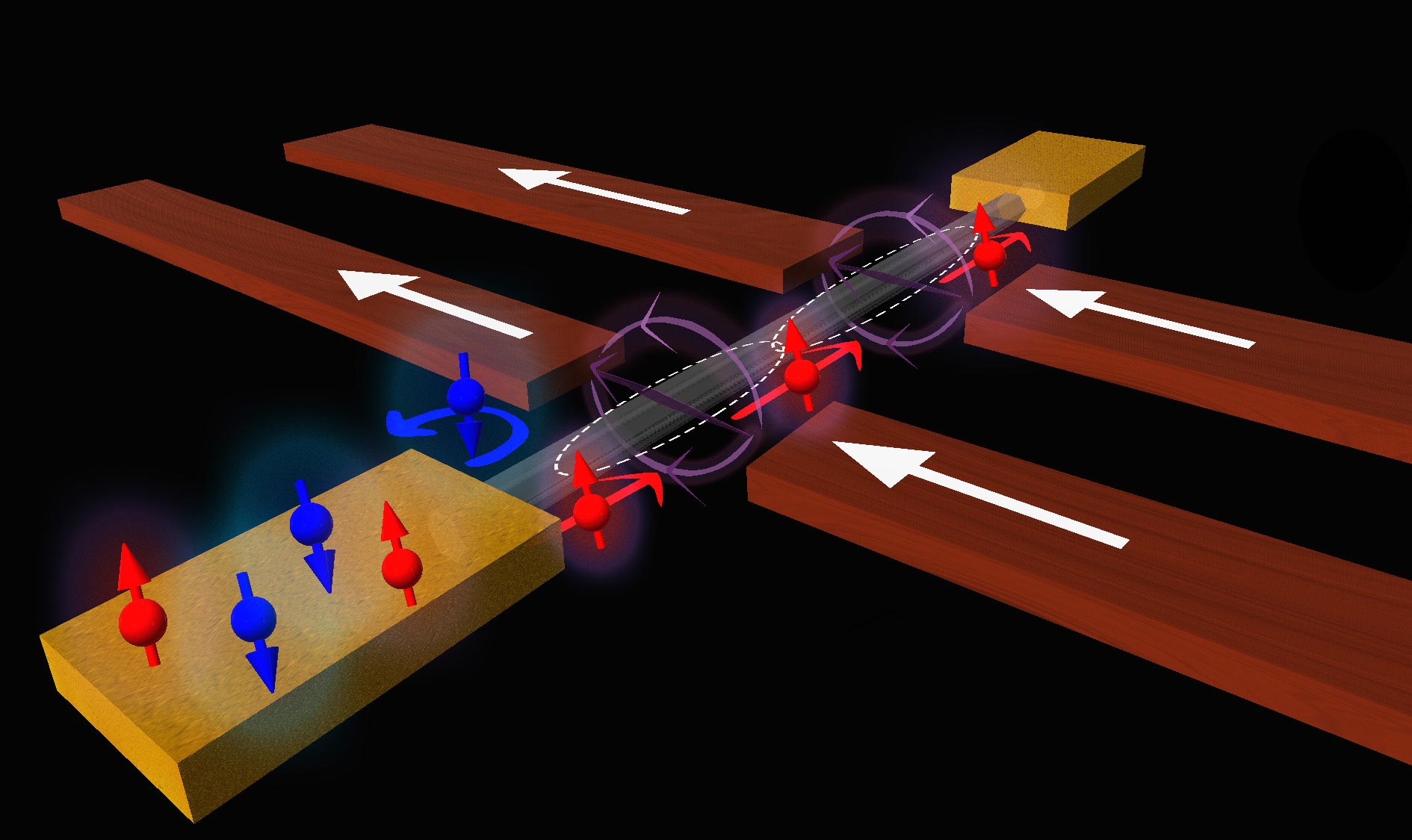
    Spin Valve Illustration
    Both quantum dots (dashed ellipses) on the nanowire are tuned by nanomagnets (brown bars) such that they only allow electrons with an “up” spin to pass. If the orientation of one of the magnets is changed, the current flow is suppressed. Credit: University of Basel, Department of Physics

    Researchers at the University of Basel in collaboration with colleagues from Pisa have developed a new concept that uses the electron spin to switch an electrical current. In addition to fundamental research, such spin valves are also the key elements in spintronics – a type of electronics that exploits the spin instead of the charge of electrons. The results were published in the scientific journal Communications Physics.

    At some point, spintronics might become a buzzword that is as much a part of our vocabulary as electronics. The idea behind it is to use the angular momentum (spin) of an electron instead of the electrical charge. Researchers around the world have been pursuing this goal for many years. Spintronics promises numerous applications in information storage and processing, and could improve the energy efficiency of electronic devices. An important prerequisite is the efficient control and detection of electron spins.

    A team of physicists around Professor Christian Schönenberger and Dr. Andreas Baumgartner from the Swiss Nanoscience Institute and the Department of Physics at the University of Basel has now developed a new technique for spintronics in semiconductor devices. Researchers from the Instituto Nanoscienze-CNR in Pisa were also involved.

    Nanomagnets are the key

    For this purpose, the scientists form two small semiconductor islands (quantum dots) behind each other on a nanowire and generate magnetic fields in the quantum dots using nanomagnets. Using an external field, they are able to control these magnets individually and thus can determine whether a quantum dot allows electrons to pass with a spin directed upward (up) or downward (down). When two quantum dots are connected in series, a current only flows if both are set to “up” or both to “down”. Ideally, no current flows if they are oriented in opposite directions.

    Arunav Bordoloi, the first author of the publication and Ph.D. student in the Schönenberger team, found that this method produced a spin polarization close to the theoretical maximum. “With this technique, we can choose whether a single electron in a given spin state is allowed to enter or leave a quantum system – with an efficiency far greater than in conventional spin valves,” he says.

    “In recent years, researchers around the world found it a hard nut to crack to fabricate spin valves useful for nano- and quantum-electronic devices,” says Dr. Andreas Baumgartner, who is supervising the project. “We have now succeeded in producing one.”

    Exploring new phenomena

    The physicists were also able to show that the magnetic fields are localized to specific locations on the nanowire. “This technique should therefore allow us to study the spin properties of new phenomena typically too sensitive to magnetic fields, such as novel states at the ends of special superconductors,” comments Dr. Baumgartner.

    This new approach to spintronics should now enable direct measurements of spin correlations and spin entanglement and shed new light on many old and new physical phenomena. In the future, the concept could even prove useful in the quest to use electron spins as the smallest information unit (quantum bit) in a quantum computer.

    Reference: “A double quantum dot spin valve” by Arunav Bordoloi, Valentina Zannier, Lucia Sorba, Christian Schönenberger and Andreas Baumgartner, 6 August 2020, Communications Physics.
    DOI: 10.1038/s42005-020-00405-2

    Never miss a breakthrough: Join the SciTechDaily newsletter.
    Follow us on Google and Google News.

    Electrical Engineering Nanotechnology Particle Physics Quantum Dots University of Basel
    Share. Facebook Twitter Pinterest LinkedIn Email Reddit

    Related Articles

    Efficiently Converting Light Energy Into Surface Waves on Graphene

    Physicists Play With the Laws of Nature: Controlling Ultrastrong Light-Matter Coupling at Room Temperature

    After Decades of Trying, Physicists Observe Kondo Cloud Quantum Phenomenon for the First Time

    Detection of Terahertz Electromagnetic Waves Could Revolutionize Electronics

    Efficient Quantum-Mechanical Interface Leads to a Strong Interaction Between Light and Matter

    Machine Learning to Automatically Measure and Control Qubits

    Photonics Breakthrough: Half-Light Half-Matter Quasiparticle Based LED

    Superabsorption Can Be Achieved and Sustained in Simple Nanostructures

    New Quantum Dots Design for Solotronics

    Leave A Reply Cancel Reply

    • Facebook
    • Twitter
    • Pinterest
    • YouTube

    Don't Miss a Discovery

    Subscribe for the Latest in Science & Tech!

    Trending News

    One of the Universe’s Largest Stars May Be Getting Ready To Explode

    Scientists Discover Enzyme That Could Supercharge Ozempic-Like Weight Loss Drugs

    Popular Sweetener Linked to DNA Damage – “It’s Something You Should Not Be Eating”

    Ancient “Rock” Microbes May Reveal How Complex Life Began

    Researchers Capture Quantum Interference in One of Nature’s Rarest Atoms

    “A Plague Is Upon Us”: The Mass Death That Changed an Ancient City Forever

    Scientists Discover Game-Changing New Way To Treat High Cholesterol

    This Small Change to Your Exercise Routine Could Be the Secret to Living Longer

    Follow SciTechDaily
    • Facebook
    • Twitter
    • YouTube
    • Pinterest
    • Newsletter
    • RSS
    SciTech News
    • Biology News
    • Chemistry News
    • Earth News
    • Health News
    • Physics News
    • Science News
    • Space News
    • Technology News
    Recent Posts
    • Revolutionary Imaging Technique Unlocks Secrets of Matter at Extreme Speeds
    • Where Does Mass Come From? Scientists Find Evidence of a New Exotic Nuclear State
    • Quantum Breakthrough: Unhackable Keys Sent Over 120 km Using Quantum Dots
    • Researchers Discover Unknown Beetle Species Just Steps From Their Lab
    • Jellyfish Caught Feasting on Exploding Sea Worms for the First Time
    Copyright © 1998 - 2026 SciTechDaily. All Rights Reserved.
    • Science News
    • About
    • Contact
    • Editorial Board
    • Privacy Policy
    • Terms of Use

    Type above and press Enter to search. Press Esc to cancel.