
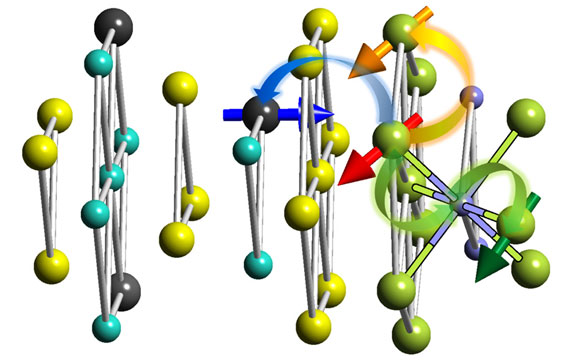
Researchers reveal an unusual magnetic behavior that could be used to probe a variety of exotic physical phenomena, and could ultimately be used to produce key components of future quantum computers.
An exotic kind of magnetic behavior, driven by the mere proximity of two materials, has been analyzed by a team of researchers at MIT and elsewhere using a technique called spin-polarized neutron reflectometry.
The novel phenomenon occurs at the boundary between a ferromagnet and a type of material called a topological insulator, which blocks electricity from flowing through all of its bulk but whose surface is, by contrast, a very good electrical conductor. In the new work, a layer of topological insulator material is bonded to a ferromagnetic layer. Where the two materials meet, an effect takes place called proximity-driven magnetic order, producing a localized and controllable magnetic pattern at the interface.
The research is described in a paper appearing this week in the journal Physical Review Letters, written by MIT doctoral student Mingda Li, postdoc Cui-Zu Chang, professor of nuclear science and engineering Ju Li, senior scientist Jagadeesh Moodera, and seven others.
This “proximity magnetism” effect could create an energy gap, a necessary feature for transistors, in a topological insulator, making it possible to turn a device off and on as a potential building block for spintronics, says Mingda Li, the lead author of the paper. “However, the proximity effect is usually weak,” he says, without this team’s use of a magnetic topological insulator “to enhance it and lock new magnetic order near the interface.”
“This could be a building block of quantum computers,” Moodera says. “It also opens up some fundamental new phenomena” for study by physicists.
“The interaction at the interface makes this exotic phenomenon possible,” Chang adds.
One of the new findings of this research is that the magnetism induced by the proximity of the two materials is not just at the surface, but actually extends into the interior of the topological insulator material. “We were able to show that the magnetism exists inside the topological insulator,” Moodera says.
Possible applications of the new findings include the creation of spintronics, transistors based on the spin of particles rather than their charge. These are expected to have low energy dissipation if based on topological insulators, and are a very active area of research.
Because the interface produces a channel with virtually no dissipation, it can act as “a perfect quantum wire,” Ju Li says. “It cannot be better than that for a quantum conductance channel. So having this precise control of the magnetic structure could lead to novel quantum spintronics.”
He adds that the findings, in addition to near-term practical applications, “from a physics point of view, opens up a huge area of productive work.” This includes the study of predicted physical phenomena such as Majorana fermions, particles predicted in 1937 but not yet observed, which, unlike all known subatomic particles, serve as their own antiparticles. These theorized particles “have yet to be explored. It opens another avenue to explore these things,” he says.
“The significance of this work is threefold,” says Qi-Kun Xue, a professor of physics at Tsinghua University in China who was not involved in this work. The three areas, he says, are “to demonstrate proximity magnetism, the enhancement of such magnetism … and the tunability of this interfacial magnetic structure.” He adds that the finding is a significant step toward a device application of magnetic topological insulators. “In particular,” he explains, “the consistent results from independent experimental tools” make the results “robust.”
The work included researchers at the National Institute of Standards and Technology, Brookhaven National Laboratory, Northeastern University, and Boston College. It was supported by the National Science Foundation, the Office of Naval Research, and the Department of Energy.
Reference: “Proximity-Driven Enhanced Magnetic Order at Ferromagnetic-Insulator–Magnetic-Topological-Insulator Interface” by Mingda Li, Cui-Zu Chang, Brian. J. Kirby, Michelle E. Jamer, Wenping Cui, Lijun Wu, Peng Wei, Yimei Zhu, Don Heiman, Ju Li and Jagadeesh S. Moodera, 17 August 2015, Physical Review Letters.
DOI: 10.1103/PhysRevLett.115.087201
Never miss a breakthrough: Join the SciTechDaily newsletter.
Follow us on Google and Google News.