
A breakthrough in scalable heterostructure design may bring topological quantum computing closer to reality.
An international team of researchers has discovered that a novel form of heterostructure made up of layered two-dimensional (2D) materials could help overcome the major obstacles to the widespread use of quantum computing.
The study, which was published in the journal Nature Materials, was conducted by a team from the Penn State Center for Nanoscale Science (CNS), which is one of the 19 Materials Research Science and Engineering Centers (MRSEC) in the US supported by the National Science Foundation.
A regular computer consists of billions of transistors, known as bits, and are governed by binary code (“0” = off and “1” = on). A quantum bit, also known as a qubit, is based on quantum mechanics and can be both a “0” and a “1” at the same time. This is known as superposition and can enable quantum computers to be more powerful than the regular, classical computers.
There is, however, an issue with building a quantum computer.
“IBM, Google, and others are trying to make and scale up quantum computers based upon superconducting qubits,” said Jun Zhu, Penn State professor of physics and corresponding author of the study. “How to minimize the negative effect of a classical environment, which causes error in the operation of a quantum computer, is a key problem in quantum computing.”
A solution for this problem may be found in an exotic version of a qubit known as a topological qubit.
“Qubits based on topological superconductors are expected to be protected by the topological aspect of the superconductivity and therefore more robust against the destructive effects of the environment,” Zhu said.
A topological qubit relates to topology in mathematics, where a structure is undergoing physical changes such as being bent or stretched, and still holds the properties of its original form. It is a theoretical type of qubit and has not been realized yet, but the basic idea is that the topological properties of certain materials can protect the quantum state from being disturbed by the classical environment.
There is currently a lot of focus on topological quantum computing, according to Cequn Li, a graduate student in physics and the first author of the study.
Developing the Ideal Materials for Quantum Computing
“Quantum computing is a very hot topic and people are thinking about how to build a quantum computer with less error in the computation,” Li said. “A topological quantum computer is an appealing way to do that. But a key to topological quantum computing is developing the right materials for it.”
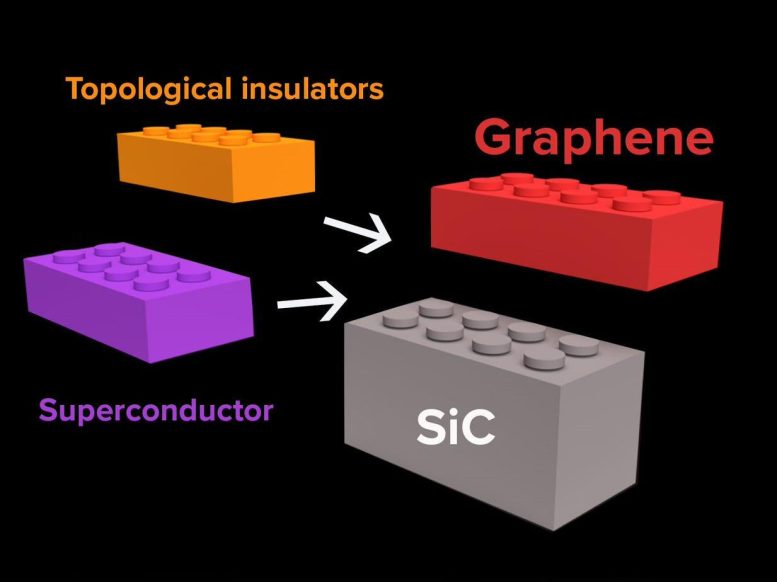
The study’s researchers have taken a step in this direction by developing a type of layered material called a heterostructure. The heterostructure in the study consists of a layer of a topological insulator material, bismuth antimony telluride or (Bi,Sb)2Te3, and a superconducting material layer, gallium.
“We developed a special measurement technique to probe the proximity-induced superconductivity at the surface of the (Bi,Sb)2Te3 film,” Zhu said. “The proximity-induced superconductivity is a key mechanism to realize a topological superconductor. Our work showed that it indeed occurs at the surface of the (Bi,Sb)2Te3 film. This is a first step towards the realization of a topological superconductor.”
However, such a topological insulator/superconductor heterostructure is difficult to create.
Confinement Heteroepitaxy
“It’s not easy usually because different materials have different lattice structures,” Li said. “Also, if you put two materials together, they may react with one another chemically and you end up with a messy interface.”
Therefore, the researchers are using a synthesis technique known as confinement heteroepitaxy, which is being explored at MRSEC. This involves inserting a layer of epitaxial graphene, which is a sheet of carbon atoms of one or two atoms thick, between the gallium layer and the (Bi, Sb)2Te3 layer. Li notes this enables the layers to interface and combine, like snapping Lego blocks together.
“The graphene separates these two materials and acts as a chemical barrier,” Li said. “So, there’s no reaction between them, and we end up with a very nice interface.”
In addition, the researchers demonstrated that this technique is scalable at the wafer level, which would make it an attractive option for future quantum computing. A wafer is a round slice of semiconductor material that serves as a substrate for microelectronics.
“Our heterostructure has all the elements for a topological superconductor but perhaps more importantly, it is a thin film and potentially scalable,” Li said. “So, a wafer scale thin film has a great potential for future applications, such as building a topological quantum computer.”
This research was a combined effort of the CNS’s IRG1 – 2D Polar Metals and Heterostructures team, led by Zhu and Joshua Robinson, professor of materials science and engineering at Penn State. Other faculty involved in the research include Cui-Zu Chang, Henry W. Knerr Early Career Professor and associate professor of physics, and Danielle Reifsnyder Hickey, assistant professor of chemistry and materials science and engineering.
“This was remarkable teamwork by the IRG1 team of our MRSEC,” Zhu said. “The Robinson group grew the two atomic layer gallium film using confinement heteroepitaxy, the Chang group grew the topological insulator film using molecular beam epitaxy, and the Reifsnyder Hickey group and Materials Research Institute staff performed atomic scale characterization of the heterostructure and devices.”
The next step is to perfect the process and take an even further step toward bringing a topological quantum computer into reality.
“The material is key so our collaborators are trying to improve the material,” Li said. “This means better uniformity and higher quality. And our group is trying to make more advanced devices on these kind of heterostructures to probe the signatures of topological superconductivity.”
Reference: “Proximity-induced superconductivity in epitaxial topological insulator/graphene/gallium heterostructures” by Cequn Li, Yi-Fan Zhao, Alexander Vera, Omri Lesser, Hemian Yi, Shalini Kumari, Zijie Yan, Chengye Dong, Timothy Bowen, Ke Wang, Haiying Wang, Jessica L. Thompson, Kenji Watanabe, Takashi Taniguchi, Danielle Reifsnyder Hickey, Yuval Oreg, Joshua A. Robinson, Cui-Zu Chang and Jun Zhu, 13 February 2023, Nature Materials.
DOI: 10.1038/s41563-023-01478-4
The study was funded by the National Science Foundation via the MRSEC program.
Never miss a breakthrough: Join the SciTechDaily newsletter.
Follow us on Google and Google News.
2 Comments
I wish I could ask them if they were also applying the magic angle/twist in the process.
What about pressure. ? Do materials demonstrate superconductivity at higher temperatures under higher pressures?
But what do I know, I’m just a plumber…..