
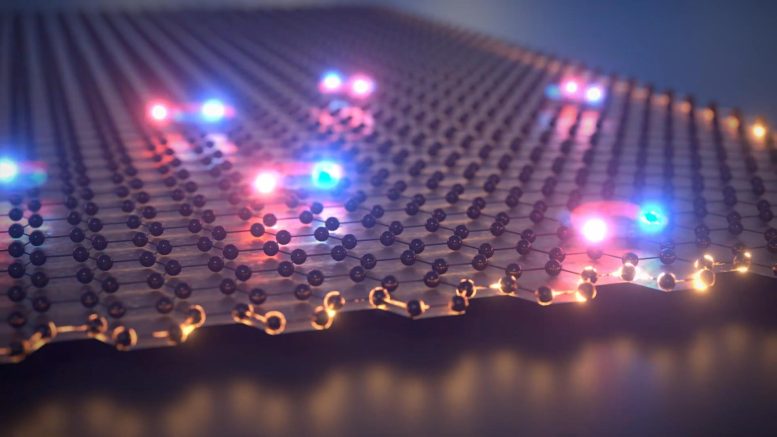
A breakthrough in quantum research – the first detection of excitons (electrically neutral quasiparticles) in a topological insulator has been achieved by an international team of scientists collaborating within the Würzburg-Dresden Cluster of Excellence ct.qmat. This discovery paves the way for a new generation of light-driven computer chips and quantum technologies. It was enabled thanks to smart material design in Würzburg, the birthplace of topological insulators. The findings have been published in the journal Nature Communications.
New Toolbox for Solid-State Physics
In their search for novel materials for future quantum technologies, one area that scientists from the Cluster of Excellence ct.qmat – Complexity and Topology in Quantum Matter – at the two universities in Würzburg and Dresden are concentrating on is topological insulators, which enable the lossless conduction of electrical current and robust information storage. The first experimental realization of this materials class took place in Würzburg in 2007, prompting a worldwide research boom in solid-state physics that continues to this day.
Previous concepts for using topological insulators are based on the application of electrical voltages in order to control currents – an approach adopted from conventional computer chips. However, if the exotic material properties are based on electrically neutral particles (which are neither positively nor negatively charged), an electric voltage no longer works. Such quantum phenomena, therefore, require other tools if they are to be generated at all – for example, light.
Optics and Electronics Are Linked by a Quantum Phenomenon
An international research team headed by Professor Ralph Claessen, quantum physicist from Würzburg and co-spokesperson of ct.qmat, has now made a crucial discovery. “For the first time, we’ve been able to generate and experimentally detect quasiparticles known as excitons in a topological insulator. We’ve thus created a new toolkit for solid-state physics that can be used to control electrons optically.” As Claessen emphasizes: “This principle could become the basis for a new type of electronic components.”
Excitons are electronic quasiparticles. Although they seem to behave like independent particles, they actually represent an excited electronic state that can only be generated in certain types of quantum matter. “We created excitons by applying a short light pulse to a thin film consisting of just one single layer of atoms,” explains Claessen. What’s unusual about this, he says, is that the excitons were activated in a topological insulator – something that wasn’t possible before. “This has opened up a completely new line of research for topological insulators,” adds Claessen.
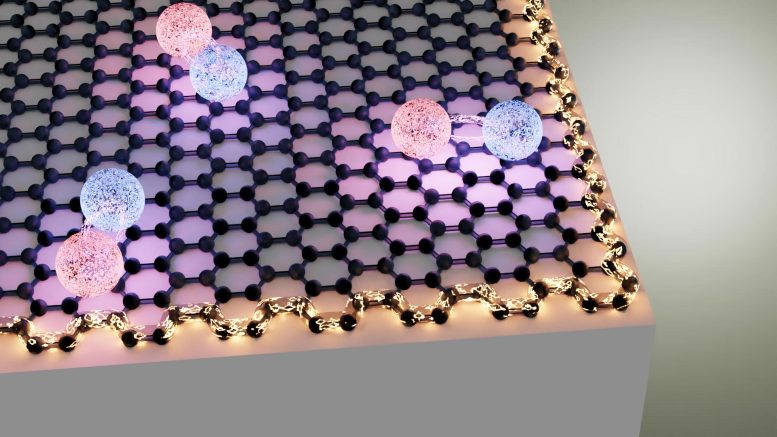
For about ten years, excitons have been investigated in other two-dimensional semiconductors and regarded as information carriers for light-driven components. “For the first time, we’ve managed to optically excite excitons in a topological insulator. The interaction between light and excitons means we can expect new phenomena in such materials. This principle could be used, for example, to generate qubits,” says Claessen.
Qubits are computing units for quantum chips. They’re far superior to traditional bits and allow to solve tasks within minutes for which conventional supercomputers would literally take years. Using light instead of electrical voltage enables quantum chips with much faster processing speeds. The latest findings therefore pave the way for future quantum technologies and a new generation of light-driven devices in microelectronics.
Global Expertise From Würzburg
The right starting material is crucial – in this case bismuthene. “It’s the heavy sibling of the miracle material graphene,” says Claessen, who first tailored the topological insulator in the lab five years ago. “We’re the global leaders in this field,” he adds. “Due to our sophisticated materials design, the atoms of the single layer of bismuthene are arranged in a honeycomb pattern, just like graphene. The difference is that bismuthene’s heavy atoms make it a topological insulator, meaning it can conduct electricity along the edge without loss – even at room temperature. This can’t be done by graphene.”
Animation: A light pulse on bismuthene generates exciton pairs that move through the two-dimensional ultrathin layer of material. A light pulse on bismuthene generates exciton pairs that move through the two-dimensional ultrathin layer of material. Information could be stored and transported in quantum chips in this way, with each pair of excitons constituting a qubit. Because bismuthene is a topological insulator, the flow of current at the edges is almost lossless. The honeycomb-shaped atomic structure was tailored in Würzburg. Credit: Jörg Bandmann, pixelwg/ct.qmat
Huge potential
Now that the research team has generated excitons in a topological insulator for the first time, attention is being turned to the quasiparticles themselves. Scientists at ct.qmat are investigating whether bismuthene’s topological properties are transferred to excitons. Proving this scientifically is the next milestone that the researchers have their sights on. It would even pave the way for the construction of topological qubits, which are considered particularly robust compared to their non-topological counterparts.
International Cooperation
These findings result from close collaboration among scientists from Bologna, Wroclaw, New York, Oldenburg and Würzburg. The 2D material samples of bismuthene were produced at JMU Würzburg.
Reference: “Photoswitching fingerprint analysis bypasses the 10-nm resolution barrier” by Dominic A. Helmerich, Gerti Beliu, Danush Taban, Mara Meub, Marcel Streit, Alexander Kuhlemann, Sören Doose and Markus Sauer, 1 August 2022, Nature Methods.
DOI: 10.1038/s41592-022-01548-6
Never miss a breakthrough: Join the SciTechDaily newsletter.
Follow us on Google and Google News.