

Antarctic ice preserves traces of iron-60 from ancient stellar explosions, helping scientists track the Solar System’s movement through interstellar clouds and changing cosmic environments.
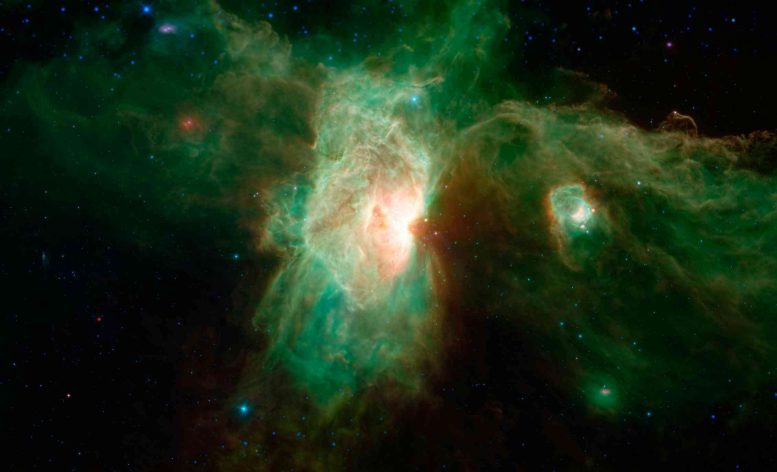
When you think of outer space, you’re likely picturing stars, planets, and moons. But much of space is filled with clouds of gas, plasma, and stardust—known as interstellar clouds.
In the local parts of our galaxy alone, there’s a complex of roughly 15 individual interstellar clouds. The Solar System is currently traversing one of them, aptly named the Local Interstellar Cloud. The origin and history of these clouds are believed to be tightly connected to the birth and death of stars. But we can see their imprints right here on Earth, in a place you might not expect—Antarctic ice.
My colleagues and I have been studying stardust trapped in old Antarctic snow and ice to trace the history of our solar neighborhood, including the solar system itself.
In a new study published in Physical Review Letters, we found a subtle clue that reveals our Solar System’s movement through the local interstellar environment over the past 80,000 years.
Studying Supernova Debris on Earth
Astronomy usually looks outward. Telescopes collect light from distant stars and galaxies, allowing us to observe events across vast stretches of space and time. From these observations, we infer how stars live and die, how elements are formed, and how the universe evolves.
Our approach turns that idea on its head.
Instead of observing the light coming to us, we study the debris of exploding stars right here on Earth. As cosmic furnaces, stars forge many elements in their cores, from carbon and oxygen to calcium and iron. This includes rare isotopes (variants of chemical elements) such as iron-60.
When massive stars explode into supernovae at the end of their lives, these elements are ejected into space and become interstellar dust.
Antarctic Ice as a Galactic Archive
Tiny grains of this dust then drift through the galaxy and occasionally find their way to Earth’s surface. Radioactive iron-60, a fingerprint of stellar explosions, is embedded within these grains. By searching for these atoms in geological archives on Earth, we can probe astrophysical events like supernovae long after their light has faded.
This is why Antarctica is so valuable. Its snow accumulates slowly and remains largely undisturbed, forming a layered record that stretches back tens of thousands of years. Each layer captures a snapshot of the material that was present in our cosmic neighborhood at the time.
When we studied 500 kg of recent snow in Antarctica, we unexpectedly found this rare radioactive isotope. Where did it come from? There was no recent near-Earth supernova.
But our solar neighborhood is filled with 15 clouds, with the solar system currently traversing at least one of them. Is the stardust waiting in the clouds to be picked up by Earth? If yes, then the amount of stardust Earth collects should be related to their structure: the denser the clouds, the more iron-60 they contain. This was our educated guess in 2019.
The Mystery of Iron-60 Signals
Soon, other explanations were brought forward. Millions of years ago, Earth received large showers of iron-60 from massive supernovae. Is the iron-60 in Antarctic snow the last remnant or an echo of this signal? A rain that became a drizzle?
To find out, we analyzed a 300 kg section of Antarctic ice, dating from 40,000 to 80,000 years ago. The process is painstaking. The ice needs to be melted and chemically treated to isolate tiny amounts of iron, including the iron-60 from the stardust.
Then, using the sensitive atom counting technique of accelerator mass spectrometry at the Heavy-Ion Accelerator Facility at Australian National University, we counted individual atoms of iron-60.
The expectation was straightforward: based on previous measurements from surface snow of Antarctica and several thousand-year-old ocean sediments, we anticipated a certain steady level of iron-60 deposition.
Evidence of Solar System Movement
Instead, we found less. Not zero, but noticeably lower than expected.
This result suggests that less interstellar dust was reaching Earth during that period. This is a remarkable change on a comparatively short astrophysical timescale and does not fit the long timescales of the iron-60 deposits that landed here millions of years ago. Instead, we needed to look for a smaller, more local source for the isotope.
Naturally, astronomers are also quite interested in the clouds around the Solar System. Last year, a study reconstructing the history of the clouds arrived at the conclusion that they most likely originated in a stellar explosion. Furthermore, they found the Solar System has been traversing the Local Interstellar Cloud from sometime between 40,000 and 124,000 years ago.
If that’s correct, we would expect that the amount of iron-60 collected on Earth should have changed sometime in the same time period—between 40,000 and 124,000 years ago.
Antarctic Ice Reveals Interstellar History
This is exactly what our results showed in Antarctica.
The story doesn’t fit perfectly, though. If these clouds did originate directly from an exploding star, we would expect way more iron-60 than we actually see in Antarctic ice.
Nevertheless, these clouds are imprinted in Earth’s geological record. If we look deeper and analyze even older ice, we might soon unravel the mystery of these local interstellar clouds, revealing their full history and uncertain origins.
Reference: “Local Interstellar Cloud Structure Imprinted in Antarctic Ice by Supernova” by Dominik Koll, Annabel Rolofs, Florian Adolphi, Sebastian Fichter, Maria Hoerhold, Johannes Lachner, Stefan Pavetich, Georg Rugel, Stephen Tims, Frank Wilhelms, Sebastian Zwickel and Anton Wallner, 13 May 2026, Physical Review Letters.
DOI: 10.1103/nxjq-jwgp
Adapted from an article originally published in The Conversation.
Never miss a breakthrough: Join the SciTechDaily newsletter.
Follow us on Google and Google News.