
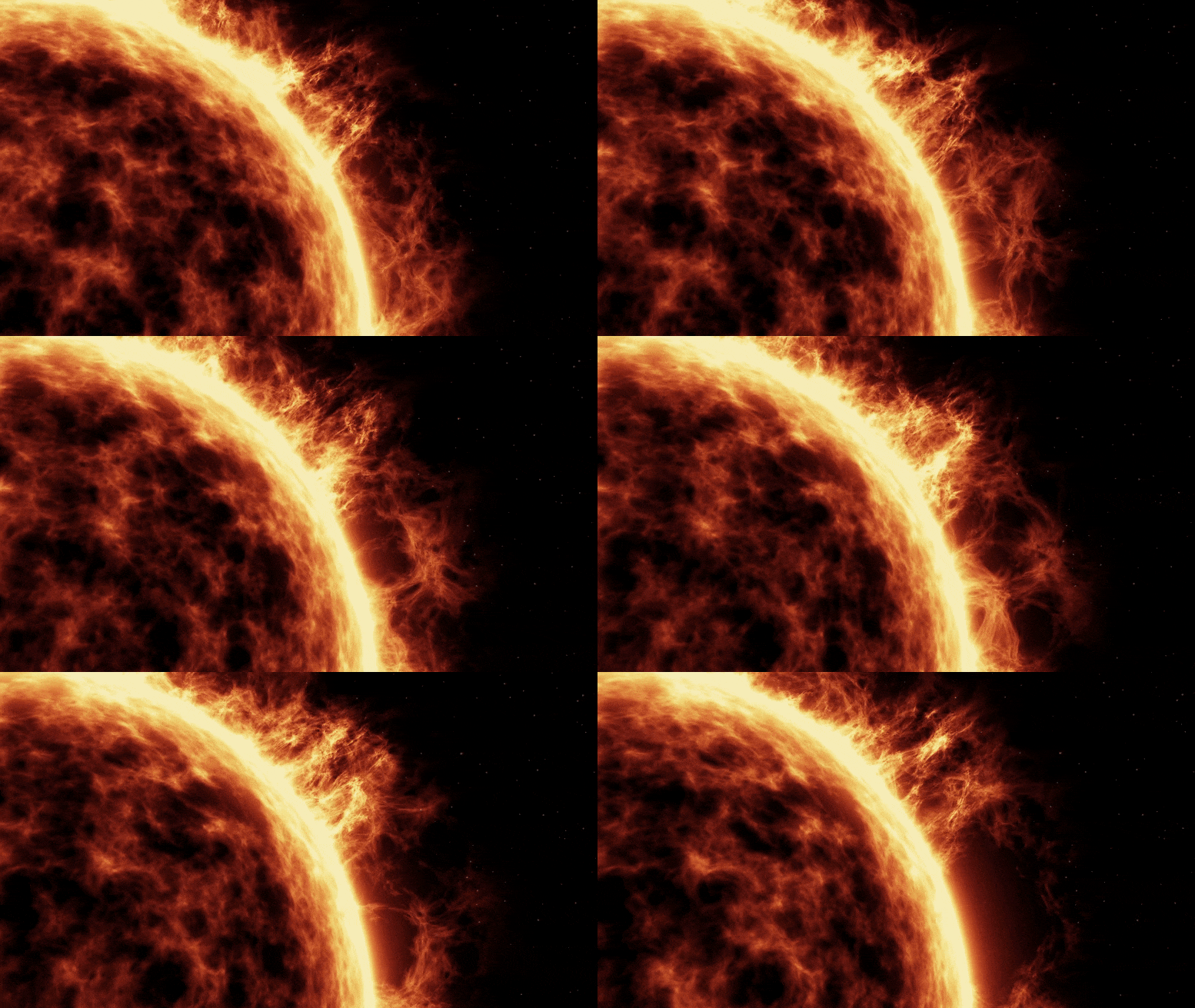
Direct observation of Alfvén waves confirms how the Sun’s outer atmosphere is superheated and may pave the way for fusion energy breakthroughs on Earth.
The visible surface of the Sun, or the photosphere, is around 6,000°C (10,000°F). But a few thousand kilometers above it – a small distance when we consider the size of the Sun – the solar atmosphere, also called the corona, is hundreds of times hotter, reaching a million degrees Celsius or higher.
This spike in temperature, despite the increased distance from the Sun’s main energy source, has been observed in most stars, and represents a fundamental puzzle that astrophysicists have mulled over for decades.
In 1942, the Swedish scientist Hannes Alfvén proposed an explanation. He theorized that magnetized waves of plasma could carry huge amounts of energy along the Sun’s magnetic field from its interior to the corona, bypassing the photosphere before exploding with heat in the Sun’s upper atmosphere.
The theory had been tentatively accepted – but we still needed proof, in the form of empirical observation, that these waves existed. Our recent study has finally achieved this, validating Alfvén’s 80-year-old theory and taking us a step closer to harnessing this high-energy phenomenon here on Earth.
Burning Questions
The coronal heating problem has been established since the late 1930s, when the Swedish spectroscopist Bengt Edlén and the German astrophysicist Walter Grotrian first observed phenomena in the Sun’s corona that could only be present if its temperature was a few million degrees Celsius.
This represents temperatures up to 1,000 times hotter than the photosphere beneath it, which is the surface of the Sun that we can see from Earth. Estimating the photosphere’s heat has always been relatively straightforward: we just need to measure the light that reaches us from the Sun, and compare it to spectrum models that predict the temperature of the light’s source.
Over many decades of study, the photosphere’s temperature has been consistently estimated at around 6,000°C. Edlén and Grotrian’s finding that the Sun’s corona is so much hotter than the photosphere – despite being further from the Sun’s core, its ultimate source of energy – has led to much head-scratching in the scientific community.
The extreme heat of the Sun’s corona is one of the most vexing problems in astrophysics.
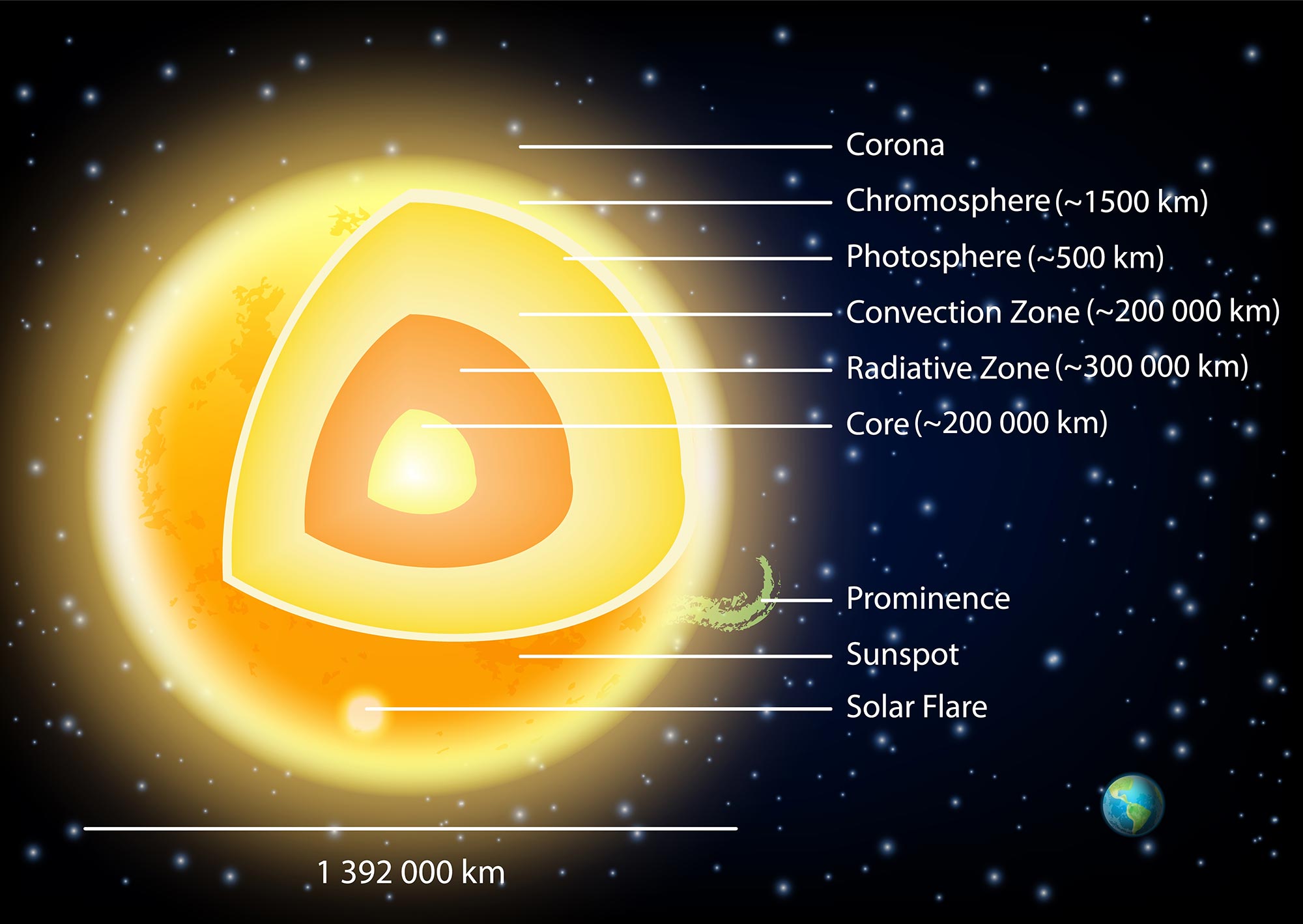
Scientists looked to the Sun’s properties to explain this disparity. The Sun is composed almost entirely of plasma, which is highly ionized gas that carries an electrical charge. The movement of this plasma in the convection zone – the upper part of the solar interior – produces huge electrical currents and strong magnetic fields.
These fields are then dragged up from the Sun’s interior by convection, and burble onto its visible surface in the form of dark sunspots, which are clusters of magnetic fields that can form a variety of magnetic structures in the solar atmosphere.
This is where Alfvén’s theory comes in. He reasoned that within the Sun’s magnetized plasma any bulk motions of electrically charged particles would disturb the magnetic field, creating waves that can carry huge amounts of energy along vast distances – from the Sun’s surface to its upper atmosphere. The heat travels along what are called solar magnetic flux tubes before bursting into the corona, producing its high temperature.
These magnetic plasma waves are now called Alfvén waves, and their part in explaining coronal heating led to Alfvén being awarded the Nobel Prize in Physics in 1970.
Observing Alfvén Waves
But there remained the problem of actually observing these waves. There’s so much happening on the Sun’s surface and in its atmosphere – from phenomena many times larger than Earth to small changes below the resolution of our instrumentation – that direct observational evidence of Alfvén waves in the photosphere has not been achieved before.
But recent advances in instrumentation have opened a new window through which we can examine solar physics. One such instrument is the Interferometric Bidimensional Spectropolarimeter (IBIS) for imaging spectroscopy, installed at the Dunn Solar Telescope in the US state of New Mexico. This instrument has allowed us to make far more detailed observations and measurements of the Sun.
Combined with good viewing conditions, advanced computer simulations, and the efforts of an international team of scientists from seven research institutions, we used the IBIS to finally confirm, for the first time, the existence of Alfvén waves in solar magnetic flux tubes.
New Energy Source
The direct discovery of Alfvén waves in the solar photosphere is an important step towards exploiting their high energy potential here on Earth. They could help us research nuclear fusion, for instance, which is the process taking place inside the Sun that involves small amounts of matter being converted into huge amounts of energy. Our current nuclear power stations use nuclear fission, which critics argue produces dangerous nuclear waste – especially in the case of disasters including the one that took place in Fukushima in 2011.
Creating clean energy by replicating the nuclear fusion of the Sun on Earth remains a huge challenge, because we’d still need to generate 100 million degrees Celsius quickly for fusion to occur. Alfvén waves could be one way of doing this. Our growing knowledge of the Sun shows it’s certainly possible – under the right conditions.
We’re also expecting more solar revelations soon, thanks to new, ground-breaking missions and instruments. The European Space Agency’s Solar Orbiter satellite is now in orbit around the Sun, delivering images and taking measurements of the star’s uncharted polar regions. Terrestrially, the unveiling of new, high-performance solar telescopes are also expected to enhance our observations of the Sun from Earth.
With many secrets of the Sun still to be discovered, including the properties of the Sun’s magnetic field, this is an exciting time for solar studies. Our detection of Alfvén waves is just one contribution to a wider field that’s looking to unlock the Sun’s remaining mysteries for practical applications on Earth.
Written by:
- Marianna Korsos – Post-Doctoral Research Assistant, Department of Physics, Aberystwyth University
- Huw Morgan – Reader in Physical Sciences, Aberystwyth University
Adapted from an article originally published on The Conversation.
Never miss a breakthrough: Join the SciTechDaily newsletter.
Follow us on Google and Google News.
14 Comments
Are you people nuts talking outside of one side your mouth and contradicting out the other side. You people chastised Alfvén after the Noble prize for being wrong now he’s correct, give me a break .
The Electric Universe concept has proven all these thing without your Government Grant idolatry. “Plasma ” in the centric Electric Universe is you can’t have one without the other magnetic sheaths containing electric flows. As has been stated before plasma in this sense is not gas. There are men out there that will crush your arguments because they are versed in Electricity. All of you would be well served to go back to school to learn what this life is about. ELECTRICITY.
I guess that with “you people” you mean people that understand the difference between the science presented in the article and the known pseudoscience you propose. Notably it has not ‘proven’ anything in many years of trolling the internet.
We would be nuts not relying on the science. And some of us has studied plasmas – obviously not you.
You are totally correct the universe is all electric connected. Mainstream science keeps running down the rabbit hole to no
where. Follower of suspicious observers.
This is a natural consequence that Solar Maagnetic Flux is affixed with the heat of sun’s inþerior part,Plasma.Alfven waves are such solar magnetic fluxes,of which measurement is performed by IBIS instŕument with succèss,also confirmìng the exìstance of such waves is a grèat wòrk.
This is a natural consequence that Solar Maagnetic Flux is affixed with the heat of sun’s inþerior part,Plasma.Alfven waves are such solar magnetic fluxes,of which measurement is performed by IBIS instŕument with succèss,also confirmìng the exìstance of such waves is a grèat wòrk.However,instances are there present,in group radio galaxies magnetic fieid lines are connected with heat phenomena (in the presence of light).
Solar magnetic flux contained heat as
Alfven wave is confirmed by ÌBIS instrument.But,is there any formulation to corelate them simply to achive some advanced aspect for heat and magnetism.
Progress!
On a side note, the vide is too US centric. I know as little about Fahrenheit as about “smores”.
What about Currie point, you haven’t a clue about the sun. It can’t be that hot or else it wouldn’t have a magnetic field
The ability of charlatans to avoid discussing electricity and the electrical nature of our sun with double mouthed speech is shocking. Alfven himself warned against magnetohydrodynamics going forward without electricity. “Flux tubes” and glactic bridges or filaments etc. Are all disappointing theivery and a defrauding of Kristian Birkeland and the Birkeland Currents which are empirically observed.
Stop this farse and fraud. There are now well known studies of electric currents in space and thanks for essentially proving the Electric Sun correct here. Gravity doesnt make magnetism and plasma IS charged and conductive. It is just a true FRAUD to never use the word electric even once. Shame on the authors of this article for this fraud and pulling the wool over the audience’s eyes.
Wiley released Electric Currents in Geospace and Beyond in 2017.
Wake up and join the PEMC wave. Gravity fusion is dead. Dark Universes are dead. String theory is dead.
Move forward!
Well according to Ferrel’s law the sun hit the earth directly which in turns heats the atmosphere. I don’t whether it’s the same scenario.
Considering this is a scientific article the writer should know that ‘hundreds of times hotter’ is a meaningless statement. Is 2°C ‘twice as hot’ as 1°C? What if you convert to °F? As an aside, when is the nonsensical Fahrenheit scale going to be banished forever?
Why is it that modern physics ignores the three laws of thermodynamics. It seems to me that physics is totally focused on Mr Albert E. and his sum rather than answering fundamental matters. Thanks. JAC
Well said. Exactly the point. The sun CANNOT perform work on itself, and gases don’t coalesce in a vacuum.
Neil you are totally correct the universe is all electrically connected. Mainstream science keeps running down the rabbit hole false truths and denial.
Follower of
suspicious observers.